Description
Glucose Oxidase (GOD) Activity Assay Kit
The Glucose Oxidase (GOD) Activity Assay Kit (MAES0248) measures GOD enzyme activity in research samples using a colorimetric, peroxidase-coupled reaction. GOD oxidizes glucose to hydrogen peroxide, and the peroxidase-driven color change is read at 550 nm on a microplate reader. Researchers use the kit to quantify GOD activity across a 0.006–0.1 U/L range in a 35-minute assay.
Glucose oxidase (GOD) is an enzyme that catalyzes the oxidation of glucose, producing hydrogen peroxide as a product. Microorganisms are the main source of GOD production. The main production strains are Aspergillus niger and Penicillium, which grow rapidly and come from a wide range of sources. In this kit, the measured quantity is GOD activity itself, so the enzyme, not glucose, is the analyte being quantified.
GOD is an important industrial enzyme in the food industry. It is used for deoxygenation in wine, beer, juice and milk powder, for flour improvement, and for preventing food browning. It is also widely applied in rapid food detection and biosensors. The product's listed research area is glycolysis and lipid metabolism, so GOD activity measurements relate to both food processing applications and metabolic research.
The assay is a coupled colorimetric method. GOD oxidizes glucose to produce hydrogen peroxide. In the presence of peroxidase, the hydrogen peroxide oxidizes a chromogenic agent to form a colored substance. Each well receives 10 µL of standard or sample, 200 µL of reaction working solution and 20 µL of chromogenic agent. After mixing, absorbance is read at 550 nm (A1), the plate is incubated at 37°C for 20 min, and absorbance is read again at 550 nm (A2). The change, ΔA = A2 − A1, is used for quantification. The detection instrument is a microplate reader set to 540–560 nm.
Samples are prepared as homogenates in normal saline (0.9% NaCl). Homogenates are centrifuged at 10000×g for 10 minutes to remove insoluble material, and the supernatant is kept on ice until assayed. The protein concentration of the supernatant must be determined separately, because the result is expressed per gram of protein. The kit's reagents are stored at -20°C for 12 months, protected from light. The enzyme working solution can be aliquoted and stored at -20°C for 1 week, with repeated freeze/thaw cycles avoided. The reaction working solution must be prepared on the spot, kept on ice and used within 4 h.
The analytical sensitivity is 0.006 U/L, and the detection range is 0.006–0.1 U/L. Intra-assay precision was 3.0% CV and 2.4–3.4% CV across three human serum samples in the manual. Inter-assay precision ranged from 6.8% to 7.1% CV in the manual. Average recovery was 101%, with individual recoveries of 99–103% at low, middle and high concentrations. The total assay time is 35 min.
| Product name: | Glucose Oxidase (GOD) Activity Assay Kit |
| SKU: | MAES0248 |
| Synonyms: | GOD |
| Assay type: | Enzyme activity |
| Detection method: | Colorimetric |
| Detection instrument: | Microplate reader (540–560 nm) |
| Measurement wavelength: | 550 nm |
| Assay time: | 35 min |
| Research area: | Glycolysis and lipid metabolism |
| Sensitivity: | 0.006 U/L |
| Detection range: | 0.006–0.1 U/L |
| Intra-assay CV: | 2.4–3.4% |
| Inter-assay CV: | 6.8–7.1% |
| Recovery: | 99–103% (three spiked levels; mean 101%) |
| Sample volume: | 10 µL |
| Assay time: | 35 min |
- Colorimetric detection of GOD activity read at 550 nm (540–560 nm filter range)
- Detection range 0.006–0.1 U/L with analytical sensitivity of 0.006 U/L
- Sample volume 10 µL per well
- Total assay time 35 min with a 20 min incubation at 37 °C
- Intra-assay CV 2.4–3.4% and inter-assay CV 6.8–7.1%
- Research Use Only
Glucose oxidase catalyzes the oxidation of glucose to produce hydrogen peroxide (H2O2). In the presence of peroxidase, the hydrogen peroxide oxidizes a pigment source to form a colored product. The OD is measured at 550 nm, and GOD activity is calculated indirectly from the change in absorbance (ΔA) against a hydrogen peroxide-generating standard curve. The sample is read at the start (A1) and after a 20 min incubation at 37 °C (A2).
- Measuring GOD enzyme activity in research samples
- Characterizing GOD activity in glycolysis and lipid metabolism studies
- Evaluating GOD activity in food science research, such as deoxygenation and browning prevention
- Supporting research on GOD-based biosensor development
| Component | Quantity | Storage |
| Reagent 1: Buffer Solution | 1 vial | -20 °C, 12 months |
| Reagent 2: Enzyme Reagent (powder) | 1 vial | -20 °C, 12 months, protect from light |
| Reagent 3: Chromogenic Agent | 1 vial | -20 °C, 12 months, protect from light |
| Reagent 4: 1 mmol/L Standard | 1 vial | -20 °C, 12 months, protect from light |
| Microplate | 1 plate | Room temperature |
- Microplate reader capable of 540–560 nm (550 nm) reading
- Micropipettes and tips
- Water bath or incubator set to 37 °C
- Centrifuge capable of 10000×g
- Double-distilled water
- 0.9% NaCl (normal saline) for sample homogenization and dilution
- Ice
- Separate protein assay to determine sample protein concentration (Cpr)
Homogenate samples
- Prepare the homogenate using normal saline (0.9% NaCl) as the homogenate medium.
- Centrifuge the homogenate at 10000×g for 10 minutes to remove insoluble material.
- Collect the supernatant and keep it on ice for detection.
- Determine the protein concentration of the supernatant separately, as it is required for the calculation.
- If the sample concentration is not within the detection range (0.006–0.1 U/L), perform an extra dilution or concentration. Use normal saline (0.9% NaCl) as the diluent.
Other sample types
- Use normal saline (0.9% NaCl) as the diluent for other sample types.
- Perform a pretest to confirm the dilution factor before testing samples not listed in the manual.
- Record the dilution factor (f) for use in the calculation.
Reagent preparation
- Equilibrate all reagents to room temperature before use.
- Enzyme working solution: dissolve one vial of Reagent 2 in 0.2 mL double-distilled water. Aliquot and store at -20 °C for up to 1 week; avoid repeated freeze/thaw cycles.
- Reaction working solution: per well, mix 196 µL of Reagent 1 with 4 µL of enzyme working solution to make 200 µL. Prepare fresh, keep on ice, and use within 4 h.
Standard curve preparation
- Prepare a fresh set of standards for each run and discard working dilutions after use.
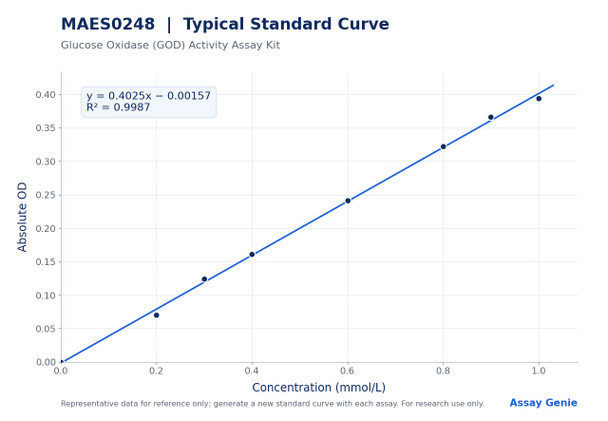
- Dilute the 1 mmol/L standard with double-distilled water as follows: 0, 0.2, 0.3, 0.4, 0.6, 0.8, 0.9, and 1 mmol/L.
- For 0 to 1 mmol/L, combine 0/100, 20/80, 30/70, 40/60, 60/40, 80/20, 90/10, and 100/0 µL of 1 mmol/L standard/double-distilled water, respectively.
Sample preparation
- Homogenize samples in 0.9% NaCl.
- Centrifuge at 10000×g for 10 min to remove insoluble material.
- Collect the supernatant and keep on ice. Determine the supernatant protein concentration separately.
- Dilute samples in 0.9% NaCl if the activity falls outside the detection range. For other sample types, run a pretest to confirm the dilution factor.
Assay procedure
- Add 10 µL of each standard to standard wells and 10 µL of sample to sample wells.
- Add 200 µL of reaction working solution to each well.
- Add 20 µL of chromogenic agent (Reagent 3) to each well.
- Mix for 3 s on the microplate reader and read OD at 550 nm. Record as A1.
- Incubate at 37 °C for 20 min.
- Mix for 3 s and read OD at 550 nm again. Record as A2. Calculate ΔA = A2 − A1. Standard wells show no change, so plot the standard curve using the A2 value of the standard.
Calculation
- Average the duplicate readings for each standard.
- Subtract the mean blank (standard ①, 0 mmol/L) OD from all standard readings to obtain the absolute OD.
- Plot absolute OD (y) against concentration in mmol/L (x) and fit a linear equation y = ax + b.
- Calculate GOD activity: GOD activity (U/g prot) = (ΔA550 − b) ÷ a ÷ T × 1000 ÷ Cpr × f, where T = 20 min, Cpr = sample protein concentration (g prot/L), and f = sample dilution factor.
- Definition: 1 unit is the enzyme amount that generates 1 µmol of hydrogen per minute per g sample protein at 37 °C.
GOD activity (U/gprot) = (ΔA550 − b) ÷ a ÷ T × 1000 ÷ Cpr × f
- ΔA550 = Δ(A2 − A1) for the sample, where A1 is the OD at 550 nm before incubation and A2 is the OD at 550 nm after 20 min at 37°C.
- a and b are the slope and intercept of the standard curve (y = ax + b), built from absolute OD values (standard OD minus the mean blank OD) plotted against standard concentration in mmol/L.
- T is the reaction time, 20 min.
- 1000 converts mmol/L to µmol/L.
- Cpr is the protein concentration of the sample supernatant in g protein/L.
- f is the dilution factor of the sample before testing.
- One unit is defined as the enzyme amount that generates 1 µmol of hydrogen per minute per gram of sample protein at 37°C, giving a result in U/gprot.
What sample volume is required per well?
Take 10 µL of each standard or sample per well. Add 200 µL of reaction working solution and 20 µL of chromogenic agent to each well.
How should the reagents be stored?
Store the reagents at -20°C for 12 months, protected from light. Aliquot the enzyme working solution and store it at -20°C for up to 1 week, avoiding repeated freeze/thaw cycles.
What should I do if my sample is outside the detection range?
If the concentration is not within the range of 0.006–0.1 U/L, perform an extra dilution or concentration of the sample. Record the dilution factor, since it is included in the calculation.
What key points affect results?
Equilibrate all reagents to room temperature before use and do not mix reagents from different kits. Prepare the reaction working solution fresh, keep it on ice and use it within 4 h. Results are closely related to reagent handling, operation and environmental conditions.
What instrument settings are used?
Use a microplate reader set to 540–560 nm and read absorbance at 550 nm. Mix the plate for 3 s before each reading. Incubate the plate at 37°C.
How long does the assay take?
The total assay time is 35 min. The reaction is incubated at 37°C for 20 min between the two absorbance readings.
| Storage: | -20 °C |
| Valid period: | 12 months |
| Light sensitivity: | Store with protection from light |
| Enzyme working solution: | Aliquot and store at -20 °C for up to 1 week; avoid repeated freeze/thaw |
| Reaction working solution: | Prepare fresh, keep on ice, use within 4 h |
Notes
- For Research Use Only. Not for use in clinical diagnosis or other diagnostic or therapeutic procedures.
- Read the instructions completely and adjust instruments before use.
- Wear a lab coat and gloves during the assay.
- If a sample falls outside the detection range, dilute or concentrate it before testing.
- Run a pretest for sample types not described in the manual.
- Centrifuge reagent vials with small volumes before use.
- Do not mix reagents from different kit lots.
- Results depend on reagent handling, operation, and environmental conditions. Reserve sufficient sample for repeat testing.