Description
Alkaline Phosphatase (ALP) Activity Assay Kit (PNPP)
The Alkaline Phosphatase (ALP) Activity Assay Kit (PNPP) measures ALP enzymatic activity in serum, plasma, animal tissue homogenates, and cell lysates. The assay uses p-nitrophenyl phosphate disodium as substrate and quantifies the p-nitrophenol product by absorbance at 405 nm. Researchers use the kit for liver and renal function research and enzyme activity studies in a 96-well microplate format with a 30 min assay time.
Alkaline phosphatase (ALP) is an enzyme that catalyzes the hydrolysis of phosphate esters under alkaline conditions. In this kit, ALP activity is measured with p-nitrobenzene phosphate disodium as the substrate, which the enzyme converts to p-nitrophenol and phosphoric acid. Activity is expressed as an enzymatic rate, so the assay reports functional ALP in a sample. The kit is intended for measuring ALP activity in animal tissue, serum or plasma, and cell samples.
The kit is listed under liver and renal function research. The publications that cite it span cholestasis, rheumatoid arthritis, osteoporosis, and osteogenic differentiation. In the cholestasis study, paeoniflorin was examined for alleviating ANIT-induced injury through a pyroptosis signaling pathway. In the rheumatoid arthritis study, a calcium-based biomineralization material was tested for reversing oxidative stress and bone loss. These contexts make ALP activity a useful readout for hepatic, renal, and bone-related physiology.
The assay is a colorimetric, microplate-based method. Under strong alkaline conditions, the p-nitrophenol product is bright yellow with a maximum absorption peak at 405 nm, so ALP activity is calculated from the optical density at that wavelength. Substrate working solution is prepared by dissolving one substrate vial in buffer solution and is stored at -20°C for up to 24 hours protected from light. Samples and controls receive substrate working solution, standard wells receive buffer, and the plate is incubated at 37°C for 10 min. Stop solution is then added, the plate is mixed, and absorbance is read at 405 nm.
Serum, plasma, animal tissue homogenates, and cell samples are supported. The dilution guidance also covers HepG2 supernatant and human urine. Serum and plasma are assayed directly, and if testing does not occur on the same day, they can be stored at -80°C for one month. Tissues and cells are washed in cold normal saline, homogenized at 4°C, and clarified by centrifugation at 10000×g for 10 min at 4°C. The resulting supernatant is kept on ice until assayed. Because the calculation for tissue and cell samples requires protein concentration, it must be measured on the supernatant separately.
Reported analytical sensitivity is 0.27 U/L, determined from two standard deviations above the mean OD of 20 replicate zero standards. The detection range is 0.27-50.8 U/L. In the product data, intra-assay precision is 1.2% CV and inter-assay precision is 4.6% CV. Replicate data in the manual show intra-assay CVs of 1.0-1.5% and inter-assay CVs of 4.3-4.8% across three human serum samples. The assay requires 50 µL of sample per well.
| Product name: | Alkaline Phosphatase (ALP) Activity Assay Kit (PNPP) |
| SKU: | MAES0023 |
| Size: | 96 Assays |
| Sample types: | Serum, plasma, animal tissue, cell samples |
| Detection method: | Colorimetric (PNPP substrate) |
| Detection instrument: | Microplate reader, 400–415 nm (optimum 405 nm) |
| Detection range: | 0.27–50.8 U/L |
| Sensitivity: | 0.27 U/L |
| Sample volume: | 50 µL |
| Assay time: | 30 min |
| Research area: | Enzymes; liver and renal function |
| Sensitivity: | 0.27 U/L |
| Detection range: | 0.27–50.8 U/L |
| Intra-assay CV: | 1.2% |
| Inter-assay CV: | 4.6% |
| Measurement wavelength: | 405 nm |
| Sample volume: | 50 µL |
| Assay time: | 30 min |
| Reaction temperature: | 37°C |
- Colorimetric PNPP method; p-nitrophenol product read at 405 nm
- Detection range 0.27–50.8 U/L with a sensitivity of 0.27 U/L
- Sample types: serum, plasma, animal tissue, and cells
- Sample volume 50 µL; 96-well microplate format
- Intra-assay CV 1.2% and inter-assay CV 4.6%
- Research Use Only
Under alkaline conditions, alkaline phosphatase catalyzes the hydrolysis of p-nitrobenzene phosphate disodium to produce p-nitrophenol and phosphoric acid. Under strong alkaline conditions, p-nitrophenol is bright yellow and has a maximum absorption peak at 405 nm. ALP activity is therefore calculated from the OD value measured at 405 nm.
- Measurement of ALP activity in serum and plasma samples
- Measurement of ALP activity in animal tissue homogenates (for example, liver, kidney, lung, and brain, using the listed dilution guidance)
- Liver and renal function research and liver biomarker studies
- Enzyme activity studies of ALP in cell lysates
| Component | Quantity | Storage |
| Reagent 1: Buffer Solution | 60 mL × 1 vial | -20°C, 12 months |
| Reagent 2: Substrate Powder | 2 vials | -20°C, 12 months, protect from light |
| Reagent 3: p-Nitrophenol Standard Solution (10 mmol/L) | 0.4 mL × 1 vial | -20°C, 12 months, protect from light |
| Reagent 4: Stop Solution | 12 mL × 1 vial | -20°C, 12 months |
| Microplate | 96 wells × 1 | No requirement |
| Plate sealer | 2 pieces | — |
| Sample layout sheet | 1 piece | — |
- Micropipettor
- Microplate reader (400–415 nm; optimum 405 nm)
- Incubator or water bath at 37°C
- Normal saline (0.9% NaCl)
- Phosphate-buffered saline (PBS, 0.01 M, pH 7.4), if used as sample diluent
- Homogenizer (Dounce or ultrasonic cell disruptor) and centrifuge capable of 10000 × g at 4°C, for tissue and cell samples
- Separate protein assay to determine supernatant protein concentration (required for tissue and cell calculations)
Serum and plasma
- Detect serum or plasma directly.
- If samples are not detected on the same day, store serum or plasma at -80°C for up to one month.
- Dilute samples according to the dilution guidance before testing.
Tissue homogenate
- Harvest the amount of tissue needed for each assay (initial recommendation: 20 mg).
- Wash tissue in cold normal saline (0.9% NaCl).
- Homogenize 20 mg tissue in 180 µL normal saline (0.9% NaCl) with a Dounce homogenizer at 4°C.
- Centrifuge at 10000×g for 10 min at 4°C to remove insoluble material.
- Collect the supernatant and keep it on ice for detection.
- Determine the protein concentration of the supernatant separately for use in the calculation.
Cells (adherent or suspension)
- Harvest the number of cells needed for each assay (initial recommendation: 3×10^6 cells).
- Wash cells with normal saline (0.9% NaCl).
- Homogenize 3×10^6 cells in 200-400 µL normal saline (0.9% NaCl) with an ultrasonic cell disruptor at 4°C.
- Centrifuge at 10000×g for 10 min at 4°C to remove insoluble material.
- Collect the supernatant and keep it on ice for detection.
- Determine the protein concentration of the supernatant separately for use in the calculation.
Dilution guidance (reference only)
- Human serum: 10-20-fold.
- Mouse serum: 20-30-fold.
- Rat serum: 10-20-fold.
- Mouse plasma: 10-20-fold.
- HepG2 supernatant: 8-12-fold.
- 10% rat kidney tissue homogenate: 400-1200-fold.
- 10% mouse liver tissue homogenate: 10-15-fold.
- 10% rat lung tissue homogenate: 50-100-fold.
- 10% mouse brain tissue homogenate: 30-50-fold.
- Human urine: 1 (undiluted).
- Diluent: kit buffer solution, normal saline (0.9% NaCl), or PBS (0.01 M, pH 7.4).
- For other sample types, perform a pretest to confirm the dilution factor.
Reagent preparation
- Equilibrate reagents to room temperature before use.
- Substrate working solution: dissolve one vial of substrate powder in 3 mL of Buffer Solution. Store at -20°C for up to 24 hours, protected from light.
- 500 µmol/L standard: dilute 35 µL of 10 mmol/L p-nitrophenol standard solution with 665 µL of Buffer Solution. Mix well. Prepare on the day of use.
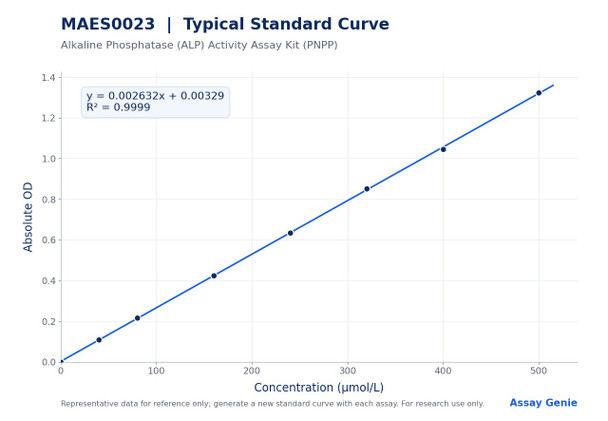
- Standard curve: prepare a fresh set of standards by diluting the 500 µmol/L standard with Buffer Solution as listed in the standard curve table. Discard working dilutions after use.
Sample preparation
- Serum and plasma: assay directly. If not assayed the same day, store at -80°C for up to one month.
- Tissue: wash tissue in cold normal saline. Homogenize 20 mg tissue in 180 µL normal saline at 4°C. Centrifuge at 10000 × g for 10 min at 4°C. Keep the supernatant on ice.
- Cells: wash cells with normal saline. Homogenize 3 × 10^6 cells in 200–400 µL normal saline using an ultrasonic cell disruptor at 4°C. Centrifuge at 10000 × g for 10 min at 4°C. Keep the supernatant on ice.
- Dilute samples using the recommended dilution factors (see Cautions). Determine supernatant protein concentration separately for tissue and cell samples.
Assay procedure
- Add 50 µL of each standard to standard wells, 50 µL of sample to sample wells, and 50 µL of Buffer Solution to control wells.
- Add 50 µL of substrate working solution to control and sample wells. Add 50 µL of Buffer Solution to standard wells.
- Incubate at 37°C for 10 min.
- Add 100 µL of Stop Solution to each well.
- Mix thoroughly for 5 s. Read OD values at 405 nm on a microplate reader.
Serum (plasma): ALP activity (U/L) = (ΔA - b) ÷ a ÷ T × f. Tissue and cell: ALP activity (U/g prot) = (ΔA - b) ÷ a ÷ T × f ÷ C_pr
- ΔA: absolute OD value (OD of sample minus OD of control), with the blank (standard #1) subtracted from standard readings to generate absolute OD values.
- a and b: slope and intercept of the standard curve y = ax + b, where y is the absolute OD and x is the concentration in µmol/L.
- T: reaction time, 10 min.
- f: dilution factor of the sample applied before the test (for example, a serum sample diluted 10-fold is entered as f = 10).
- C_pr: protein concentration of the sample in g prot/L, used only for tissue and cell samples.
- Units: for serum, 1 unit is the amount of enzyme that produces 1 µmol p-nitrophenol per L of serum per minute at 37°C; for tissue and cell samples, the unit is per g of protein.
- Worked example from the manual: for human serum diluted 10-fold, with standard curve y = 0.0027x - 0.0051, control OD 0.099, and sample OD 0.544, ALP activity = (0.544 - 0.099 + 0.0051) ÷ 0.0027 ÷ 10 × 10 = 166.70 U/L.
What sample types can be tested with this kit?
The kit measures ALP activity in animal tissue, serum or plasma, and cell samples. The dilution guidance also lists HepG2 supernatant and human urine, and other sample types require a pretest to confirm the dilution factor.
How should samples be stored before testing?
Serum and plasma can be stored at -80°C for one month if they are not detected on the same day. Tissue and cell supernatants should be kept on ice until detection.
How should the kit and working reagents be stored?
The kit is stored at -20°C for 12 months, protected from light. Substrate working solution can be stored at -20°C for 24 hours protected from light, and fresh standard dilutions should be prepared for each assay.
What should be done if a result is outside the detection range?
The detection range is 0.27-50.8 U/L. If a sample concentration is not within this range, an extra dilution or concentration should be applied to the sample.
What are the key points for running the assay?
Keep the substrate working solution and standards protected from light. Do not mix reagents from different kits, and centrifuge small reagent volumes before use to ensure sufficient volume is delivered.
What instrument settings and assay time are required?
Read absorbance on a microplate reader at 405 nm, within the 400-415 nm range. The incubation at 37°C takes 10 min, and the total assay time is 30 min.
| Storage: | -20°C |
| Shelf life: | 12 months |
| Light sensitivity: | Substrate working solution, p-nitrophenol standard, and substrate powder: protect from light |
| Shipping: | Gel pack |
Notes
- For Research Use Only. Not for clinical diagnosis or other diagnostic or therapeutic use.
- Do not mix reagents between kits with different lots or kit codes.
- Prepare the 500 µmol/L standard and substrate working solution fresh; protect from light.
- Centrifuge small reagent volumes before use to ensure sufficient volume is recovered.
- Recommended sample dilution factors (reference only): human serum 10–20; mouse serum 20–30; rat serum 10–20; mouse plasma 10–20; HepG2 supernatant 8–12; 10% rat kidney homogenate 400–1200; 10% mouse liver homogenate 10–15; 10% rat lung homogenate 50–100; 10% mouse brain homogenate 30–50; human urine 1. For other sample types, run a pretest to confirm the dilution factor.
- If the sample concentration falls outside the detection range, perform an additional dilution or concentration.
- Wear a lab coat and latex gloves during handling.