Description
Annexin V-AF647 Azide-Free Lyophilized Powder
Annexin V-AF647 Azide-Free Lyophilized Powder (AKES010) is a lyophilized, AF647-conjugated Annexin V reagent for detecting apoptosis. Annexin V binds phosphatidylserine (PS) exposed on the outer leaflet of the apoptotic cell membrane in a calcium-dependent manner. The azide-free, preservative-free formulation supports long-term storage and user-defined working concentrations. Research Use Only.
Annexin V is a member of the annexin family of proteins that binds phosphatidylserine (PS) in a calcium-dependent manner. Its binding is specific to PS displayed on the outer leaflet of the apoptotic cell membrane. Annexin V-AF647 is Annexin V conjugated to the AF647 dye, which allows the bound protein to be detected as a fluorescent signal. The product is supplied as an azide-free, lyophilized powder for long-term storage and for preparing working solutions at user-defined concentrations.
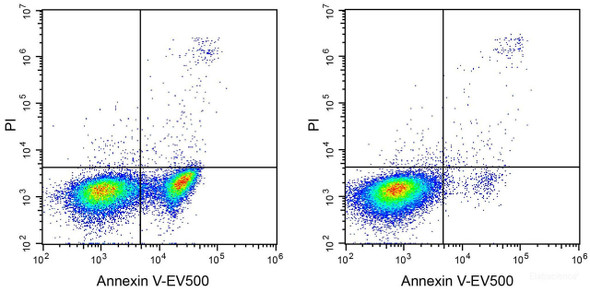
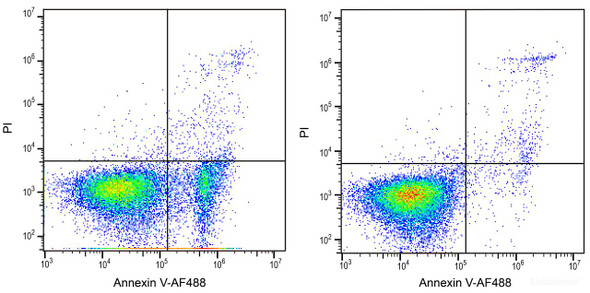
Researchers use Annexin V-AF647 to detect apoptosis by measuring PS exposure on the outer membrane leaflet. The manual pairs it with propidium iodide (PI) to separate cell populations: early apoptotic cells are Annexin V-positive only, necrotic or late apoptotic cells are positive for both Annexin V and PI, and PI single-positive events represent naked nuclei. The manual's example uses Jurkat cells treated with 5 µM camptothecin for 4 h compared with untreated cells, which illustrates the approach under an apoptosis-inducing condition.
Annexin V-AF647 is read by flow cytometry or fluorescence microscopy. The AF647 dye has excitation and emission maxima of 650 nm and 670 nm, and the listed channel set is APC. The powder is reconstituted in sterile deionized water to a final concentration below 1 mg/mL to produce a stock solution. Internal testing indicates that working solutions of 1 to 2 µg/mL Annexin V-AF647 gave the best results for flow cytometry.
The manual's example uses cultured Jurkat cells. Analyze samples as soon as possible after staining, because delay increases the number of apoptotic or necrotic cells. Limit extended exposure of stained samples to direct light to prevent fluorophore quenching. The lyophilized powder ships on ice bags and should be stored at -20°C, shielded from light, where it is stable for at least two years after arrival. Wear a lab coat and disposable gloves during experiments.
| Product Name: | Annexin V-AF647 Azide-Free Lyophilized Powder |
| SKU: | AKES010 |
| Pack Size: | 25 µg, 100 µg |
| Application: | Annexin V |
| Dye Type: | AF647 |
| Ex/Em: | 650/670 nm |
| Channel Set: | APC |
| Other Reagents Required: | Sterile deionized water |
| Detection Method: | Flow cytometry or fluorescence microscopy |
- Annexin V conjugated to AF647; Ex/Em 650/670 nm, APC channel
- Binds phosphatidylserine on the outer leaflet of apoptotic cells in a calcium-dependent manner
- Azide-free and preservative-free lyophilized powder for long-term storage
- Reconstituted in sterile deionized water; user-defined working concentration
- Compatible with flow cytometry and fluorescence microscopy
Annexin V binds phosphatidylserine exposed on the outer leaflet of apoptotic cell membranes. The AF647-conjugated Annexin V signal is collected by flow cytometry or fluorescence microscopy to detect apoptotic cells.
- Detection of early apoptosis by flow cytometry using APC-channel detection of Annexin V-AF647 binding
- Apoptosis analysis by fluorescence microscopy
- Co-staining with a membrane-impermeant viability dye such as propidium iodide to distinguish early apoptotic, late apoptotic or necrotic, and nuclear-only events
- Apoptosis studies in cell-based models treated with pro-apoptotic agents, using camptothecin as an example inducer
| Component | Quantity | Storage |
| Annexin V-AF647 Azide-Free Lyophilized Powder | 25 µg or 100 µg, per pack size selected | -20°C, protect from light |
- Sterile deionized water for reconstitution
- Calcium-containing buffer for binding
- Flow cytometer with APC channel or fluorescence microscope
- Propidium iodide or other viability dye (optional; used in the example protocol)
- Lab coat and disposable gloves
Reconstitution
- Reconstitute the lyophilized powder with sterile deionized water.
- Keep the final concentration below 1 mg/mL. The example adds at least 10 µL water to 10 µg Annexin V-AF647.
- Ensure the lyophilized cake is thoroughly soaked before use.
Staining and detection
- Dilute the stock solution to a working concentration; the reported range is 1 to 2 µg/mL for flow cytometry in internal testing.
- Stain cells, protecting the reagent and stained samples from light.
- Analyze by flow cytometry (APC channel) or fluorescence microscopy as soon as possible after staining.
What sample types can be analyzed with Annexin V-AF647?
The manual's example uses cultured Jurkat cells treated with camptothecin, compared with untreated cells. Signal is collected by flow cytometry or fluorescence microscopy.
How should the lyophilized powder be stored?
Store the lyophilized powder at -20°C in the dark. It is stable for at least two years after arrival when stored this way.
How do I reconstitute the powder?
Reconstitute with sterile deionized water and keep the final concentration below 1 mg/mL. For example, add at least 10 µL of water to 10 µg of Annexin V-AF647, because a smaller volume may not thoroughly soak the lyophilized cake.
Which instrument settings should I use?
The listed channel set is APC, with excitation and emission at 650 nm and 670 nm. For flow cytometry, the manual reports that working solutions of 1 to 2 µg/mL gave the best results.
How soon should I analyze stained samples?
Detect apoptosis as soon as possible after staining, because delay increases the number of apoptotic or necrotic cells. Avoid extended exposure of samples to direct light to protect the fluorophore from quenching.
How do I distinguish apoptotic from necrotic cells?
Annexin V-positive, PI-negative cells are early apoptotic cells. Cells positive for both Annexin V and PI are necrotic or late apoptotic cells, and PI single-positive cells are naked nuclei.
| Storage: | -20°C, protect from light (shading light) |
| Shelf Life: | 24 months (stable for at least two years at -20°C in the dark after arrival, per manual) |
| Expiration: | 24 months |
| Shipping: | Ice bag |
Cautions
- For Research Use Only. Not for diagnostic or therapeutic use.
- Detect apoptosis as soon as possible after staining to avoid increased apoptosis or necrosis in the sample.
- Avoid extended exposure of samples to direct light to prevent fluorophore quenching.
- Wear a lab coat and disposable gloves during experiments.