Description
Annexin V-FITC Azide-Free Lyophilized Powder
Annexin V-FITC Azide-Free Lyophilized Powder (AKES008) is a fluorescein (FITC)-conjugated Annexin V reagent supplied as a lyophilized powder with no azide or Proclin preservatives. It binds phosphatidylserine (PS) in a calcium-dependent manner and localizes to the outer leaflet of apoptotic cell membranes. Researchers use it to detect early apoptosis by flow cytometry or fluorescence microscopy, typically with propidium iodide (PI) co-staining to distinguish cell populations.
Annexin V is a member of the annexin family, which binds phosphatidylserine (PS) in a calcium-dependent manner. The FITC-conjugated form, Annexin V-FITC, binds specifically to PS displayed on the outer leaflet of the apoptotic cell membrane. Because PS exposure on the outer leaflet marks apoptotic cells, the labeled protein serves as a probe for identifying cells undergoing apoptosis in a population. Its signal can be collected with flow cytometry or fluorescence microscopy to detect cell apoptosis.
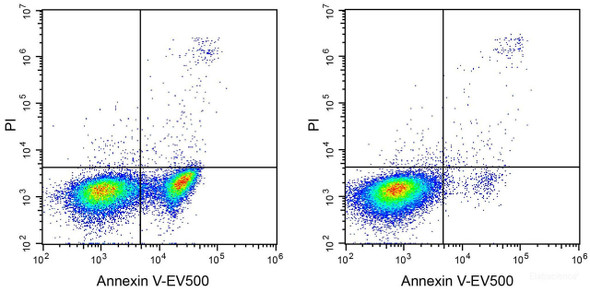
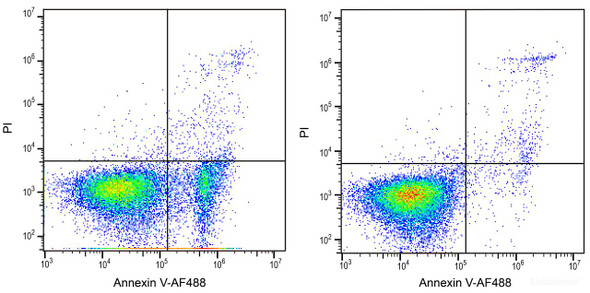
The manual's example uses Jurkat cells treated with 5 µM camptothecin for 4 hours, a treatment used to induce apoptosis. Staining with Annexin V-FITC together with propidium iodide (PI) separates cell populations: Annexin V-FITC single-positive cells are early apoptotic, Annexin V-FITC and PI double-positive cells are necrotic or late apoptotic, and PI single-positive cells are naked nuclei. This separation allows researchers to compare untreated and treated populations and to quantify the proportion of cells at each stage.
Lyophilized Annexin V-FITC is reconstituted with sterile deionized water to a final concentration below 1 mg/mL, a concentration that is high enough for a stock solution. The manual reports that working solutions of 1 to 2 µg/mL give the best results for flow cytometry. The FITC label is detected at excitation and emission wavelengths of 490 and 530 nm in the FITC channel of a flow cytometer; the signal can also be collected by fluorescence microscopy. Because the fluorophore is sensitive to light, samples should be protected from extended exposure to direct light to prevent quenching, and apoptosis should be detected as soon as possible after staining.
The manual demonstrates the reagent with Jurkat cells, and the signal can be collected from cell samples by flow cytometry or fluorescence microscopy. The product page and the manual both specify storage at -20°C, protected from light, and the lyophilized powder is stable for at least two years in the dark after arrival. The formulation contains no preservatives such as azides or Proclin, which the manual links to its design for long-term storage with user-defined concentrations of FITC-conjugated Annexin V. The product ships on ice bags. Avoid extended exposure of samples to direct light, and detect apoptosis as soon as possible after staining.
| Product Name: | Annexin V-FITC Azide-Free Lyophilized Powder |
| SKU: | AKES008 |
| Pack Size: | 25 µg, 100 µg |
| Application: | Annexin V |
| Dye Type: | FITC |
| Ex/Em: | 490/530 nm |
| Channel Set: | FITC |
| Detection Method: | Fluorometric; flow cytometry; fluorescence microscopy |
| Other Reagents Required: | Deionized water (sterile) |
| Format: | Lyophilized powder, azide-free |
- FITC-conjugated Annexin V for PS exposure detection in apoptotic cells
- Azide-free and Proclin-free formulation
- Lyophilized powder; reconstitute in sterile deionized water
- Ex/Em 490/530 nm, FITC channel
- Compatible with flow cytometry and fluorescence microscopy
- Research use only
Annexin V is a member of the annexin family, which binds to phosphatidylserine (PS) in a calcium-dependent manner. The FITC-conjugated Annexin V binds specifically to PS on the outer leaflet of apoptotic cell membranes. The fluorescent signal (Ex/Em 490/530 nm) can be collected by flow cytometry or fluorescence microscopy to detect apoptosis.
- Detection of early apoptosis by PS exposure using flow cytometry (FITC channel)
- Imaging of apoptotic cells by fluorescence microscopy
- Discrimination of early apoptotic, necrotic, and late apoptotic populations when combined with PI
- Apoptosis assays in cell models treated with apoptosis-inducing agents, such as camptothecin in Jurkat cells
| Component | Quantity | Storage |
| Annexin V-FITC, azide-free lyophilized powder | 25 µg or 100 µg, per pack size selected | -20°C, protected from light |
- Sterile deionized water for reconstitution
- Flow cytometer with FITC channel or fluorescence microscope
- Propidium iodide (PI), user-supplied, if discriminating necrotic and late apoptotic cells
- Appropriate buffer for preparing working solution (user-supplied)
- Lab coat and disposable gloves
Reconstitution
- Add sterile deionized water to the lyophilized powder. Use at least 10 µL of water per 10 µg of Annexin V-FITC to ensure the cake is fully soaked.
- Make sure the final stock concentration is less than 1 mg/mL.
- Protect the reconstituted reagent from direct light.
Staining and detection
- Dilute the stock to a working solution of 1 to 2 µg/mL Annexin V-FITC, which gives the best results for flow cytometry.
- Stain cells with the working solution. Add PI if discriminating necrotic and late apoptotic cells.
- Analyze promptly by flow cytometry (FITC channel) or fluorescence microscopy. Limit light exposure of stained samples.
What types of samples can be used with this reagent?
The reagent is used to detect apoptosis in cells by flow cytometry or fluorescence microscopy. The manual demonstrates it with Jurkat cells treated with 5 µM camptothecin for 4 hours.
How should the lyophilized powder be stored?
Store the lyophilized powder at -20°C in the dark. It is stable for at least two years when stored this way after arrival, and the formulation contains no azides or Proclin.
How should the lyophilized powder be reconstituted?
Reconstitute the reagent with sterile deionized water, making sure the final concentration is less than 1 mg/mL and that the lyophilized cake is thoroughly soaked. Working solutions of 1 to 2 µg/mL gave the best results for flow cytometry in internal tests.
What instrument settings should be used for detection?
Use the FITC channel with excitation and emission at 490 and 530 nm. Detection is possible on a flow cytometer or a fluorescence microscope.
Can Annexin V-FITC be used together with propidium iodide?
Yes. The manual shows Annexin V-FITC with PI to distinguish early apoptotic cells (Annexin V-FITC single-positive), necrotic or late apoptotic cells (double-positive), and naked nuclei (PI single-positive).
| Storage: | -20°C, in the dark (protect from light) |
| Stability: | Expiration 24 months; the lyophilized powder is stable for at least two years at -20°C in the dark after arrival |
| Shipping: | Ice bag |
Cautions
- For research use only. Not for diagnostic or therapeutic use.
- Detect apoptosis as soon as possible after staining to avoid increased apoptosis or necrosis in the sample.
- Avoid extended exposure of samples to direct light to protect the fluorophore from quenching.
- Use sterile deionized water for reconstitution and keep the final stock concentration below 1 mg/mL.
- Wear a lab coat and disposable gloves during experiments.