Description
Aspartate Aminotransferase (AST/GOT) Activity Assay Kit (Reitman-Frankel)
The Assay Genie Aspartate Aminotransferase (AST/GOT) Activity Assay Kit (Reitman-Frankel) measures AST/GOT enzyme activity in animal serum or plasma, tissue homogenates, cultured cells and cell culture supernatants. The assay uses a colorimetric readout at 510 nm on a microplate reader. It is intended for Research Use Only.
Aspartate aminotransferase (AST), also called glutamic-oxaloacetic transaminase (GOT), catalyzes the transfer of amino and keto groups between aspartic acid and alpha-ketoglutaric acid. The reaction forms glutamic acid and oxaloacetic acid. This kit measures AST/GOT enzyme activity, so results reflect the catalytic capacity of the sample rather than total enzyme protein. The enzyme is present in animal serum and plasma, tissue, cultured cells, and cell culture supernatant.
Researchers measure AST/GOT activity as part of liver and renal function studies, which is the research area listed for this kit. Published work that cites this product covers liver injury, cholestasis, metabolic dysfunction-associated steatohepatitis, and hepatic encephalopathy. It also includes myocarditis and thioacetamide-induced liver injury models in zebrafish and rodents. These contexts make AST/GOT activity a useful readout for hepatic status in preclinical experiments.
The assay is colorimetric. Aspartate and alpha-ketoglutarate substrate is pre-warmed at 37 °C for 10 minutes. The sample is mixed with substrate and incubated at 37 °C for 30 minutes, then chromogenic agent is added and the mixture is incubated for a further 20 minutes at 37 °C. Alkali working solution is added, and the plate stands for 15 minutes at room temperature. Pyruvic acid reacts with 2,4-dinitrophenylhydrazine to form a 2,4-dinitrophenylhydrazone that appears reddish brown in alkaline solution. Absorbance is read at 510 nm on a microplate reader.
Serum, plasma, urine, animal tissue, cultured cells, and cell culture supernatant are supported. Serum and plasma are tested directly, and urine is centrifuged at 10000 g for 15 minutes at 4 °C before use. Tissue and cell samples are homogenized in cold PBS (0.01 M, pH 7.4), then centrifuged at 10000×g for 10 minutes to remove insoluble material. The supernatant is kept on ice, and protein concentration is measured so that activity can be normalized per gram of protein. Samples should be detected as soon as possible after collection.
Reported analytical sensitivity is 1.10 IU/L, and the detection range is 1.10 to 72.30 IU/L. Inter-assay precision is 6.8% CV, and intra-assay precision is 5.3% CV. In recovery testing at low, middle, and high standard concentrations, the average recovery was 97%, with individual values of 96%, 97%, and 99%.
| Product Name: | Aspartate Aminotransferase (AST/GOT) Activity Assay Kit (Reitman-Frankel) |
| SKU: | MAES0158 |
| Size: | 96 Assays |
| Sample Types: | Serum, plasma, animal tissue, cells, cell culture supernatant |
| Detection Method: | Colorimetric (2,4-dinitrophenylhydrazone, reddish brown in alkaline solution) |
| Instrument: | Microplate reader (500-520 nm; read at 510 nm) |
| Assay Time: | 80 min (1 h 20 min) |
| Sensitivity: | 1.1 IU/L |
| Detection Range: | 1.1-72.3 IU/L |
| Research Area: | Enzymes, Liver Biomarkers |
| Synonyms: | AST; GOT; Glutamic-oxalacetic transaminase |
| Sample Volume: | 5 µL per well (per manual operating steps) |
| Intra-assay CV: | 5.3% |
| Inter-assay CV: | 6.8% |
| Sensitivity: | 1.1 IU/L |
| Detection Range: | 1.1-72.3 IU/L |
| Assay Time: | 80 min |
- Colorimetric endpoint measured at 510 nm on a microplate reader
- Quantifies AST/GOT activity in serum, plasma, animal tissue, cells and cell culture supernatant
- Detection range 1.1-72.3 IU/L with sensitivity of 1.1 IU/L
- Total assay time of 80 min, including a 15 min room temperature color development step
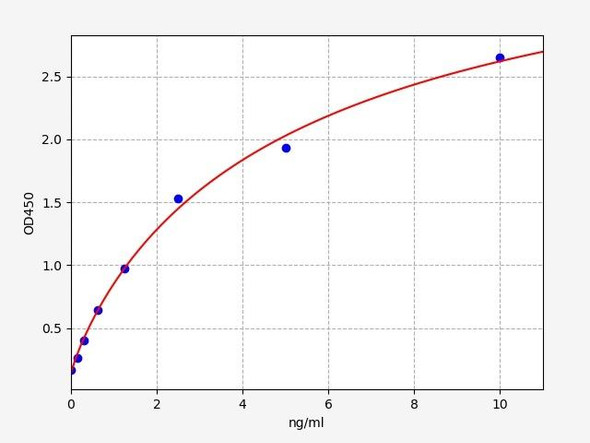
- Standard curve generated from five calibrators (0-190 Carmen units)
AST/GOT catalyzes the exchange of amino and keto groups between alpha-ketoglutaric acid and aspartic acid, forming glutamic acid and oxaloacetic acid. During the reaction, oxaloacetic acid decarboxylates to form pyruvic acid (pyroracemic acid). The pyruvate reacts with 2,4-dinitrophenylhydrazine (DNPH) to form a 2,4-dinitrophenylhydrazone, which develops a reddish brown color in alkaline solution. The OD is measured at 510 nm and enzyme activity is calculated from the standard curve.
- Measurement of AST/GOT activity in serum and plasma samples from animal studies
- Profiling AST/GOT activity in animal tissue homogenates, including liver, lung and other organs
- Assessing AST/GOT activity in cell lysates and cell culture supernatants
- Investigating enzyme changes in models of acute pancreatitis, ischemic stroke, acute renal disease and motor neuron disease
- Studying hepatic and nitrogen metabolism pathways
| Component | Quantity | Storage |
| Reagent 1 (Buffer Solution) | 0.5 mL × 1 vial | 2-8°C, 12 months |
| Reagent 2 (Sodium Pyruvate, 2 mmol/L) | 0.5 mL × 1 vial | 2-8°C, 12 months |
| Reagent 3 (Substrate Solution) | 5 mL × 1 vial | 2-8°C, 12 months |
| Reagent 4 (Chromogenic Agent) | 5 mL × 1 vial | 2-8°C, 12 months, protect from light |
| Reagent 5 (Alkali Reagent) | 5 mL × 1 vial | 2-8°C, 12 months |
| Microplate | 96 wells × 1 | Room temperature |
- Microplate reader capable of reading 500-520 nm (510 nm used for readout)
- Vortex mixer
- Incubator set to 37°C
- Multichannel pipette
- Double distilled water
- Normal saline (0.9% NaCl)
- PBS (0.01 mol/L, pH 7.4)
Serum/plasma
- Detect serum and plasma directly.
- If samples are not detected on the same day, store serum or plasma at -80 °C for up to one month.
- Serum samples can be stored at 2-8 °C for 7 days or at -20 °C for 20 days.
- Dilution: for human serum, human plasma, porcine serum, and rat serum, the recommended dilution factor is 1.
- The diluent is normal saline (0.9% NaCl) or PBS (0.01 M, pH 7.4).
Urine
- Collect fresh urine.
- Centrifuge at 10000 g for 15 minutes at 4 °C.
- Take the supernatant and keep it on ice for detection.
Tissue
- Harvest the amount of tissue needed for each assay (initial recommendation: 20 mg).
- Wash the tissue in cold PBS (0.01 M, pH 7.4).
- Homogenize 20 mg of tissue in 180 µL of PBS (0.01 M, pH 7.4) with a Dounce homogenizer at 4 °C.
- Centrifuge at 10000×g for 10 minutes to remove insoluble material.
- Collect the supernatant and keep it on ice for detection.
- Determine the protein concentration of the supernatant separately for normalization.
- Dilution: for 10% mouse liver tissue homogenate, the recommended dilution factor is 15-30. For 10% mouse lung tissue homogenate, the recommended dilution factor is 2-8.
- The diluent is normal saline (0.9% NaCl) or PBS (0.01 M, pH 7.4).
Cells
- Harvest the number of cells needed for each assay (initial recommendation: 1×10^6 cells).
- Wash cells with PBS (0.01 M, pH 7.4).
- Homogenize 1×10^6 cells in 300 µL of PBS (0.01 M, pH 7.4) with an ultrasonic cell disruptor at 4 °C.
- Centrifuge at 10000×g for 10 minutes to remove insoluble material.
- Collect the supernatant and keep it on ice for detection.
- Determine the protein concentration of the supernatant separately for normalization.
Cell culture supernatant
- Dilution: for HC-60 cellular supernatant and Calu-3 cellular supernatant, the recommended dilution factor is 1.
- The diluent is normal saline (0.9% NaCl) or PBS (0.01 M, pH 7.4).
- For other sample types, perform a pretest to confirm the dilution factor.
Reagent and sample preparation
- Prepare alkali working solution fresh for each assay: mix 20 µL of Reagent 5 with 180 µL of double distilled water per well (200 µL per well).
- Pre-incubate substrate solution (Reagent 3) at 37°C for 10 min.
- Serum and plasma: assay directly. Urine: centrifuge fresh urine at 10000 g for 15 min at 4°C and keep the supernatant on ice.
- Tissue: homogenize 20 mg tissue in 180 µL cold PBS (0.01 mol/L, pH 7.4) with a dounce homogenizer at 4°C. Centrifuge at 10000 × g for 10 min and keep the supernatant on ice.
- Cells: homogenize 1 × 10^6 cells in 300 µL cold PBS (0.01 mol/L, pH 7.4) by ultrasonication at 4°C. Centrifuge at 10000 × g for 10 min and keep the supernatant on ice.
- Dilute samples in normal saline (0.9% NaCl) or PBS (0.01 mol/L, pH 7.4). Recommended dilution factors: human serum 1; human plasma 1; porcine serum 1; rat serum 1; HC-60 cell supernatant 1; Calu-3 cell supernatant 1; 10% mouse liver homogenate 15-30; 10% mouse lung homogenate 2-8. Pretest other sample types.
Assay procedure
- Standard wells A to E: add 5 µL of buffer solution (Reagent 1). Add 20, 18, 16, 14 and 12 µL of substrate solution to wells A to E, respectively. Add 0, 2, 4, 6 and 8 µL of Reagent 2 to wells A to E, respectively.
- Sample wells: add 20 µL of pre-warmed substrate solution and 5 µL of sample.
- Control wells: add 20 µL of pre-warmed substrate solution.
- Mix well and incubate at 37°C for 30 min.
- Add 20 µL of chromogenic agent (Reagent 4) to each well.
- Add 5 µL of sample to the control wells.
- Mix for 10 s on the microplate reader, then incubate at 37°C for 20 min.
- Add 200 µL of alkali working solution to each well. A multichannel pipette is recommended.
- Mix for 10 s, stand for 15 min at room temperature, and read the OD at 510 nm.
Serum (plasma) sample: AST/GOT activity (IU/L) = [a × (ΔA510)^2 + b × ΔA510 + c] × 0.482 × f Tissue and cell sample: AST/GOT activity (IU/gprot) = [a × (ΔA510)^2 + b × ΔA510 + c] × 0.482 × f ÷ Cpr ΔA510 = OD510 sample − OD510 control
- a, b, and c are the coefficients of the standard curve, y = ax² + bx + c, where x is the absorbance (absoluted OD) and y is the concentration in Carmen units. Standard concentrations are 0, 24, 61, 114, and 190 Carmen units. Absoluted OD is the standard OD minus the mean OD of the blank (Standard A).
- ΔA510 is the sample OD at 510 nm minus the control OD at 510 nm.
- 0.482 converts Carmen units to IU/L (1 Carmen unit = 0.482 IU/L at 25 °C).
- f is the dilution factor of the sample before testing. Multiply by f to correct for dilution.
- Cpr is the protein concentration of the sample in g prot/L. Dividing by Cpr normalizes tissue and cell results to IU/g prot.
- International unit definition: 1 IU is the amount of enzyme that consumes 1 µmol of NADH per minute in the reaction system (1 mL sample or 1 g tissue protein, 25 °C, 340 nm, 1 cm optical path).
Which sample types can be tested with this kit?
The kit measures AST/GOT activity in animal serum and plasma, tissue, cultured cells, and cell culture supernatant. Urine supernatant is also described in the sample preparation section.
How should serum and plasma be stored before testing?
Serum and plasma should be detected as soon as possible after collection. If not tested the same day, they can be stored at -80 °C for one month. Serum can also be kept at 2-8 °C for 7 days or at -20 °C for 20 days.
What should I do if my sample is outside the detection range of 1.10 to 72.30 IU/L?
Take an extra dilution or concentration of the sample if the concentration falls outside the detection range. For dilution, normal saline (0.9% NaCl) or PBS (0.01 M, pH 7.4) can be used as the diluent. Use the recommended dilution factors for listed sample types.
What are the key points that affect assay performance?
Use a multichannel pipette to add alkali working solution to reduce well-to-well variation. Mix well after adding the substrate, which the manual describes as very important. The alkali working solution must be prepared on the spot.
What instrument settings are required?
Read the plate on a microplate reader with a 500-520 nm filter, measuring the OD value of each well at 510 nm. Stand the plate for 15 minutes at room temperature before reading.
How long does the assay take?
The total assay time is 1 hour 20 minutes. This includes 30 minutes at 37 °C after substrate and sample mixing, 20 minutes at 37 °C after chromogenic agent addition, and 15 minutes at room temperature after alkali working solution addition.
| Storage: | 2-8°C, protect from light |
| Shelf Life: | 12 months |
| Shipping: | Gel pack |
Notes
- For Research Use Only. Not for clinical diagnosis.
- Store all reagents strictly at 2-8°C as listed. Do not mix reagents from different kits.
- Centrifuge small reagent volumes before use.
- Prepare the alkali working solution on the spot before use.
- Add the alkali working solution using a multichannel pipette to reduce well-to-well variation. Mix thoroughly at the substrate addition step.
- Detect samples as soon as possible after collection. Serum or plasma may be stored at 2-8°C for 7 days or at -20°C for 20 days (per manual key points), or at -80°C for one month (per manual sample preparation).
- If a sample falls outside the detection range, dilute or concentrate it and repeat the assay.
- Run a pretest for sample types not listed in the manual.
- Wear a lab coat and gloves during use.