Description
Bovine BDNF ELISA Kit
Bovine BDNF ELISA kits are used to detect BDNF in biological samples. BDNF, or brain-derived neurotrophic factor, is a secreted member of the neurotrophin family that is synthesised as a precursor, proBDNF, and processed to the mature dimeric protein. Mature BDNF activates signalling cascades downstream of its receptor TrkB (NTRK2). During development it promotes the survival and differentiation of selected neuronal populations in the peripheral and central nervous systems. In the adult brain it is a major regulator of synaptic transmission and plasticity, including long-term potentiation. BDNF is also found in platelets and serum, and reduced levels have been associated with depression, Alzheimer disease, Huntington disease and other neurological disorders, whereas exercise may raise them, so it is widely studied as a biomarker of neuronal health.
| Product Name: | Bovine BDNF ELISA Kit |
| SKU: | AEKE03004 |
| Reactivity: | Bovine |
| Synonyms: | Neurotrophin, Abrineurin |
| Assay Type: | Sandwich ELISA |
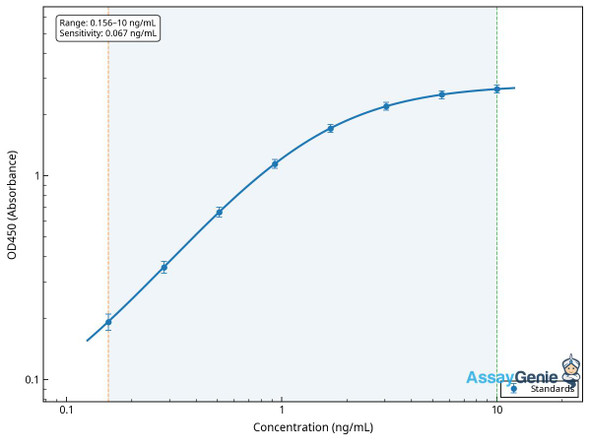
| Sensitivity: | 0.062 ng/mL |
| Standard: | 10 ng/mL |
| Range: | 0.16-10 ng/mL |
| Sample Type: | Serum, Plasma, Tissue Homogenates, Cell Lysates, Cell Culture Supernates and Other Biological fluids |
| Assay Length: | 3.5h |
| Research Area: | Cytokine, Infection Immunity, Neuro Science |
| Uniprot: | Q95106 |
| Component | Quantity | Storage | |
| 48T | 96T | ||
| Pre-Coated Microplate | 6 strips × 8 wells | 12 strips × 8 wells | 4°C–20°C |
| Standard (Lyophilized) | 1 vial | 2 vials | 4°C–20°C |
| Biotinylated Antibody (100×) | 60 μL | 120 μL | 4°C–20°C |
| Streptavidin-HRP (100×) | 60 μL | 120 μL | 4°C–20°C |
| Standard/Sample Diluent Buffer | 10 mL | 20 mL | 4°C–20°C |
| Biotinylated Antibody Diluent | 6 mL | 12 mL | 4°C–20°C |
| HRP Diluent | 6 mL | 12 mL | 4°C–20°C |
| Wash Buffer (25×) | 10 mL | 20 mL | 4°C–20°C |
| TMB Substrate Solution | 6 mL | 10 mL | 4°C–20°C (store in dark) |
| Stop Reagent | 3 mL | 6 mL | 4°C–20°C |
| Plate Covers | 1 piece | 2 pieces | Room Temperature |
This assay utilizes a sandwich enzyme-linked immunosorbent assay (ELISA) technique. The microtiter plate included in this kit is pre-coated with a capture antibody specific for Cattle BDNF. Standards and samples are added to the wells, followed by the addition of a biotin-conjugated detection antibody specific to Cattle BDNF.
Subsequently, Avidin conjugated to Horseradish Peroxidase (HRP) is added to each well and incubated. After washing to remove unbound reagents, a TMB (3,3′,5,5′-Tetramethylbenzidine) substrate solution is added. Wells containing Cattle BDNF, the biotin-labeled antibody, and the HRP-Avidin complex will develop a blue color due to enzymatic conversion of the substrate.
The reaction is terminated by the addition of sulfuric acid, resulting in a color change from blue to yellow. The optical density (OD) is measured at 450 nm ± 10 nm using a spectrophotometer. The concentration of Cattle BDNF in the samples is determined by comparing the OD values to a standard curve generated from known concentrations.
| Standard Curve: |
| |||||||||||||||||||||||||||
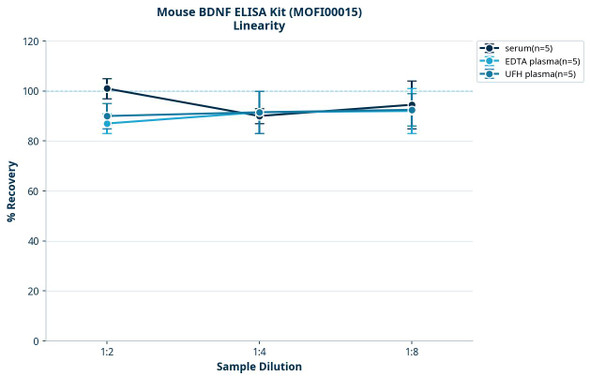
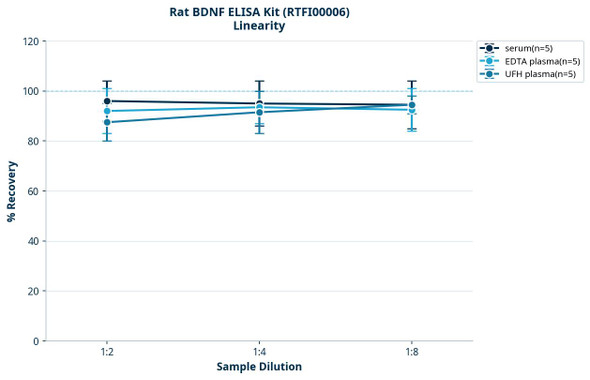
| Linearity: |
| |||||||||||||||||||||||||||
| Recovery: |
| |||||||||||||||||||||||||||
| Precision: | Intra-assay Precision (within-run): Coefficient of variation (CV) < 8% Inter-assay Precision (between-run): Coefficient of variation (CV) < 10% |
*Note: The following protocol is a general guideline. Please refer to the specific protocol provided with your kit, as procedures may vary by batch or lot.
| Step | Procedure |
| 1. | Equilibrate the kit components to room temperature. Add 100 μL of the standard (serially diluted as instructed) or 100 μL of sample to each well. Incubate at 37°C for 80 minutes. |
| 2. | Discard the solution from the wells. Wash the wells 3 times with 200 μL of 1× Wash Buffer per well. Blot the plate onto clean absorbent paper. Add 100 μL of 1× Biotinylated Antibody Working Solution to each well and incubate at 37°C for 50 minutes. |
| 3. | Repeat the washing step as above. Add 100 μL of 1× Streptavidin-HRP Working Solution to each well. Incubate at 37°C for 50 minutes. |
| 4. | Wash the plate 5 times with 200 μL of 1× Wash Buffer per well. Blot dry. Add 90 μL of TMB Substrate Solution to each well and incubate in the dark at 37°C for 20 minutes. |
| 5. | Add 50 μL of Stop Solution to each well. Mix thoroughly using a plate shaker for 1 minute. Measure absorbance immediately at 450 nm. |
Proper sample preparation is critical for optimal ELISA performance. Below are guidelines for preparing various sample types.
| Sample Type | Preparation Protocol |
| Serum | Collect blood into a serum separator tube. Allow clotting for 2 hours at room temperature or overnight at 4°C. Centrifuge at 1000 × g for 20 minutes. Use fresh serum immediately or store aliquots at -20°C or -80°C. Avoid repeated freeze–thaw cycles. |
| Plasma | Collect blood using EDTA or heparin as anticoagulants. Centrifuge at 1000 × g at 2–8°C for 15 minutes within 30 minutes of collection. Use immediately or store aliquots at -20°C or -80°C. Avoid repeated freeze–thaw cycles. |
| Tissue Homogenates | 1. Rinse tissue with ice-cold PBS to remove blood and weigh. 2. Mince and homogenize in fresh lysis buffer (typically PBS) using a glass homogenizer on ice. 3. Sonicate the mixture until a clear solution is obtained. 4. Centrifuge at 10,000 × g for 5 minutes. Collect the supernatant and use immediately or store at ≤ -20°C. |
| Cell Lysates | 1. Wash adherent cells with PBS, detach using trypsin, then centrifuge at 1000 × g for 5 minutes. 2. Wash cells 3 times with PBS. 3. Resuspend in lysis buffer at 10⁷ cells/mL. Sonicate if needed. 4. Centrifuge at 1500 × g for 10 minutes at 2–8°C. Use the supernatant immediately or store at ≤ -20°C. |
| Urine | Collect midstream morning urine into a sterile container. Centrifuge to remove debris. Use immediately or aliquot and store at ≤ -20°C. Avoid repeated freeze–thaw cycles. |
| Saliva | Collect using a saliva collection device. Centrifuge at 1000 × g for 15 minutes at 2–8°C. Remove debris and use immediately or store aliquots at ≤ -20°C. Avoid repeated freeze–thaw cycles. |
| Feces | Collect more than 50 mg of dried feces. Suspend in PBS at a 1:9 ratio (w:v), sonicate, and centrifuge at 5000 × g for 10 minutes. Use the supernatant for the assay. |
| CSF (Cerebrospinal Fluid) | Centrifuge to remove particulates. Use immediately or store aliquots at ≤ -20°C. Avoid repeated freeze–thaw cycles. |
| Cell Culture Supernatant | Centrifuge at 1000 × g for 20 minutes. Collect the supernatant. Use immediately or store at -20°C or -80°C. Avoid repeated freeze–thaw cycles. |