Description
Bradford Protein Colorimetric Assay Kit
The Bradford Protein Colorimetric Assay Kit (MAES0126) quantifies total protein (TP) in serum, plasma, animal tissue, plant tissue, and cell samples. The assay uses Coomassie brilliant blue G-250, which shifts absorbance from 465 nm to 595 nm when bound to protein, and it is read on a microplate reader in about 20 minutes. Researchers use the kit to determine total protein concentration for sample normalization and protein-level comparisons across biological sample types. For Research Use Only.
The Bradford Protein Colorimetric Assay Kit (MAES0126) measures total protein (TP), the combined protein content of a sample, rather than any single protein species. The kit is intended for serum, plasma, animal tissue, plant tissue, and cell samples. Results are reported as a total protein concentration in mg/mL, calculated directly from absorbance at 595 nm against a protein standard curve. Because the signal reflects all protein present, the value describes overall protein content in the prepared sample. For research use only.
Research Area listings place this kit in amino acids and proteins and in liver and renal function studies. Protein content of tissue homogenates is relevant to these contexts, and the sources include liver, kidney, lung, spleen, and heart tissue from mouse and rat. Serum and plasma from human, rabbit, rat, and chicken are also covered. Cell lines 293T and HL-60 are listed as sample types, and plant tissues such as avocado mesocarp, carrot cortical tissue, and banana mesocarp appear in the dilution guidance.
The assay relies on Coomassie brilliant blue G-250, which is red in its free state with maximum absorbance at 465 nm. When the dye binds protein, its maximum shifts to 595 nm, and absorbance at 595 nm is directly proportional to protein content. In practice, 10 µL of standard or sample is added to each well, followed by 250 µL of chromogenic agent. The plate is mixed for 10 s on a microplate reader, held at room temperature for 10 min, and read at 595 nm.
Serum and plasma are assayed directly. If they are not run on the same day, they can be stored at -80°C for up to one month. Tissue is harvested at an initial recommendation of 20 mg, washed in Extraction Solution, and homogenized in 180 µL with a dounce homogenizer at 4°C. Cells are harvested at an initial recommendation of 1×10^6 and homogenized in 300-500 µL with an ultrasonic cell disruptor at 4°C. Tissue and cell homogenates are centrifuged at 10000×g for 10 min, and the supernatant is kept on ice until detection.
The analytical sensitivity is 0.046 mg/mL, and the detection range is 0.046-0.6 mg/mL. Intra-assay precision ranged from 3.0% to 3.5% CV across three human serum samples tested in replicates of 20. Inter-assay precision ranged from 7.4% to 9.1% CV across 20 runs in duplicate by three operators. Recovery averaged 104%, with individual standard recoveries of 101%, 106%, and 105%.
| Product Name: | Bradford Protein Colorimetric Assay Kit |
| SKU: | MAES0126 |
| Size: | 96 Assays |
| Detection Method: | Colorimetric (Coomassie brilliant blue G-250) |
| Sample Types: | Serum, plasma, animal tissue, plant tissue, cells |
| Analyte: | Total protein (TP) |
| Assay Time: | 20 min |
| Instrument: | Microplate reader (550–630 nm; 595 nm optimum) |
| Research Area: | Amino acids and proteins; liver and renal function |
| Sensitivity: | 0.046 mg/mL |
| Detection Range: | 0.046–0.6 mg/mL |
| Intra-assay CV: | 3.2% |
| Inter-assay CV: | 8.2% |
| Recovery Rate: | 104% |
| Sample Volume: | 10 µL |
- Colorimetric total protein measurement based on Coomassie brilliant blue G-250 binding, read at 595 nm
- Detection range 0.046–0.6 mg/mL with analytical sensitivity of 0.046 mg/mL
- Assay time of 20 min with 10 µL sample volume
- Validated for serum, plasma, animal tissue, plant tissue, and cell samples
- Includes 1 mg standard for a 0–0.6 mg/mL standard curve
- Supplied for 96 assays
Coomassie brilliant blue G-250 is red in the free state, with maximum absorbance at 465 nm. When the dye binds protein, the compound shows maximum absorbance at 595 nm. Absorbance at 595 nm is directly proportional to protein content, so total protein concentration is calculated directly from the OD value at 595 nm against a standard curve.
- Total protein quantification of serum and plasma samples prior to protein-based analyses
- Normalization of protein content in animal tissue homogenates, including liver and kidney samples
- Protein quantification of plant tissue extracts
- Total protein determination in cell lysates for normalization of cell-based assays
- Liver and renal function research involving total protein measurements
| Component | Quantity | Storage |
| Reagent 1: Extraction Solution | 110 mL × 1 vial | 2–8°C, 12 months |
| Reagent 2: Chromogenic Agent Stock Solution | 6 mL × 1 vial | 2–8°C, 12 months, protect from light |
| Reagent 3: 1 mg Standard | 1 mg × 2 vials | Room temperature, 12 months |
| Microplate | 96 wells | No requirement |
| Plate Sealer | 2 pieces | — |
| Sample Layout Sheet | 1 piece | — |
- Microplate reader capable of 550–630 nm reading (595 nm optimum)
- Micropipettor
- Incubator
- Vortex mixer
- Centrifuge (capable of 10000×g)
- Double distilled water
- Homogenizer (dounce homogenizer for tissue; ultrasonic cell disruptor for cells)
- Normal saline (0.9% NaCl) or PBS (0.01 mol/L, pH 7.4) as listed as other reagents required
Serum/plasma
- Detect serum and plasma directly.
- If samples are not detected on the same day, store serum or plasma at -80°C for up to one month.
- Dilute human serum, human plasma, rabbit serum, rat plasma, and chicken serum 90-110 fold with Extraction Solution (dilution factor 90-110).
- Add 10 µL of diluted sample per well and proceed with the assay; multiply the result by the dilution factor.
- For sample types not listed, perform a pretest to confirm the dilution factor.
Tissue
- Harvest the amount of tissue needed for each assay (initial recommendation 20 mg).
- Wash tissue in Extraction Solution.
- Homogenize 20 mg tissue in 180 µL Extraction Solution with a dounce homogenizer at 4°C.
- Centrifuge at 10000×g for 10 min to remove insoluble material.
- Collect the supernatant and keep it on ice for detection.
- Dilute 10% homogenates with Extraction Solution: mouse kidney, mouse lung, rat spleen, and rat heart 15-20 fold; rat liver 20-25 fold; avocado mesocarp 3-6 fold.
- Use a dilution factor of 1 (no dilution) for 10% oyster mushroom fruiting body, cucumber mesocarp, carrot cortical, banana mesocarp, and chili pepper mesocarp tissue.
- For tissue types not listed, perform a pretest to confirm the dilution factor.
Cells (adherent or suspension)
- Harvest the number of cells needed for each assay (initial recommendation 1×10^6 cells).
- Wash cells with Extraction Solution.
- Homogenize 1×10^6 cells in 300-500 µL Extraction Solution with an ultrasonic cell disruptor at 4°C.
- Centrifuge at 10000×g for 10 min to remove insoluble material.
- Collect the supernatant and keep it on ice for detection.
- For 293T and HL-60 cells, use a dilution factor of 1 (no dilution).
- For cell types not listed, perform a pretest to confirm the dilution factor.
Reagent preparation
- Equilibrate all reagents to room temperature before use.
- Prepare chromogenic agent: for each well, mix 50 µL of Chromogenic Agent Stock Solution with 200 µL double distilled water (250 µL per well). Store at 2–8°C for up to 7 days, protected from light.
- Prepare 1 mg/mL standard: dissolve one 1 mg standard vial in 1 mL double distilled water and mix well.
- Prepare fresh standards for each assay and discard working dilutions after use.
Standard curve preparation (1 mg/mL standard and double distilled water)
- 0 mg/mL: 0 µL standard + 100 µL water
- 0.05 mg/mL: 5 µL standard + 95 µL water
- 0.1 mg/mL: 10 µL standard + 90 µL water
- 0.2 mg/mL: 20 µL standard + 80 µL water
- 0.3 mg/mL: 30 µL standard + 70 µL water
- 0.4 mg/mL: 40 µL standard + 60 µL water
- 0.5 mg/mL: 50 µL standard + 50 µL water
- 0.6 mg/mL: 60 µL standard + 40 µL water
Sample preparation
- Serum and plasma: assay directly. If not assayed the same day, serum or plasma can be stored at -80°C for up to one month.
- Tissue: homogenize 20 mg tissue in 180 µL Extraction Solution at 4°C with a dounce homogenizer, centrifuge at 10000×g for 10 min, and keep the supernatant on ice.
- Cells: homogenize 1×10^6 cells in 300–500 µL Extraction Solution at 4°C with an ultrasonic cell disruptor, centrifuge at 10000×g for 10 min, and keep the supernatant on ice.
- Dilute samples as needed using the recommended dilution factors (for example, human serum 90–110; 10% mouse kidney homogenate 15–20; 10% rat liver homogenate 20–25). Pretest samples not listed.
Assay procedure
- Add 10 µL of each standard to its well (standard tube) or 10 µL of sample to its well (sample tube).
- Add 250 µL chromogenic agent to each well.
- Mix for 10 s and stand at room temperature for 10 min.
- Measure OD at 595 nm on a microplate reader.
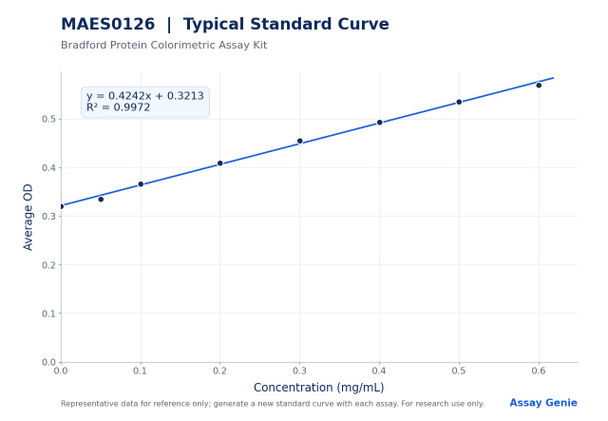
- Average duplicate readings, subtract the blank (0 mg/mL standard) mean OD to obtain absoluted OD, and plot absoluted OD (y) against concentration (x) to fit y = ax + b.
- Calculate total protein: TP (mg/mL) = (ΔA − b) ÷ a × f, where ΔA = OD595 sample − OD595 blank and f = sample dilution factor.
TP content (mg/mL) = (ΔA595 - b) ÷ a × f
- ΔA595 = OD595 Sample − OD595 Blank, where the sample and blank OD values are read at 595 nm.
- a and b are the slope and intercept of the standard curve y = ax + b, where y is the absoluted OD value and x is the standard concentration in mg/mL.
- Absoluted OD value: average the duplicate readings for each standard, then subtract the mean OD of the blank (Standard #1, 0 mg/mL) from all standard readings.
- f is the dilution factor of the sample before testing; multiply the calculated concentration by f to obtain the undiluted TP content.
- The result is expressed in mg/mL. For example, a 100-fold diluted human serum sample gave 60.83 mg/mL using f = 100 in the manual example.
Which sample types can be measured with this kit?
The kit measures total protein in serum, plasma, animal tissue, plant tissue, and cell samples. Sample types not listed in the dilution guidance require a pretest to confirm the dilution factor.
How should the kit components and samples be stored?
Reagent 1 and Reagent 2 are stored at 2-8°C for 12 months, with Reagent 2 protected from light, and the standard is stored at room temperature for 12 months. Prepared chromogenic agent is stored at 2-8°C for 7 days protected from light, and serum or plasma can be kept at -80°C for up to one month.
What should I do if my sample is outside the detection range?
The detection range is 0.046-0.6 mg/mL. If the concentration is not within this range, take an extra dilution or concentration of the sample and repeat the assay.
What are the key points to avoid errors during setup?
Prevent bubbles when adding liquid to the microplate. For small reagent volumes, centrifuge before use so that the full amount is recovered.
What instrument settings and assay time are required?
Use a microplate reader set between 550 and 630 nm, with 595 nm as the optimum wavelength for reading. The assay time is 20 min, including 10 min at room temperature after the chromogenic agent is added.
| Reagent 1: Extraction Solution: | 2–8°C, 12 months |
| Reagent 2: Chromogenic Agent Stock Solution: | 2–8°C, 12 months, protect from light |
| Reagent 3: 1 mg Standard: | Room temperature, 12 months |
| Valid Period: | 12 months |
| Shipping: | Gel pack |
Notes
- For Research Use Only. Not for use in clinical diagnosis or therapeutic procedures.
- Wear a lab coat and gloves during use.
- Do not mix reagents from different kits.
- Centrifuge small volumes of reagent before use to ensure sufficient recovery.
- Avoid bubbles when adding liquid to the microplate.
- Prepare standards fresh for each assay and discard working standard dilutions after use.
- If a sample is outside the detection range, use an additional dilution or concentration.
- Pretest samples not listed in the protocol to confirm dilution factor.
- Results depend on reagent, operator, and environmental conditions; the standard curve should be run with each assay.