Description
Carnitine Palmitoyltransferase 1 (CPT1) Activity Assay Kit
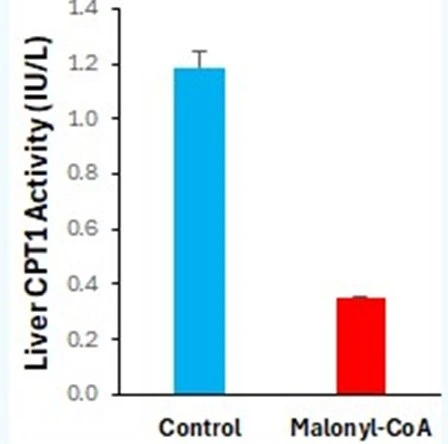
The Assay Genie Carnitine Palmitoyltransferase 1 (CPT1) Activity Assay Kit measures CPT1 (EC 2.3.1.21) activity in cell and tissue lysates. Located in the outer mitochondrial membrane, CPT1 transfers long-chain fatty acyl groups from acyl-CoA to carnitine and is the rate-limiting step of mitochondrial fatty acid β-oxidation. Its isoforms CPT1A (liver), CPT1B (muscle and heart) and CPT1C (brain) are major targets in metabolic disease and cancer research.
Free CoA released from palmitoyl-CoA drives the reduction of the tetrazolium dye INT to a coloured formazan, measured at 492 nm. The kit offers a one-step lysis for most samples and a two-step membrane preparation for muscle and heart, and supports CPT1 inhibitor screening by simply adding the test compound to the well.
| Product Name: | Carnitine Palmitoyltransferase 1 (CPT1) Assay Kit |
| SKU: | BR00005 |
| Kit Size: | 100 wells |
| Detection Method: | Colorimetric (INT → formazan, OD 492 nm) |
| Sample Types: | Cell and tissue lysates; two-step membrane preparation for muscle and heart |
| Recommended Protein: | 0.5–2 mg/ml |
| Incubation Time: | Read at 30, 60 and 90 min at 37 °C |
| Units: | IU/L (µmol/L/min); normalise to protein or GAPDH |
| Equipment Required: | Microplate reader (492 nm) |
| Storage: | -80 °C (see component storage) |
| Intended Use: | For research use only (RUO). Not for diagnostic procedures. |
- Measures the rate-limiting enzyme of fatty acid oxidation
- Optimised two-step protocol for muscle and heart tissue
- Inhibitor screening compatible (1 µl compound per well)
- Kinetic readings at 30, 60 and 90 min to select the optimal window
- Direct activity calculation in IU/L, no standard curve required
- CPT1 transfers the palmitoyl group from palmitoyl-CoA to carnitine, releasing free CoA.
- The released CoA drives the reduction of INT to a coloured formazan. Formazan has an absorbance maximum at 492 nm (ε = 18 mM-1cm-1), so activity is calculated directly in IU/L (µmol/L/min) without a standard curve.
- Activity is calculated from ΔOD: IU/L = ΔOD × 16.2 (30 min), × 8.1 (60 min) or × 5.4 (90 min).
- One-step (most cells and tissues): ~105 cells in 50–100 µl, or ~2 mg tissue in 0.2 ml, ice-cold 1x Tissue Lysis Solution.
- Two-step (muscle and heart): homogenise in 1x Lysis Buffer, discard the supernatant, then extract the pellet in 1x Tissue Lysis Solution.
- Centrifuge at ~14,000 rpm, 4 °C, 5 min; adjust protein to 0.5–2 mg/ml.
| Component | Size | Storage |
| CPT1 Assay Solution | 5 ml | -80 °C, protect from light |
| 10x Palmitoyl-CoA | 0.5 ml | -80 °C, avoid freeze-thaw |
| 10x Tissue Lysis Solution | 25 ml | 4 °C |
| 10x Lysis Buffer | 25 ml | 4 °C |
- Fatty acid β-oxidation and mitochondrial lipid metabolism
- Obesity, insulin resistance, type 2 diabetes and fatty liver research
- Cardiac and skeletal muscle metabolism
- Cancer metabolism and screening of CPT1 inhibitors
Can the CPT1 kit be used for inhibitor screening?
Yes. Add 1 µl of the test inhibitor to the sample in the well before adding the reaction solution.
Why is there a separate protocol for muscle and heart?
These tissues have high CPT1B content in mitochondrial membranes. The two-step method removes the cytosolic fraction first and then extracts the membrane-bound enzyme.
Which time point should I use?
Read at 30, 60 and 90 min and use the time point giving the largest ΔOD, with the matching conversion factor.