The Cathepsin L/V/K/H Antibody (CAB12200) is a high-quality antibody developed for reliable detection and analysis of target proteins. This antibody, produced in rabbits, is highly specific to human samples and has been validated for use in Western blot applications.Cathepsin L1 is known to play a key role in cancer progression, inflammation, and tissue remodeling, making it a promising target for therapeutic interventions in cancer and inflammatory diseases. By detecting and measuring the levels of Cathepsin L1 in different cell types, researchers can gain valuable insights into its function and potential as a biomarker or therapeutic target.
This antibody is validated for use in WB, ELISA applications and has demonstrated reactivity against Human, Rat samples.
Product Name:
Cathepsin L/V/K/H Antibody
SKU:
CAB12200
Size:
20μL, 100μL
Reactivity:
Human, Rat
Conjugate:
Unconjugated
Immunogen:
Recombinant protein (or fragment).This information is considered to be commercially sensitive.
Recommended starting concentration is 1 μg/mL. Please optimize the concentration based on your specific assay requirements.
Synonyms:
MEP, CATL, CTSL1, Cathepsin L/V/K/H
Positive Sample:
Rat kidney
Cellular Localization:
Lysosome.
Calculated MW:
38kDa
Observed MW:
38kDa
The protein encoded by this gene is a lysosomal cysteine proteinase that plays a major role in intracellular protein catabolism. Its substrates include collagen and elastin, as well as alpha-1 protease inhibitor, a major controlling element of neutrophil elastase activity. The encoded protein has been implicated in several pathologic processes, including myofibril necrosis in myopathies and in myocardial ischemia, and in the renal tubular response to proteinuria. This protein, which is a member of the peptidase C1 family, is a dimer composed of disulfide-linked heavy and light chains, both produced from a single protein precursor. Additionally, this protein cleaves the S1 subunit of the SARS-CoV-2 spike protein, which is necessary for entry of the virus into the cell.
Purification Method
Affinity purification
Gene ID
1514
RRID
AB_2759082
Buffer Information
Store at -20℃. Avoid freeze / thaw cycles. Buffer: PBS with 0.01% thimerosal,50% glycerol,pH7.3.
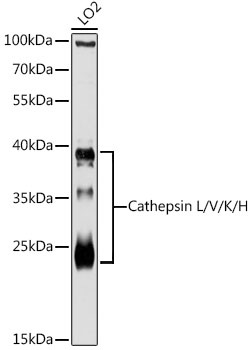
Western blot analysis of lysates from LO2 cells, using Cathepsin L/V/K/H Rabbit pAb (CAB12200) at 1:3000 dilution. Secondary antibody: HRP-conjugated Goat anti-Rabbit IgG (H+L) (CABS014) at 1:10000 dilution. Lysates/proteins: 25μg per lane. Blocking buffer: 3% nonfat dry milk in TBST. Detection: ECL Basic Kit (AbGn00020). Exposure time: 30s.




![Anti-Cathepsin L/V/K/H [R06-6H6] Monoclonal Antibody (AGMB02710)](https://cdn11.bigcommerce.com/s-h68l9z2lnx/images/stencil/590x590/products/273999/680392/anti-cathepsin-lvkh-r06-6h6-monoclonal-antibody-agmb02710__15544.1773041912.jpg?c=2 "Anti-Cathepsin L/V/K/H [R06-6H6] Monoclonal Antibody (AGMB02710)")