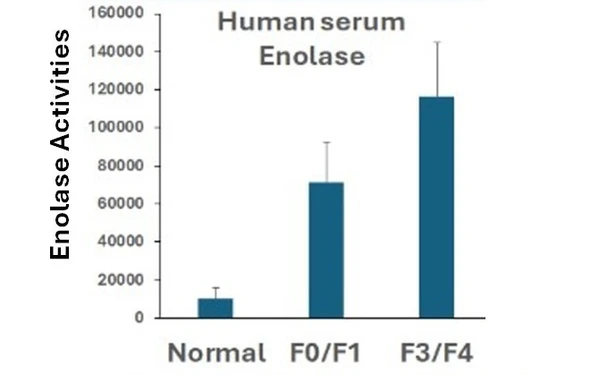
Description
Enolase (ENO) Activity Assay Kit – Luminescent
The Assay Genie Enolase Activity Assay Kit is a fast, luminescent assay for measuring enolase (phosphopyruvate hydratase, EC 4.2.1.11) activity in cell and tissue lysates, diluted serum and cell culture medium. Enolase catalyses the conversion of 2-phosphoglycerate to phosphoenolpyruvate (PEP) in glycolysis and exists as the isoforms ENO1 (α-enolase), ENO2 (γ, neuron-specific enolase) and ENO3 (β, muscle).
PEP produced by enolase is coupled by pyruvate kinase to ATP generation, and ATP is then quantified with a luciferase detection reagent read as relative light units (RLU). With a 1-minute enzymatic step for lysates, the kit is ideal for glycolysis, cancer metabolism and neuroscience research.
| Product Name: | Enolase Assay Kit |
| SKU: | BR00006 |
| Kit Size: | 100 assays |
| Detection Method: | Luminescent (PK-coupled ATP detection, RLU) |
| Sample Types: | Cell and tissue lysates, serum (diluted 3x), cell culture medium; not for plasma |
| Recommended Protein: | 0.05–0.5 mg/ml |
| Reaction Time: | 1 min (lysates) or 5 min (medium and serum) at 37 °C |
| Readout: | ΔRLU, normalised to protein or GAPDH activity |
| Equipment Required: | Luminometer (RLU) |
| Storage: | -80 °C (see component storage) |
| Intended Use: | For research use only (RUO). Not for diagnostic procedures. |
- Ultra-fast enzymatic step: 1 min for lysates
- Pyruvate kinase coupling with luciferase ATP readout
- Low sample input: 0.05–0.5 mg/ml protein
- Works with lysates, diluted serum and cell culture medium
- Pyruvate kinase enzyme and buffer included
- Enolase converts its substrate (2-phosphoglycerate) to phosphoenolpyruvate (PEP).
- Pyruvate kinase (PK) couples PEP to ATP production; the reaction is then stopped with TCA Stop.
- ATP is quantified with the luciferase-based ATP Assay Solution and read as RLU; activity is expressed as ΔRLU (sample − control).
- Cells: ~105 freeze-thawed cells in 50–100 µl ice-cold 1x Cell Lysis Solution, 5 min on ice.
- Tissue: ~2 mg tissue homogenised in 0.5 ml ice-cold 1x Cell Lysis Solution.
- Centrifuge at ~14,000 rpm for 5 min at 4 °C; adjust protein to 0.05–0.5 mg/ml.
- Serum: dilute 3-fold with ice-cold dH2O. Do not use plasma or undiluted serum.
| Component | Size | Storage |
| Enolase Substrate | 0.15 ml | -80 °C |
| ATP Assay Solution | 10 ml | -80 °C, protect from light |
| PK Buffer | 0.5 ml | -80 °C |
| PK Enzyme | 20 µl | 4 °C, do not freeze |
| TCA Stop | 1 ml | 4 °C |
| 10x Cell Lysis Solution | 25 ml | Room temperature |
- Glycolysis and central carbon metabolism
- Cancer metabolism and the Warburg effect (ENO1)
- Neuroscience research (neuron-specific enolase, ENO2)
- Muscle metabolism (ENO3) and drug or inhibitor studies
How does the luminescent enolase assay work?
Enolase produces PEP, which pyruvate kinase converts to ATP. ATP is then measured with luciferase, so light output reflects enolase activity.
What samples are compatible?
Cell and tissue lysates, serum diluted 3-fold and cell culture medium. Plasma and undiluted serum should not be used.
What if my signal is low?
Increase the sample protein concentration or the reaction time, keeping the time identical for all samples.