Description
GenieKine Recombinant Human M-CSF/CSF1 Protein (GKRP0016)
GenieKine Recombinant Human M-CSF/CSF1 Protein is expressed in CHO cells. M-CSF drives the survival, proliferation and differentiation of monocytes into macrophages, and is used to generate human monocyte-derived macrophages. Supplied as a lyophilized powder with purity of >97% by SDS-PAGE and endotoxin below 0.02 EU/µg by LAL assay. Suitable for immune cell culture and stem cell culture. For research use only.
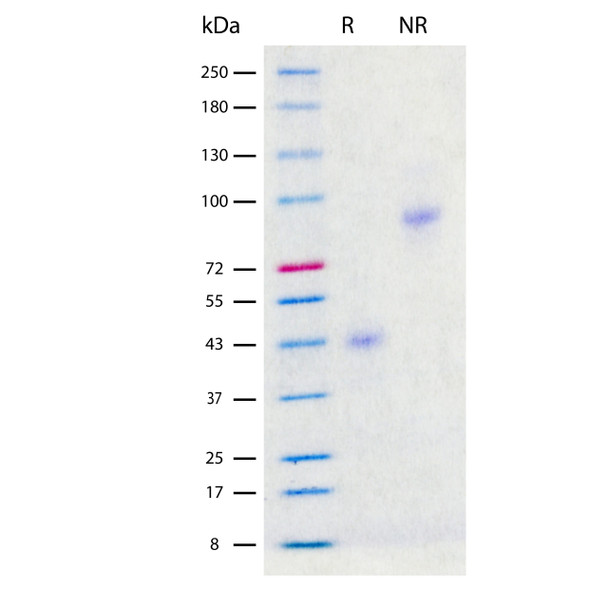
This product (SKU: GKRP0016) is expressed in CHO cells as a disulfide-linked homodimer and is supplied unconjugated. It has a calculated molecular weight of 25.1 kDa (monomer) and an observed molecular weight of 43 kDa (reducing), 86 kDa (non-reducing) on SDS-PAGE. Purity is >97% by SDS-PAGE and endotoxin is <0.02 EU/µg by the LAL method.
Key Features
| High Purity: >97% by SDS-PAGE | |
| Low Endotoxin: <0.02 EU/µg | |
| Bioactivity Validated: ED50 2-5 ng/mL | |
| Expressed in CHO cells |
| Product Name: | GenieKine Recombinant Human M-CSF/CSF1 Protein |
| SKU: | GKRP0016 |
| Size: | 2 µg, 10 µg, 50 µg, 100 µg, 250 µg, 500 µg, 1 mg |
| Reactivity: | Human |
| Synonyms: | Macrophage Colony Stimulating Factor, CSF1, CSF-1, MCSF, MGC31930, Lanimostim, PG-M-CSF, Proteoglycan Macrophage Colony Stimulating Factor |
| Tag: | Unconjugated |
| Calculated MW: | 25.1 kDa (monomer) |
| Observed MW: | 43 kDa (reducing), 86 kDa (non-reducing) |
| Gene ID: | 1435 |
| UniProt: | P09603 |
| Expression System: | CHO cells |
| Sequence: | Glu33-Arg255 |
| Biological Activity: | Determined by a cell proliferation assay using mouse M-NFS-60 cells. The ED50 for this effect is typically 2-5 ng/mL. |
| Endotoxin: | <0.02 EU/µg of protein, as determined by the LAL method. |
| Purity: | >97% by SDS-PAGE and quantitative densitometry by Coomassie Blue staining. |
| Formulation: | Lyophilized from sterile PBS with Trehalose, pH 7.4. |
| Reconstitution: | Reconstitute at 100 µg/mL in sterile PBS. |
| Storage: | 12 months from date of receipt at -20°C to -70°C, lyophilized powder. 3 months at -20°C to -70°C under sterile conditions after reconstitution. Avoid repeated freeze-thaw cycles. |
Macrophage Colony-stimulating Factor (M-CSF), also known as CSF-1, is a cytokine with roles in the growth, differentiation, and survival of monocytes and macrophages. M-CSF promotes the differentiation of monocytes into mature tissue-resident macrophages involved in the phagocytosis of pathogens, clearance of debris, and secretion of growth factors for tissue repair. In addition, M-CSF is involved in regulating bone homeostasis by stimulating osteoclast differentiation and activity. M-CSF is primarily produced by monocytes and macrophages themselves. It acts in an autocrine and paracrine manner to regulate the proliferation, differentiation, and survival of these cells. However, M-CSF is also produced in bone marrow stromal cells, fibroblasts and endothelial cells as a component in the local microenvironmental regulation of the immune cell function. M-CSF is often highly expressed in the tumor microenvironment where it recruits tumor-associated macrophages (TAMs) that suppress the native immune response leading to tumor progression and infiltration. M-CSF binds M-CSF R (CD115), a Receptor Tyrosine Kinase (RTK) family III member.
 | Determined by a cell proliferation assay using mouse M-NFS-60 cells. The ED50 for this effect is typically 2-5 ng/mL. |
 | Recombinant Human M-CSF (2 µg/lane) on SDS-PAGE under reducing (R) and non-reducing (NR) conditions. The gel was stained using Coomassie Blue showing single bands at 43 kDa and 86 kDa, respectively, and purity greater than 97%. |