Description
Glutamine Colorimetric Assay Kit
The Glutamine Colorimetric Assay Kit (MAES0235) quantifies glutamine (Gln) in serum, plasma, tissue homogenates, cell lysates and cell culture supernatants. Gln is converted through a glutaminase and glutamate dehydrogenase coupled reaction to a WST-8 colored product read at 450 nm. The kit is designed for Research Use Only.
Glutamine (Gln) is an amino acid that this kit quantifies as its analyte. In the assay, glutaminase hydrolyzes Gln to glutamic acid, which is the first enzymatic step that links the glutamine pool to downstream metabolism. The kit is indexed to the research areas amino acids and proteins, cuproptosis, and energy metabolism, which reflect the position of Gln within these pathways. Gln is measured under the synonym Gln.
Researchers measure Gln in tissue homogenates and cell lysates from several sources, including rat liver, mouse lung, rat brain, mouse liver, rat spleen, and Epipremnum aureum tissue, as well as in THP-1 and Molt-4 cells. Serum, plasma, and cell culture supernatant are also listed as supported sample types. Measuring Gln across these organs, cell lines, and biofluids allows investigators to compare Gln content in the context of the cuproptosis and energy metabolism research areas that this kit is aligned with.
The method is a colorimetric, two-step enzymatic reaction. Glutamic acid is further converted by glutamic acid dehydrogenase, which reduces NAD+ to NADH. A hydrogen transmitter then transfers electrons from NADH to WST-8, producing a yellow product. The sample (50 µL) is first incubated with enzyme reagent A working solution at 37 °C for 20 minutes in the dark, after which reaction working solution (140 µL) is added. The first absorbance reading (A1) is taken at 450 nm, followed by a 30-minute incubation at 37 °C in the dark and a second reading (A2). The signal is ΔA = A2 − A1, read on a microplate reader with a 440–460 nm filter range.
Serum, plasma, tissue, and cell samples require preparation before testing. Serum and plasma are ultrafiltered through a 50 kDa tube, and tissue and cell samples are homogenized in normal saline at 4 °C, clarified by centrifugation, and then ultrafiltered. Filtrates should be kept on ice until use. Kit components are stored at −20 °C for 12 months and must be protected from light. Working solutions are prepared on the day of use and have defined short use windows, so each reagent should be prepared only as needed for the number of wells in the run.
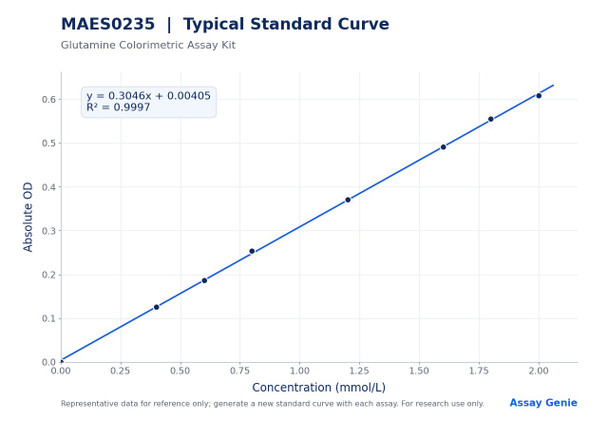
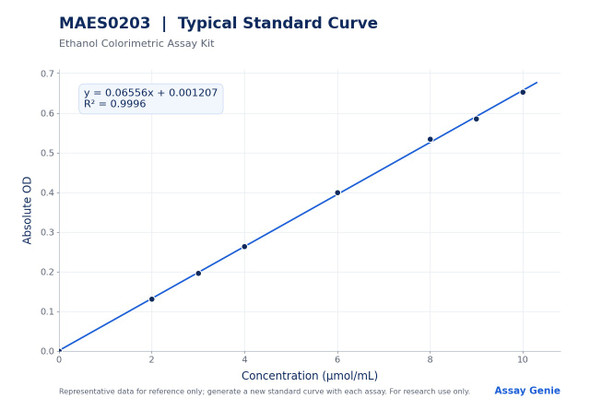
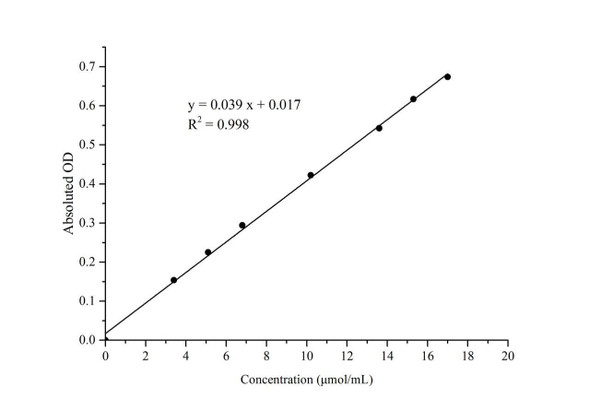
The reported analytical sensitivity is 0.036 mmol/L, determined by adding two standard deviations to the mean OD of the zero standard assayed 20 times. The detection range is 0.036–2.0 mmol/L. Intra-assay CV is 3.2% and inter-assay CV is 4.7%. Average recovery across high, middle, and low standards was 97%, with individual recoveries of 95–99%. The standard curve data in the manual are provided for reference only, and each run should include its own standard curve.
| Product Name: | Glutamine Colorimetric Assay Kit |
| SKU: | MAES0235 |
| Assay Type: | Quantitative |
| Detection Method: | Colorimetric |
| Synonyms: | Gln |
| Sample Types: | Serum, plasma, tissue, cells and cell culture supernatant |
| Sensitivity: | 0.036 mmol/L |
| Detection Range: | 0.036–2.0 mmol/L |
| Wavelength: | 450 nm (440–460 nm range) |
| Intra-assay CV: | 3.2% |
| Inter-assay CV: | 4.7% |
| Sample Volume: | 50 µL |
| Assay Time: | 70 min (1 h 10 min) |
| Detection Method: | Colorimetric |
| Detection Instrument: | Microplate reader, 440–460 nm (optimum 450 nm) |
| Sensitivity: | 0.036 mmol/L |
| Detection Range: | 0.036–2.0 mmol/L |
| Intra-assay CV: | 3.2% |
| Inter-assay CV: | 4.7% |
| Sample Volume: | 50 µL |
| Assay Time: | 1 h 10 min |
| Incubation Temperature: | 37 °C |
- Quantitative colorimetric measurement of glutamine (Gln) with a detection range of 0.036–2.0 mmol/L
- Sensitivity of 0.036 mmol/L, determined from the zero standard
- Read at 450 nm on a microplate reader (440–460 nm)
- Validated sample types: serum, plasma, tissue, cells and cell culture supernatant
- Assay time of approximately 70 min (1 h 10 min) with a 50 µL sample volume
- Intra-assay CV 3.2% and inter-assay CV 4.7%
Gln is hydrolyzed to glutamic acid by glutaminase. Glutamic acid is further converted by glutamic acid dehydrogenase, which reduces NAD+ to NADH. NADH, through a hydrogen transmitter, transfers electrons to WST-8 to produce a yellow product. The Gln content is calculated from the change in absorbance at 450 nm (ΔA450) against a standard curve.
- Quantifying Gln in serum and plasma samples in amino acid metabolism studies
- Measuring Gln in tissue homogenates for energy metabolism research
- Monitoring Gln consumption or accumulation in cell culture supernatants
- Supporting research on cuproptosis and related metabolic pathways
| Component | Quantity | Storage |
| Enzyme Reagent 1 (Reagent A) | Powder (vial) | -20 °C, 12 months, protect from light |
| Enzyme Reagent 2 (Reagent B) | Powder (vial) | -20 °C, 12 months, protect from light |
| Enzyme Diluent (Reagent 3) | Liquid (vial) | -20 °C, 12 months |
| Accelerator (Reagent 4) | Powder (vial) | -20 °C, 12 months, protect from light |
| Substrate (Reagent 5) | Powder (vial) | -20 °C, 12 months, protect from light |
| Chromogenic Agent (Reagent 6) | Liquid (vial) | -20 °C, 12 months, protect from light |
| Standard (Reagent 7) | Powder (vial) | -20 °C, 12 months, protect from light |
| Buffer Solution (Reagent 8) | Liquid (vial) | -20 °C, 12 months |
| Microplate | Plate | No requirement |
- Microplate reader capable of 440–460 nm reading (450 nm optimum)
- Incubator set to 37 °C
- 50 kDa ultrafiltration tube
- Normal saline (0.9% NaCl)
- Phosphate-buffered saline (PBS, 0.01 M, pH 7.4) for tissue and cell washing
- Doubled distilled water
- Centrifuge capable of 10000 × g
- Homogenizer (tissue) or ultrasonic cell disruptor (cells)
- Ice
Serum/plasma
- Centrifuge the sample through a 50 kDa ultrafiltration tube at 10000×g for 15 min.
- Collect the filtrate on ice for detection.
- Dilution factors: human serum 2–3; rat plasma 1; mouse serum 1; mouse plasma 1. Dilute with normal saline (0.9% NaCl) or PBS (0.01 M, pH 7.4). For other sample types, perform a pretest to confirm the dilution factor.
Tissue
- Harvest the amount of tissue needed for each assay (initial recommendation 0.1 g).
- Wash the tissue in cold PBS (0.01 M, pH 7.4).
- Homogenize 0.1 g of tissue in 900 µL normal saline (0.9% NaCl) with a dounce homogenizer at 4 °C.
- Centrifuge at 10000×g for 15 min to remove insoluble material. Take the supernatant and centrifuge it through a 50 kDa ultrafiltration tube at 10000×g for 15 min.
- Collect the filtrate on ice for detection.
- Dilution factors (10% homogenate): rat liver 1; mouse lung 1; rat brain 1; mouse liver 1; rat spleen 3–5; Epipremnum aureum 3–5. Use normal saline (0.9% NaCl) or PBS (0.01 M, pH 7.4) as diluent. For other tissues, perform a pretest to confirm the dilution factor.
Cells (adherent or suspension)
- Harvest the number of cells needed for each assay (initial recommendation 1×10^6 cells).
- Wash cells with PBS (0.01 M, pH 7.4).
- Homogenize 1×10^6 cells in 200 µL normal saline (0.9% NaCl) with an ultrasonic cell disruptor at 4 °C.
- Centrifuge at 10000×g for 15 min to remove insoluble material. Take the supernatant and centrifuge it through a 50 kDa ultrafiltration tube at 10000×g for 15 min.
- Collect the filtrate on ice for detection.
- Dilution factors: THP-1 cells (1×10^6) 1; Molt-4 cells (2×10^6) 1. For other cell types, perform a pretest to confirm the dilution factor.
Sample preparation
- Serum and plasma: centrifuge the sample in a 50 kDa ultrafiltration tube at 10000 × g for 15 min and keep the filtrate on ice.
- Tissue: wash tissue in cold PBS, homogenize 0.1 g tissue in 900 µL 0.9% NaCl at 4 °C, centrifuge at 10000 × g for 15 min, then ultrafilter the supernatant at 10000 × g for 15 min and keep the filtrate on ice.
- Cells: wash 1 × 10⁶ cells with PBS, homogenize in 200 µL 0.9% NaCl by ultrasonic disruption at 4 °C, centrifuge at 10000 × g for 15 min, then ultrafilter the supernatant as for tissue.
- Dilute samples as needed in 0.9% NaCl (for example, human serum 2–3-fold; rat or mouse plasma and serum 1-fold). Pretest other sample types to confirm the dilution factor.
Reagent preparation
- Equilibrate all reagents to room temperature before use.
- Enzyme Reagent A stock: dissolve one vial in 200 µL Buffer Solution. Store at -20 °C for up to 3 days, protected from light.
- Enzyme Reagent A working solution: mix 3 µL stock with 27 µL Buffer Solution per well. Use within 4 h.
- Enzyme Reagent B working solution: dissolve one vial in 200 µL doubled distilled water. Store at -20 °C for up to 3 days, protected from light.
- Accelerator working solution: dissolve one vial in 1 mL doubled distilled water. Store at -20 °C for up to 3 days, protected from light.
- Substrate stock solution: dissolve one vial in 0.5 mL doubled distilled water. Store at -20 °C for up to 3 days, protected from light.
- Substrate working solution: mix 60 µL substrate stock, 1080 µL Enzyme Diluent and 60 µL accelerator working solution per 1200 µL. Use within 12 h.
- Reaction working solution: mix 8 µL Enzyme Reagent B working solution, 1192 µL substrate working solution and 200 µL Chromogenic Agent per 1400 µL. Prepare fresh and use within 1 h.
- Standard stock (100 mmol/L): dissolve one vial in 1 mL 0.9% NaCl. Store at -20 °C for up to 3 days, protected from light.
- 2 mmol/L standard: mix 20 µL 100 mmol/L stock with 980 µL 0.9% NaCl. Prepare on the day of use.
Standard curve
- Prepare a fresh set of standards from the 2 mmol/L standard in 0.9% NaCl at 0, 0.4, 0.6, 0.8, 1.2, 1.6, 1.8 and 2.0 mmol/L (for example, 0, 40, 60, 80, 120, 160, 180 and 200 µL of 2 mmol/L standard, brought to 200 µL with 0.9% NaCl). Discard working dilutions after use.
Assay operation
- Add 30 µL Enzyme Reagent A working solution to each standard and sample well.
- Add 50 µL of each standard to standard wells and 50 µL of sample to sample wells.
- Mix for 3 s on the microplate reader and incubate at 37 °C for 20 min protected from light.
- Add 140 µL reaction working solution to each well.
- Mix for 3 s and read OD450 of each well (A1).
- Incubate at 37 °C for 30 min protected from light.
- Read OD450 of each well (A2). Calculate ΔA = A2 − A1.
- Add Enzyme Reagent A working solution at the bottom of the well and avoid bubbles when adding reaction working solution.
Calculation
- Average duplicate readings. Subtract the mean blank (standard 0 mmol/L) ΔA from all standard readings to obtain absolute OD values.
- Plot absolute OD450 (y) against Gln concentration (x) and fit a linear standard curve, y = ax + b.
- Serum, plasma and cell culture supernatant: Gln (mmol/L) = (ΔA450 − b) ÷ a × f, where f is the dilution factor.
- Tissue: Gln (mmol/kg wet weight) = (ΔA450 − b) ÷ a × f ÷ (m ÷ V), where m is wet tissue weight (g) and V is homogenate volume (mL).
- Cells: Gln (µmol/106 cells) = (ΔA450 − b) ÷ a × f ÷ (n ÷ V), where n is cell number (106) and V is homogenate volume (mL).
Serum/plasma and cell culture supernatant: Gln content (mmol/L) = (ΔA450 − b) ÷ a × f Tissue: Gln content (mmol/kg wet weight) = (ΔA450 − b) ÷ a × f ÷ (m ÷ V) Cells: Gln content (µmol/10^6 cells) = (ΔA450 − b) ÷ a × f ÷ (n ÷ V)
- ΔA450 = ΔA(Sample) − ΔA(Blank), the change in OD value when the standard concentration is 0.
- a and b are the slope and intercept of the standard curve y = ax + b, generated by plotting the absolute OD value of each standard (mean OD minus blank mean) against its concentration in mmol/L.
- f is the dilution factor of the sample before testing.
- m is the weight of wet tissue in g.
- n is the number of cells, in units of 10^6.
- V is the volume of homogenate in mL.
- Units: serum, plasma, and cell culture supernatant results are in mmol/L; tissue results are in mmol/kg wet weight; cell results are in µmol/10^6 cells.
Which sample types can be tested with this kit?
The kit measures Gln in serum, plasma, tissue, cells, and cell culture supernatant. Tissue and cell samples are homogenized in normal saline and ultrafiltered before testing.
How should the kit and working solutions be stored?
Kit components are stored at −20 °C for 12 months and must be protected from light. Working solutions are stored at −20 °C for 3 days protected from light, while enzyme reagent A working solution and substrate working solution have short on-the-day use windows of 4 hours and 12 hours, respectively.
What should I do if my sample is outside the detection range?
The detection range is 0.036–2.0 mmol/L. If the concentration is not within this range, an extra dilution or concentration should be applied to the sample.
What are the key points for a successful assay?
Avoid bubbles when adding reaction working solution, and keep the reaction protected from light. Add enzyme reagent A working solution to the bottom of the well. Use the 50 µL standard or sample volume specified in the protocol.
What instrument settings should be used?
Use a microplate reader with a 440–460 nm filter range, with 450 nm as the optimum wavelength. Measure absorbance at 450 nm before and after the 30-minute incubation at 37 °C, and calculate ΔA as A2 − A1.
How long does the assay take?
The total assay time is 1 h 10 min.
| Storage Temperature: | -20 °C |
| Valid Period: | 12 months |
| Light Protection: | Protect from light (shading light) during storage and assay |
Notes
- For Research Use Only. Not for use in clinical diagnosis or therapeutic procedures.
- Protect reagents and reaction steps from light.
- Do not mix reagents from different kits.
- Centrifuge small volumes of reagent before use to ensure sufficient recovery.
- Avoid bubbles when adding reaction working solution.
- Prepare working solutions on the day of use and observe the stated use windows (Enzyme Reagent A working solution within 4 h, substrate working solution within 12 h, reaction working solution within 1 h).
- If the sample concentration falls outside the 0.036–2.0 mmol/L range, dilute or concentrate the sample and repeat the assay.
- Run a pretest for sample types not listed in the protocol to confirm the dilution factor.