The Glypican 3 (GPC3) Antibody (CAB1946) is a high-quality antibody developed for reliable detection and analysis of target proteins. This antibody, produced in rabbits, exhibits high reactivity towards human samples and has been validated for use in Western blot applications.Glypican-3 is known for its role in promoting cell proliferation and tumor growth, making it a target of interest in cancer research. By specifically binding to Glypican-3, this antibody enables precise detection and analysis of the protein in different cell types, making it suitable for studies in cancer biology and developmental biology.
This antibody is validated for use in WB, FC, ELISA applications and has demonstrated reactivity against Human, Mouse, Rat samples.
Product Name:
Glypican 3 (GPC3) Antibody
SKU:
CAB1946
Size:
20μL, 100μL
Reactivity:
Human, Mouse, Rat
Conjugate:
Unconjugated
Immunogen:
Synthetic peptide. This information is considered to be commercially sensitive.
Sequence:
GNSQ QATP KDNE ISTF HN
Tested Applications:
WBFCELISA
Recommended Dilution:
WB
1:500 - 1:1000
FC
1:50 - 1:200
ELISA
Recommended starting concentration is 1 μg/mL. Please optimize the concentration based on your specific assay requirements.
Cell surface heparan sulfate proteoglycans are composed of a membrane-associated protein core substituted with a variable number of heparan sulfate chains. Members of the glypican-related integral membrane proteoglycan family (GRIPS) contain a core protein anchored to the cytoplasmic membrane via a glycosyl phosphatidylinositol linkage. These proteins may play a role in the control of cell division and growth regulation. The protein encoded by this gene can bind to and inhibit the dipeptidyl peptidase activity of CD26, and it can induce apoptosis in certain cell types. Deletion mutations in this gene are associated with Simpson-Golabi-Behmel syndrome, also known as Simpson dysmorphia syndrome. Alternative splicing results in multiple transcript variants.
Purification Method
Affinity purification
Gene ID
2719
RRID
AB_2763972
Buffer Information
Store at -20℃. Avoid freeze / thaw cycles. Buffer: PBS containing 50% glycerol, preserved with proclin300 or sodium azide, pH 7.3.
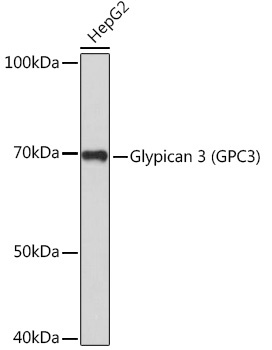
Western blot analysis of lysates from HepG2 cells, using Glypican 3 (Glypican 3 (GPC3)) Rabbit pAb (CAB1946) at 1:1000 dilution. Secondary antibody: HRP-conjugated Goat anti-Rabbit IgG (H+L) (CABS014) at 1:10000 dilution. Lysates/proteins: 25μg per lane. Blocking buffer: 3% nonfat dry milk in TBST. Detection: ECL Basic Kit (AbGn00020). Exposure time: 3min.
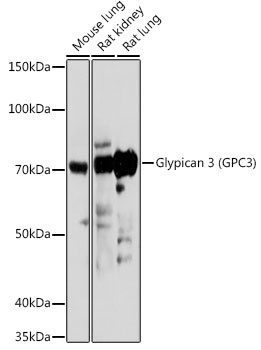
Western blot analysis of various lysates using Glypican 3 (GPC3) Rabbit pAb (CAB1946) at 1:1000 dilution. Secondary antibody: HRP-conjugated Goat anti-Rabbit IgG (H+L) (CABS014) at 1:10000 dilution. Lysates/proteins: 25μg per lane. Blocking buffer: 3% nonfat dry milk in TBST. Detection: ECL Basic Kit (AbGn00020). Exposure time: 180s.