Hamster CXCL10/IP-10 (Interferon Gamma Induced Protein 10kDa) ELISA Kit
The Hamster CXCL10/IP-10 (Interferon Gamma Induced Protein 10kDa) ELISA Kit from AssayGenie is a highly sensitive assay for the quantitative measurement of Hamster CXCL10/IP-10 in serum, plasma, cell culture supernatant, cell or tissue lysate, other liquid samples.
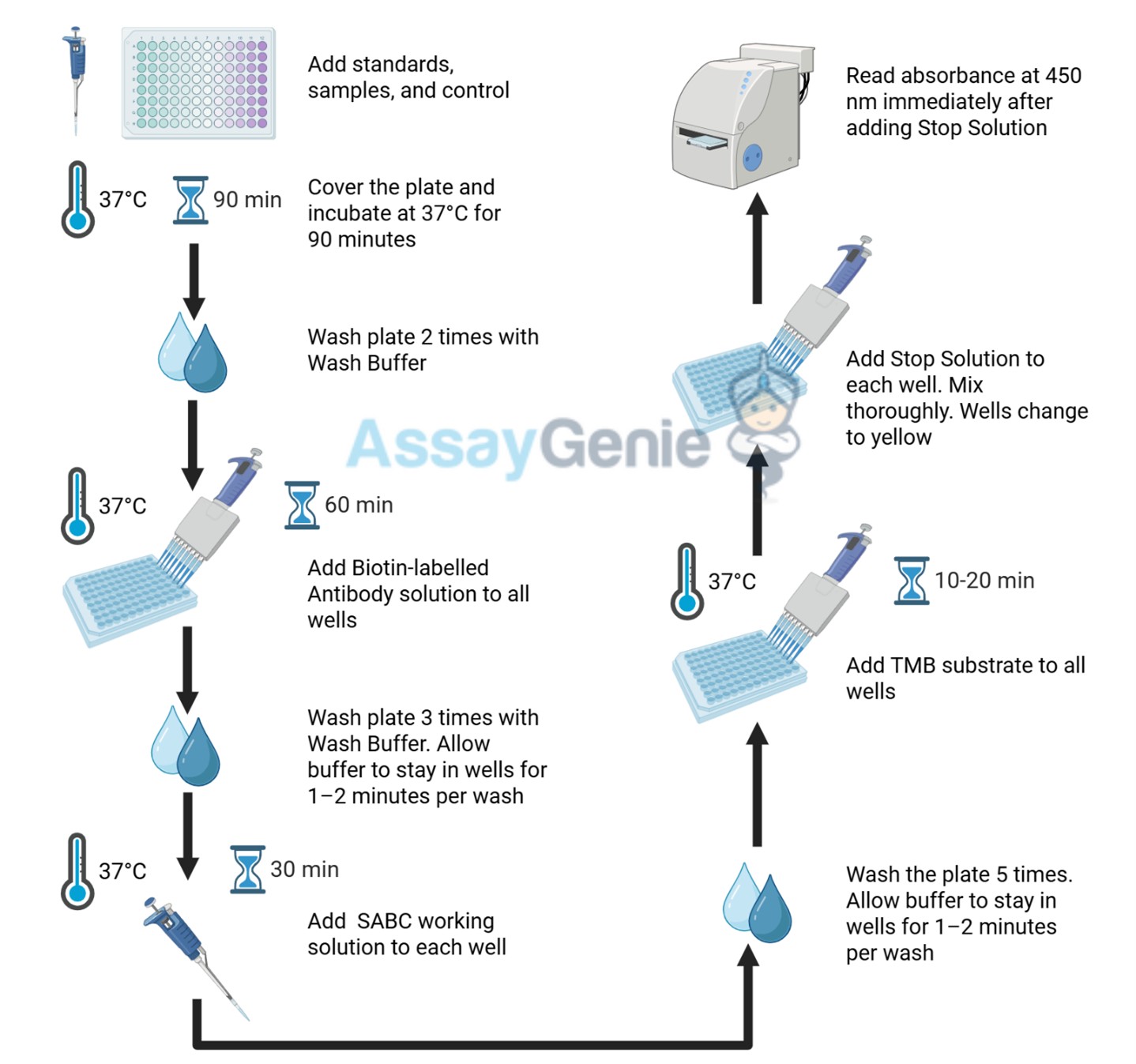
This kit utilises a sandwich enzyme-linked immunosorbent assay (ELISA) format. An antibody specific to the target protein is pre-coated onto the wells of a 96-well microplate. Samples and standards are added to the wells, allowing the target to bind to the immobilized antibody. After incubation, unbound substances are removed through washing. A biotinylated detection antibody is then added, which binds specifically to the captured target. Following a second wash, HRP-conjugated Streptavidin is introduced, forming a biotin-streptavidin-HRP complex. After a third washing step, TMB substrate is added to initiate a colorimetric reaction catalysed by HRP. The reaction produces a blue product that turns yellow upon addition of the acidic Stop Solution.
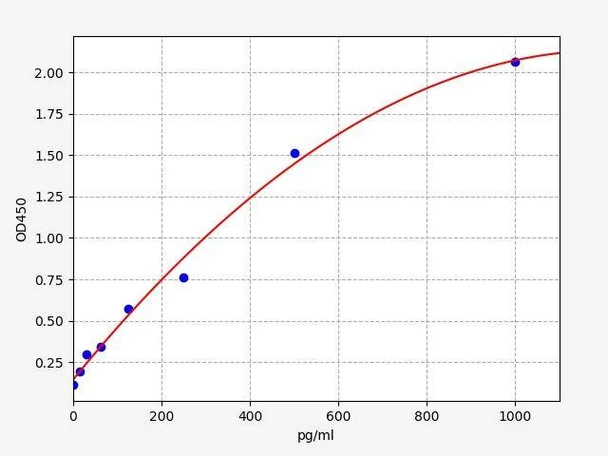
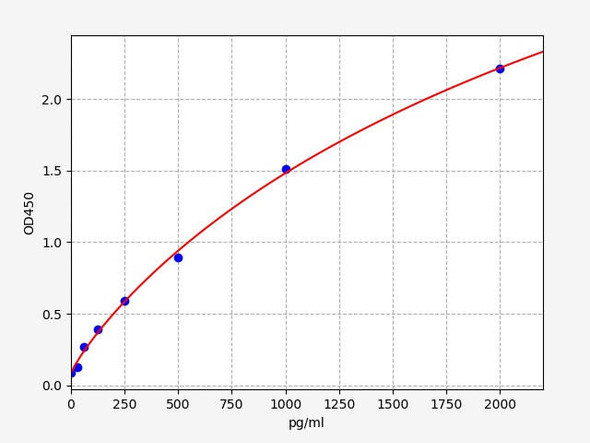
The optical density (OD) is measured at 450 nm using a microplate reader. The OD450 value is directly proportional to the concentration of CXCL10/IP-10 in the sample, which can be determined by referencing a standard curve.
Product Name:
Hamster CXCL10/IP-10 (Interferon Gamma Induced Protein 10kDa) ELISA Kit
SKU:
HMFI0014
Reactivity:
Hamster
Detection Method:
Sandwich ELISA, Double Antibody
Sensitivity:
9.375 pg/mL
Range:
15.625-1000 pg/mL
Sample Type:
Serum, Plasma, Cell Culture Supernatant, Cell or Tissue Lysate, Other Liquid Samples
Storage:
2-8°C for 12 months.
Linearity:
Sample
1:2
1:4
1:8
Serum (n = 5)
94-105%
85-101%
85-105%
EDTA Plasma (n = 5)
89-100%
92-101%
88-101%
Heparin Plasma (n = 5)
82-98%
80-98%
82-88%
Recovery:
Matrix
Recovery Range (%)
Average (%)
Serum (n = 5)
89-101
94
EDTA Plasma (n = 5)
86-103
96
Heparin Plasma (n = 5)
85-103
94
Note:The below protocol is a sample protocol. Protocols are specific to each batch/lot. For the correct instructions please follow the protocol included in your kit.
Step
Procedure
1
Reagent & Plate Preparation: Equilibrate TMB substrate to room temperature for at least 30 minutes. Set standard, test sample and control (zero) wells on the pre-coated plate and record their positions.
2
Standard, Sample & Control Loading: Aliquot 100 µl of standard solutions into the standard wells, 100 µl of properly diluted sample into test sample wells, and 100 µl of Sample Dilution Buffer into the control (blank) well.
3
First Incubation & Wash: Seal the plate and incubate at 37°C for 90 minutes. Aspirate the liquid and wash the plate 2 times with Wash Buffer.
4
Biotin-labelled Antibody & Wash: Add Biotin-labelled Antibody working solution to each well and incubate at 37°C for 60 minutes. Wash the plate 3 times, allowing the buffer to stay in the wells for 1-2 minutes per wash. Add SABC working solution and incubate at 37°C for 30 minutes, then wash 5 times.
5
Color Development: Add 90 µl of TMB substrate into each well and incubate at 37°C in the dark for 10-20 minutes.
6
Stop Reaction & Reading: Add 50 µl of Stop Solution and measure absorbance at 450 nm in a microplate reader immediately.
Sample Type
Protocol
Serum
Allow whole blood to coagulate at room temperature (2 h) or 2-8°C overnight. Centrifuge at 1000 × g for 20 min and collect the supernatant. Store or use immediately.
Plasma
Collect in anticoagulant tubes (EDTA, citrate, or heparin), mix gently, and centrifuge within 30 min at 1000 × g, 2-8°C for 15 min. Store or assay as needed.
Tissue Homogenate
Homogenize tissue in 50 mM Tris + 0.9% NaCl + 0.1% SDS (pH 7.3) with protease inhibitors (e.g. 1 mM PMSF). Avoid NP-40, Triton X-100 and DTT. Disrupt by ultrasonic homogenization or freeze-thaw cycles, centrifuge at 5000 × g for 5 min and collect the supernatant.
Cell Culture Supernatant
Centrifuge at 2500 rpm for 5 minutes at 2-8°C and collect the clarified cell culture supernatant.
Cell Lysate
Lyse cells in lysis buffer with protease inhibitor (e.g. 1 mM PMSF) on ice for 30-60 minutes, or by ultrasonic treatment. Centrifuge at 10,000 rpm for 10 min at 2-8°C and collect the supernatant.
Other Sample Types
For more information about how to process other sample types, (e.g., body fluids, breast milk & more), please contact our Tech Support Team at techsupport@assaygenie.com.
Component
Quantity
Storage
48T
96T
ELISA Microplate (Dismountable)
8×6
8×12
Place the test strips into a sealed foil bag with the desiccant. Store for 1 month at 2-8°C; Store for 12 months at -20°C.
Lyophilized Standard
1 vial
2 vial
Place the standards into a sealed foil bag with the desiccant. Store for 1 month at 2-8°C; Store for 12 months at -20°C.