Description
Human CD371/CLEC12A Recombinant Protein (C-His)
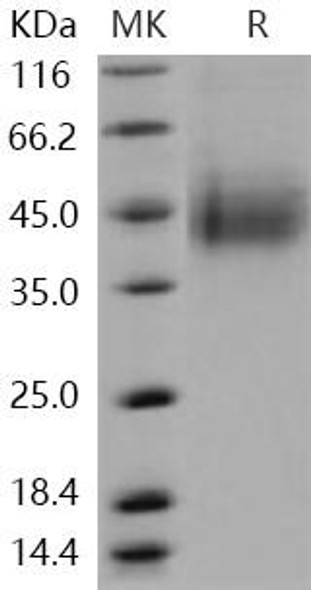
Human CD371/CLEC12A Recombinant Protein (C-His) is a recombinant protein expressed in mammalian cells, spanning His65-Ala265, with a C-terminal His tag. Predicted molecular weight: 26.63 kDa. Purity: >90% as determined by SDS-PAGE. Supplied lyophilized from a solution in PBS pH 7.4, 1 mM EDTA, 4% Trehalose, 1% Mannitol. Applications: ELISA, immunogen, SDS-PAGE and Western blot. C-type lectin domain family 12 member A (CD371/CLEC12A) is a ~30 kDa protein. Myeloid inhibitory C-type lectin receptor that acts as a negative regulator of myeloid cell activation. For research use only.
Myeloid cell inhibition is required to limit proinflammatory pathways and protect against excessive inflammation. Specifically recognizes and binds various structures, such as neutrophil extracellular traps (NETs) or monosodium urate crystals. Also acts as a pattern-recognition receptor for pathogen-associated molecules, such as plasmodium hemozoin or mycobacterial micolic acid. Ligand-binding induces phosphorylation of its ITIM motif, followed by recruitment of tyrosine-protein phosphatases PTPN6 and PTPN11, which counteract tyrosine-protein kinase SYK, thereby preventing myeloid cell activation.
| Product Name: | Human CD371/CLEC12A Recombinant Protein (C-His) |
| SKU: | GXRP03911 |
| Size: | 50 µg, 100 µg, 1 mg |
| Species: | Human |
| Synonyms: | CLEC12A, DCAL2, Dendritic cell-associated lectin 2, CLL-1, Myeloid inhibitory C-type lectin-like receptor, C-type lectin domain family 12 member A, CLL1, DCAL-2, C-type lectin-like molecule 1, MICL, CD371 |
| Tag: | C-His |
| Expression Host: | Mammalian cells |
| Protein Length: | His65-Ala265 |
| Calculated MW: | 26.63 kDa |
| UniProt: | Q5QGZ9 |
| Applications: | ELISA, Immunogen, SDS-PAGE, WB |
| Purity: | >90% as determined by SDS-PAGE. |
| Form: | Lyophilized |
| Formulation: | Lyophilized from a solution in PBS pH 7.4, 1 mM EDTA, 4% Trehalose, 1% Mannitol. |
| Reconstitution: | Reconstitute in sterile water for a stock solution. Adjust the volume of sterile water so that, after reconstitution, the final stock concentration matches the value indicated on the product label or datasheet. |
| Storage: | Store at 2 to 8°C for frequent use. Store at -20 to -80°C for twelve months from the date of receipt. |
| Shipping: | In general, proteins are provided as lyophilized powder/frozen liquid. They are shipped out with dry ice/blue ice unless customers require otherwise. |
| Note: | For research use only. |