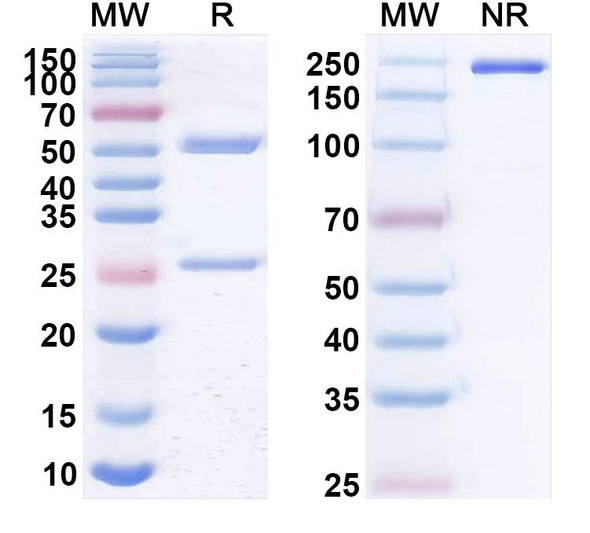
Human EPHA4 Antibody (MEDI-542) is a research-grade biosimilar monoclonal antibody targeting Tyrosine-protein kinase receptor SEK. It is a mouse IgG2a, kappa antibody. Reactivity: Human. Supplied as a liquid in 0.01M PBS pH 7.4. Applications: ELISA, flow cytometry, functional assays and in vivo research. Endotoxin: < 10 EU/mg. Purity: >95% purity as determined by SDS-PAGE. For research use only.
Ephrin type-A receptor 4 (EPHA4) is a ~109 kDa protein. Receptor tyrosine kinase which binds membrane-bound ephrin family ligands residing on adjacent cells, leading to contact-dependent bidirectional signaling into neighboring cells. The signaling pathway downstream of the receptor is referred to as forward signaling while the signaling pathway downstream of the ephrin ligand is referred to as reverse signaling. Highly promiscuous, it has the unique property among Eph receptors to bind and to be physiologically activated by both GPI-anchored ephrin-A and transmembrane ephrin-B ligands including EFNA1 and EFNB3. Upon activation by ephrin ligands, modulates cell morphology and integrin-dependent cell adhesion through regulation of the Rac, Rap and Rho GTPases activity. Plays an important role in the development of the nervous system controlling different steps of axonal guidance including the establishment of the corticospinal projections.
Product Name:
Human EPHA4 Antibody (MEDI-542)
SKU:
GXBS02267
Size:
100 µg, 1 mg
Antibody Type:
Monoclonal Antibody
Clone:
MEDI-542
Target:
Tyrosine-protein kinase receptor SEK
Isotype:
IgG2a, kappa
Host Species:
Mouse
Reactivity:
Human
Applications:
ELISA, FACS, Functional assay, Research in vivo
Expression Host:
Mammalian cells
Synonyms:
MEDI-542, MEDI542, MEDI542
Purity:
>95% purity as determined by SDS-PAGE.
Endotoxin Level:
< 10 EU/mg
Formulation:
0.01M PBS pH 7.4
State of Matter:
Liquid
Regulatory Status:
For research use only. Not suitable for clinical or therapeutic use.
Product Preparation:
Protein A/G purified from cell culture supernatant.
Storage and Handling:
Store at 2 to 8°C for frequent use. Store at -20 to -80°C for twelve months from the date of receipt.