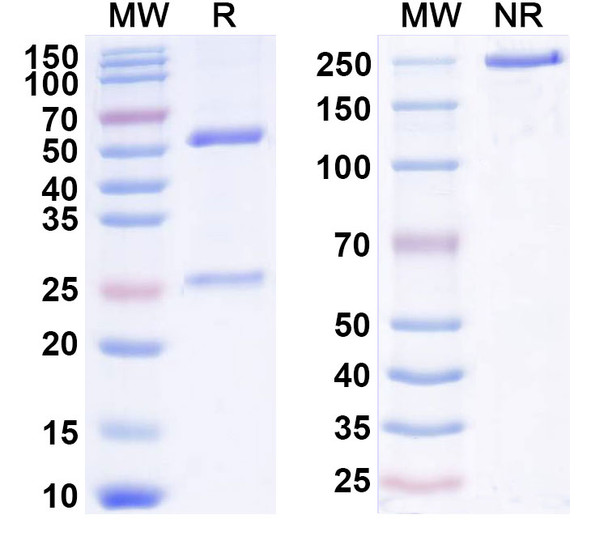
Human IL2 (MT204) Antibody is a research-grade biosimilar monoclonal antibody. It is a human IgG antibody. Reactivity: Human. Supplied as a liquid in 0.01M PBS pH 7.4. Applications: ELISA, flow cytometry, functional assays and in vivo research. Endotoxin: < 10 EU/mg. Purity: >95% purity as determined by SDS-PAGE. For research use only.
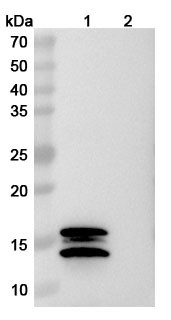
Interleukin-2 (IL2) is a ~17 kDa protein. Cytokine produced by activated CD4-positive helper T-cells and to a lesser extend activated CD8-positive T-cells and natural killer (NK) cells that plays pivotal roles in the immune response and tolerance. Binds to a receptor complex composed of either the high-affinity trimeric IL-2R (IL2RA/CD25, IL2RB/CD122 and IL2RG/CD132) or the low-affinity dimeric IL-2R (IL2RB and IL2RG). Interaction with the receptor leads to oligomerization and conformation changes in the IL-2R subunits resulting in downstream signaling starting with phosphorylation of JAK1 and JAK3. In turn, JAK1 and JAK3 phosphorylate the receptor to form a docking site leading to the phosphorylation of several substrates including STAT5. This process leads to activation of several pathways including STAT, phosphoinositide-3-kinase/PI3K and mitogen-activated protein kinase/MAPK pathways.
Product Name:
Human IL2 (MT204) Antibody
SKU:
GXBS01631
Size:
100 µg, 1 mg
Antibody Type:
Monoclonal Antibody
Clone:
MT204
Target:
IL2
Isotype:
IgG
Host Species:
Human
Reactivity:
Human
Applications:
ELISA, FACS, Functional assay, Research in vivo
Expression Host:
Mammalian cells
Synonyms:
MT204
Biological Activity:
MT204 (1-100 ug/mL, 4 days) dose-dependently inhibits proliferation and IFN-γ secretion in rhesus PBMCs stimulated by the mitogen concavalin A [1]. MT204 can block CD25-bound IL-2 on high-affinity IL-2 receptors with a k d of 0.58 nM [1] [2]. MT204 (5 h) dose dependently reduces the IL-2 inducible cell surface expression of the alpha subunit of IL-4 receptor (CD124) in CTLL-2 cells [2]. MT204 (5 days) inhibits IL-2-induced proliferation of NKL cells and T cells with IC 50 s of approximately 1.3 nM and 0.21 nM, respectively [2]. MT204 (15 min) potently antagonizes downstream signaling of IL-2 at sub-nanomolar concentrations, significantly reducing cellular pY-STAT3 levels stimulated by IL-2 in Primary human lymphocytes [2]. MT204 significantly inhibits IL-2 induced proliferation independently of CD25 expression levels in NKL cells, T cells and all NK cells with IC 50 s of 0.35-0.36 nM, 0.33 nM, and 0.1-0.13 nM, respectively [2]. Parmacokinetics Species Dose Route Note Plasma Concentration T 1/2 Rhesus monkey 2, 10, 50 or repeat 50 mg/kg i.v. 1 h infusion 1 mg/mL 326.4 h MT204 (50 mg/kg, i.v., day 0, day 5 and day 12 at a speed of 1.5 mL/kg/h over 1 h) significant delays in rejection of allogeneic skin graft in allogeneic skin graft model of rhesus monkey [1].
Purity:
>95% purity as determined by SDS-PAGE.
Endotoxin Level:
< 10 EU/mg
Formulation:
0.01M PBS pH 7.4
State of Matter:
Liquid
Regulatory Status:
For research use only. Not suitable for clinical or therapeutic use.
Product Preparation:
Protein A/G purified from cell culture supernatant.
Storage and Handling:
Store at 2 to 8°C for frequent use. Store at -20 to -80°C for twelve months from the date of receipt.