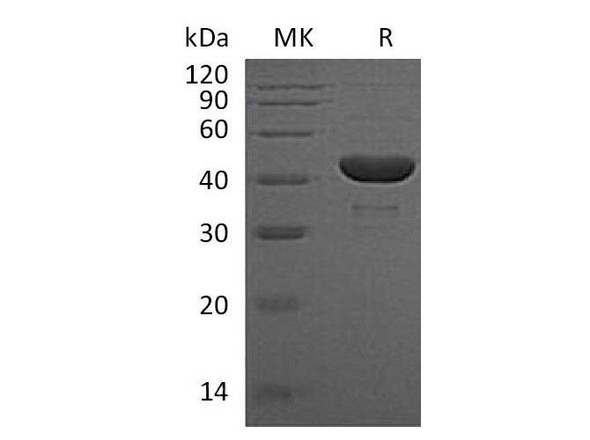
Description
Human PGK1 Recombinant Protein (N-His)
Human PGK1 Recombinant Protein (N-His) is a recombinant protein expressed in E. coli, spanning Ser2-Ile417, with an N-terminal His tag. Predicted molecular weight: 46.78 kDa. Purity: >90% as determined by SDS-PAGE. Supplied lyophilized from a solution in PBS pH 7.4, 1 mM EDTA, 4% Trehalose, 1% Mannitol. Applications: ELISA, immunogen, SDS-PAGE and Western blot. Phosphoglycerate kinase 1 (PGK1) is a ~44 kDa protein. Catalyzes one of the two ATP producing reactions in the glycolytic pathway via the reversible conversion of 1,3-diphosphoglycerate to 3-phosphoglycerate. For research use only.
Both L- and D- forms of purine and pyrimidine nucleotides can be used as substrates, but the activity is much lower on pyrimidines. In addition to its role as a glycolytic enzyme, it seems that PGK1 acts as a polymerase alpha cofactor protein (primer recognition protein). Acts as a protein kinase when localized to the mitochondrion where it phosphorylates pyruvate dehydrogenase kinase PDK1 to inhibit pyruvate dehydrogenase complex activity and suppress the formation of acetyl-coenzyme A from pyruvate, and consequently inhibit oxidative phosphorylation and promote glycolysis. May play a role in sperm motility.
| Product Name: | Human PGK1 Recombinant Protein (N-His) |
| SKU: | GXRP00361 |
| Size: | 50 µg, 100 µg, 1 mg |
| Species: | Human |
| Synonyms: | PRP 2, Primer recognition protein 2, PGKA, PGK1, Phosphoglycerate kinase 1, Cell migration-inducing gene 10 protein |
| Tag: | N-His |
| Expression Host: | E. coli |
| Protein Length: | Ser2-Ile417 |
| Calculated MW: | 46.78 kDa |
| UniProt: | P00558 |
| Applications: | ELISA, Immunogen, SDS-PAGE, WB |
| Purity: | >90% as determined by SDS-PAGE. |
| Form: | Lyophilized |
| Formulation: | Lyophilized from a solution in PBS pH 7.4, 1 mM EDTA, 4% Trehalose, 1% Mannitol. |
| Reconstitution: | Reconstitute in sterile water for a stock solution. Adjust the volume of sterile water so that, after reconstitution, the final stock concentration matches the value indicated on the product label or datasheet. |
| Storage: | Store at 2 to 8°C for frequent use. Store at -20 to -80°C for twelve months from the date of receipt. |
| Shipping: | In general, proteins are provided as lyophilized powder/frozen liquid. They are shipped out with dry ice/blue ice unless customers require otherwise. |
| Note: | For research use only. |