Description
Human PRKG1 Recombinant Protein (N-His)
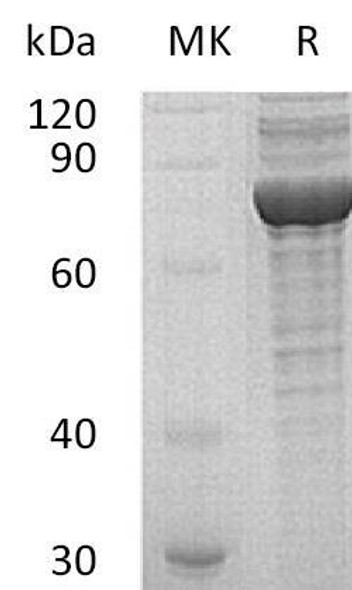
Human PRKG1 Recombinant Protein (N-His) is a recombinant protein expressed in E. coli, spanning Tyr336-Thr631, with an N-terminal His tag. Predicted molecular weight: 36.25 kDa. Purity: >90% as determined by SDS-PAGE. Supplied lyophilized from a solution in PBS pH 7.4, 0.02% NLS, 1 mM EDTA, 4% Trehalose, 1% Mannitol. Applications: ELISA, immunogen, SDS-PAGE and Western blot. cGMP-dependent protein kinase 1 (PRKG1) is a ~76 kDa protein. Serine/threonine protein kinase that acts as a key mediator of the nitric oxide (NO)/cGMP signaling pathway. For research use only.
GMP binding activates PRKG1, which phosphorylates serines and threonines on many cellular proteins. Numerous protein targets for PRKG1 phosphorylation are implicated in modulating cellular calcium, but the contribution of each of these targets may vary substantially among cell types. Proteins that are phosphorylated by PRKG1 regulate platelet activation and adhesion, smooth muscle contraction, cardiac function, gene expression, feedback of the NO-signaling pathway, and other processes involved in several aspects of the CNS like axon guidance, hippocampal and cerebellar learning, circadian rhythm and nociception. Smooth muscle relaxation is mediated through lowering of intracellular free calcium, by desensitization of contractile proteins to calcium, and by decrease in the contractile state of smooth muscle or in platelet activation.
| Product Name: | Human PRKG1 Recombinant Protein (N-His) |
| SKU: | GXRP04436 |
| Size: | 50 µg, 100 µg, 1 mg |
| Species: | Human |
| Synonyms: | cGKI, cGMP-dependent protein kinase 1, PRKG1B, PRKGR1B, cGK 1, PRKGR1A, PRKG1, cGK1, cGMP-dependent protein kinase I |
| Tag: | N-His |
| Expression Host: | E. coli |
| Protein Length: | Tyr336-Thr631 |
| Calculated MW: | 36.25 kDa |
| UniProt: | Q13976 |
| Applications: | ELISA, Immunogen, SDS-PAGE, WB |
| Purity: | >90% as determined by SDS-PAGE. |
| Form: | Lyophilized |
| Formulation: | Lyophilized from a solution in PBS pH 7.4, 0.02% NLS, 1 mM EDTA, 4% Trehalose, 1% Mannitol. |
| Reconstitution: | Reconstitute in sterile water for a stock solution. Adjust the volume of sterile water so that, after reconstitution, the final stock concentration matches the value indicated on the product label or datasheet. |
| Storage: | Store at 2 to 8°C for frequent use. Store at -20 to -80°C for twelve months from the date of receipt. |
| Shipping: | In general, proteins are provided as lyophilized powder/frozen liquid. They are shipped out with dry ice/blue ice unless customers require otherwise. |
| Note: | For research use only. |