Description
Hydroxyl Free Radical Scavenging Capacity Assay Kit
The Hydroxyl Free Radical Scavenging Capacity Assay Kit (MAES0187) measures the ability of a sample to scavenge hydroxyl radicals generated by a Fenton reaction. The colorimetric readout at 510 nm is based on the reduction of salicylic acid-derived colored product. Researchers use the kit to assess the antioxidant capacity of serum, plasma, and tissue samples in oxidative stress studies.
Hydroxyl free radical is a highly reactive reactive oxygen species. In this kit, it is generated in situ through the Fenton reaction, in which hydrogen peroxide (H2O2) reacts with ferrous iron (Fe2+). Because the hydroxyl radical reacts rapidly with nearby molecules, a sample's ability to neutralize it reflects the scavenging capacity of its endogenous components. The kit expresses this capacity as a percentage relative to a control reaction that contains no sample.
The kit is intended for oxidative stress research, which concerns the balance between reactive oxygen species and antioxidant capacity. Researchers use hydroxyl radical scavenging capacity to compare serum, plasma, and tissue samples across species, including human, dog, rat, cynomolgus monkey, and mouse. Tissue homogenates from spleen, liver, kidney, and lung are among the sample types the manual lists. The kit is for research use only and is not to be used for clinical diagnosis.
The detection chemistry relies on salicylic acid, which captures the hydroxyl radical generated by the Fenton reaction and forms the colored product 2,3-dihydroxybenzoic acid. This product has a characteristic absorption peak at 510 nm. Antioxidants in the sample reduce the colored product, so a lower absorbance indicates higher scavenging capacity. Reactions are assembled from substrate A, substrate B, and substrate C working solutions in control, blank, and sample tubes, then incubated at 37°C for 20 minutes before reading.
Serum and plasma are tested directly without dilution at the recommended factor of 1. Tissue samples are homogenized at a ratio of 20 mg tissue to 180 µL double distilled water, yielding a 10% homogenate, using a dounce homogenizer kept at 4°C. Homogenates are centrifuged at 10000×g for 10 minutes, and the supernatant is kept on ice until use. Turbid samples must be clarified before reading, and samples that are not listed require a pretest to confirm the dilution factor.
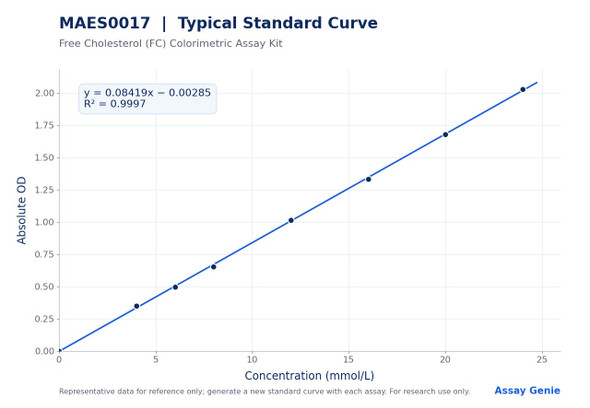
Performance data reported for the kit include an inter-assay coefficient of variation of 4.6% and an intra-assay coefficient of variation of 4.1%. The manual describes a standard curve generated from serial dilutions of human serum in double distilled water, but the curve values are provided for reference only. As a worked example, 20 µL of human serum with a control OD of 0.803, a blank OD of 0.038, and a sample OD of 0.557 yields a scavenging capacity of 32%.
| Product Name: | Hydroxyl Free Radical Scavenging Capacity Assay Kit |
| SKU: | MAES0187 |
| Size: | 96 Assays |
| Sample Types: | Serum, plasma, tissue |
| Detection Method: | Colorimetric |
| Wavelength: | 510 nm (reader range 500-530 nm) |
| Sample Volume: | 20 µL |
| Assay Time: | 40 min |
| Instrument: | Microplate reader |
| Research Area: | Oxidative stress |
| Intra-assay CV: | 4.1% |
| Inter-assay CV: | 4.6% |
| Detection Method: | Colorimetric |
| Absorbance Wavelength: | 510 nm |
| Reader Range: | 500-530 nm |
| Sample Volume: | 20 µL |
| Assay Time: | 40 min |
- Colorimetric endpoint read at 510 nm (microplate reader, 500-530 nm range)
- Fenton-reaction hydroxyl radical generation with salicylic acid capture
- Validated for serum, plasma, and tissue homogenate samples
- Sample volume of 20 µL per reaction
- Assay time of 40 min
- Intra-assay CV 4.1% and inter-assay CV 4.6%
H2O2/Fe2+ generates hydroxyl free radicals through the Fenton reaction. Salicylic acid captures the generated hydroxyl radicals and reacts with them to form the colored product 2,3-dihydroxybenzoic acid, which has a characteristic absorption peak at 510 nm. Substances with hydroxyl radical scavenging ability reduce the amount of colored product formed. The scavenging capacity of the sample is calculated from the absorbance values.
- Measuring hydroxyl radical scavenging capacity of serum and plasma samples in oxidative stress research
- Assessing antioxidant capacity of tissue homogenates from animal models
- Screening antioxidant activity of candidate compounds in drug research
- Evaluating antioxidant properties of health care product formulations
| Component | Quantity | Storage |
| Substrate A (powder) | 2 vials | 2-8 °C, 12 months, protect from light |
| Substrate B (powder) | 2 vials | 2-8 °C, 12 months, protect from light |
| Substrate C (solution) | 24 mL × 1 vial | 2-8 °C, 12 months, protect from light |
| Microplate | 96 wells × 1 | No requirement |
| Plate sealer | 2 pieces | — |
| Sample layout sheet | 1 piece | — |
- Micropipettor
- Vortex mixer
- Centrifuge (capable of 10000×g)
- Microplate reader (500-530 nm)
- Double-distilled water
- Absolute ethanol (for substrate A working solution)
- 1.5 mL EP tubes
- Dounce homogenizer and ice (tissue samples)
Serum/plasma
- Use serum or plasma directly for detection without additional processing.
- If samples are not tested on the same day, store serum or plasma at -80°C for up to one month.
- Recommended dilution factor is 1 (no dilution) for human serum, dog serum, rat serum, and cynomolgus monkey serum.
- The diluent specified in the manual is double distilled water.
- For other sample types, perform a pretest to confirm the dilution factor.
- If a sample is turbid, centrifuge at room temperature at 10000×g for 5 minutes and use the supernatant for measurement.
Tissue
- Harvest the amount of tissue needed for each assay; the initial recommendation is 20 mg.
- Homogenize 20 mg tissue in 180 µL double distilled water with a dounce homogenizer at 4°C.
- Centrifuge the homogenate at 10000×g for 10 minutes to remove insoluble material.
- Collect the supernatant and keep it on ice until detection.
- Recommended dilution factor is 1 for 10% rat spleen, 10% mouse liver, 10% rat kidney, and 10% rat lung tissue homogenates.
- For other tissue types, perform a pretest to confirm the dilution factor.
Reagent preparation
- Equilibrate all reagents to room temperature before use.
- Dissolve one vial of substrate A with 10 mL absolute ethanol and mix well. Store at 2-8 °C for 1 month, protected from light.
- Dissolve one vial of substrate B with 8 mL double-distilled water. Store at 2-8 °C for 1 month, protected from light.
- Centrifuge small-volume reagents briefly before use.
Sample preparation
- Serum and plasma: assay directly. If not assayed the same day, store at -80 °C for up to 1 month.
- Tissue: homogenize 20 mg tissue in 180 µL double-distilled water with a Dounce homogenizer at 4 °C.
- Centrifuge the homogenate at 10000×g for 10 min. Collect the supernatant and keep it on ice.
- Dilution factor is 1 for the listed serum and tissue types. For other sample types, run a pretest to confirm the dilution factor.
Assay
- Label control, sample, and blank tubes. Add 100 µL substrate A working solution to each tube.
- Control tube: add 100 µL substrate B working solution and 500 µL double-distilled water.
- Sample tube: add 100 µL substrate B working solution and 480 µL double-distilled water.
- Blank tube: add 600 µL double-distilled water.
- Add 200 µL substrate C to each tube.
- Add 20 µL sample to the sample tube.
- Mix thoroughly and incubate at 37 °C for 20 min.
- Transfer 200 µL of each reaction solution to the corresponding wells. Read absorbance at 510 nm. Avoid bubbles in the wells.
Calculation
- Hydroxyl free radical scavenging capacity (%) = (A1 − A3) ÷ (A1 − A2) × 100, where A1 is the control OD, A2 is the blank OD, and A3 is the sample OD.
- If the scavenging capacity falls outside 10-50%, adjust the sample input or dilution so that it falls within this range.
Hydroxyl free radical scavenging capacity (%) = (A1 − A3) ÷ (A1 − A2) × 100%
- A1 is the OD value of the control tube, measured at 510 nm.
- A2 is the OD value of the blank tube, measured at 510 nm.
- A3 is the OD value of the sample tube, measured at 510 nm.
- The result is a percentage. Keep results between 10% and 50%; if the capacity is below 10% or above 50%, increase the sample volume added to the reaction or dilute the sample.
- To compare different samples, decrease the volume of double distilled water in the reaction while increasing the sample volume so that the final sample tube volume stays constant.
- The manual's formula contains no separate dilution-factor term.
Which sample types can be tested with this kit?
The kit is validated for serum, plasma, and tissue samples. The manual lists tissue homogenates at 10% for rat spleen, mouse liver, rat kidney, and rat lung, and recommends a pretest for sample types not listed.
How should the reagents and samples be stored?
Kit reagents should be stored at 2-8°C for 12 months, protected from light. Substrate A and substrate B working solutions are stable at 2-8°C for 1 month, protected from light. Serum or plasma not tested on the same day can be stored at -80°C for up to one month.
What should I do if the scavenging capacity is out of range?
Results should fall between 10% and 50% scavenging capacity. If the value is below 10% or above 50%, increase the sample volume added to the reaction or dilute the sample and repeat the measurement.
What key points help avoid assay errors?
Make sure no bubbles are present in the wells before reading the OD value. Balance the pipette tip with the reagent before aspirating, and centrifuge reagents with small volumes before use. Reagents from different kits must not be mixed, and turbid sample tubes should be centrifuged before measurement.
What instrument settings are required?
Read absorbance with a microplate reader in the 500-530 nm range, measuring OD at 510 nm.
How long does the assay take?
The product page lists an assay time of 40 minutes. The protocol's incubation step is 20 minutes at 37°C, followed by plate reading.
| Storage: | 2-8 °C, protect from light |
| Shelf Life: | 12 months |
| Shipping: | Gel pack |
| Substrate A Working Solution: | 2-8 °C for 1 month, protect from light |
| Substrate B Working Solution: | 2-8 °C for 1 month, protect from light |
| Serum/Plasma (unassayed): | -80 °C for up to 1 month |
Notes
- For Research Use Only. Not for clinical diagnosis or other diagnostic or therapeutic use.
- Avoid bubbles in the wells when reading absorbance.
- Pipette-tip balancing: pipette the reagent up and down three times before aspirating.
- If a sample tube is turbid, centrifuge at room temperature at 10000×g for 5 min and use the supernatant.
- If the sample is outside the detection range, perform an additional dilution or concentration.
- Wear a lab coat and gloves during handling.
- Do not mix reagents from different kit lots.