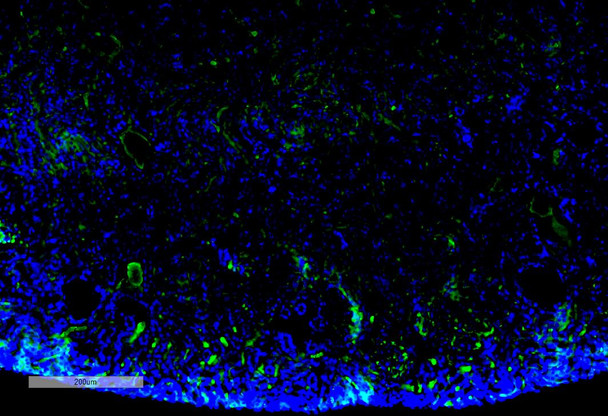
Immunohistochemistry analysis using Mouse Anti-Malondialdehyde Monoclonal Antibody, Clone 11E3 (STMA00185). Tissue: Kidney. Species: Mouse. Primary Antibody: Mouse Anti-Malondialdehyde Monoclonal Antibody (STMA00185) at 1:100 for Overnight at 4C, then 30 min at 37C. Secondary Antibody: Goat Anti-Mouse IgG (H+L): FITC for 45 min at 37C. Counterstain: DAPI for 3 min at RT. Magnification: 10X.
Malondialdehyde Antibody [11E3] is a mouse monoclonal antibody directed against Malondialdehyde, offered by Assay Genie for research applications. Reported applications include WB, ICC/IF, ELISA and IHC. Reactivity is species independent. Supplied as IgG1, purified by Protein G.
Malondialdehyde (MDA) is a highly reactive, low-molecular-weight aldehyde and one of the most widely used biomarkers of oxidative stress due to its chemical stability and ease of detection. Formed as a byproduct of lipid peroxidation, MDA reflects oxidative damage to polyunsaturated fatty acids in cellular membranes—a process central to the pathology of neurodegenerative diseases. MDA exhibits a strong affinity for amino groups, forming adducts with free amino acids, proteins, and nucleic acids. These adducts can disrupt protein function and induce DNA cross-linking, contributing to mutagenesis and cellular dysfunction. Elevated MDA levels have been consistently observed in Alzheimer’s disease and other neurodegenerative conditions, as well as in systemic diseases such as diabetes and cancer. In neuroscience research, MDA serves not only as a diagnostic and prognostic marker but also as a mechanistic link between oxidative stress and neuronal injury. Its quantification—commonly performed using the thiobarbituric acid reactive substances (TBARS) assay—provides valuable insights into the redox state of the brain and the efficacy of antioxidant therapies. Given its dual role as both a biomarker and a mediator of oxidative damage, MDA is a critical target in neurodegenerative disease research. Understanding and mitigating MDA-associated toxicity may offer new avenues for therapeutic intervention in oxidative stress-driven neurological disorders. This antibody is also available conjugated to ATTO 390, ATTO 488, ATTO 594, APC, Biotin, FITC, HRP, PerCP and RPE. Supplied in 100 µg. For research use only; not for diagnostic or therapeutic procedures.
Store at -20°C. Shipped on Blue Ice or 4°C. Conjugated variants should be stored according to the product label.
Format:
Liquid
Applications:
WB, ICC/IF, ELISA, IHC
Antibody Isotype:
IgG1
Purification:
Protein G Purified
Concentration:
1 mg/ml
Reactivity:
Species Independent
Recommended Dilution:
WB (1:1000); ICC/IF (1:50); ELISA (1:1000); IHC (1:100); optimal dilutions for assays should be determined by the user.
Specificity:
Specific for Malondialdehyde conjugated proteins. Does not detect free Malondialdehyde. Does not cross-react with Acrolein, Crotonaldehyde, Hexanoyl Lysine, 4-Hydroxy-2-hexenal, 4-Hydroxy nonenal, or Methylglyoxal modified proteins.