Description
Mouse CLEC6A Recombinant Protein (N-His)
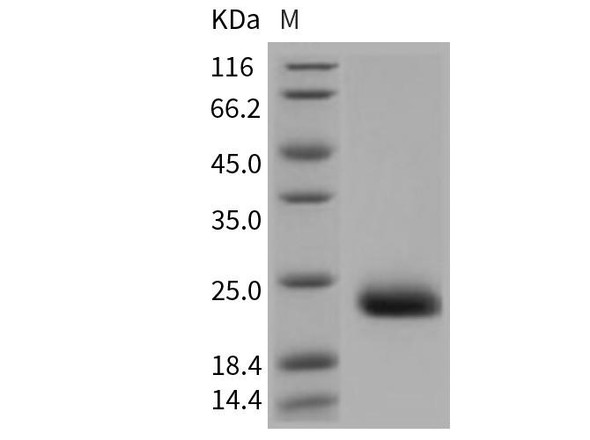
Mouse CLEC6A Recombinant Protein (N-His) is a recombinant protein expressed in E. coli, spanning Ile44-Leu209, with an N-terminal His tag. Predicted molecular weight: 21.78 kDa. Purity: >90% as determined by SDS-PAGE. Supplied lyophilized from a solution in PBS pH 7.4, 0.02% NLS, 1 mM EDTA, 4% Trehalose, 1% Mannitol. Applications: ELISA, immunogen, SDS-PAGE and Western blot. C-type lectin domain family 6 member A (CLEC6A) is a ~24 kDa protein. Calcium-dependent lectin that acts as a pattern recognition receptor (PRR) of the innate immune system: specifically recognizes and binds alpha-mannans on C.albicans hypheas. For research use only.
Binding of C.albicans alpha-mannans to this receptor complex leads to phosphorylation of the immunoreceptor tyrosine-based activation motif (ITAM) of FCER1G, triggering activation of SYK, CARD9 and NF-kappa-B, consequently driving maturation of antigen-presenting cells and shaping antigen-specific priming of T-cells toward effector T-helper 1 and T-helper 17 cell subtypes. Also recognizes, in a mannose-dependent manner, allergens from house dust mite and fungi, by promoting cysteinyl leukotriene production. Recognizes soluble elements from the eggs of Shistosoma mansoni altering adaptive immune responses.
| Product Name: | Mouse CLEC6A Recombinant Protein (N-His) |
| SKU: | GXRP06630 |
| Size: | 50 µg, 100 µg, 1 mg |
| Species: | Mouse |
| Synonyms: | DC-associated C-type lectin 2, DECTIN2, Dendritic cell-associated C-type lectin 2, CLECSF10, CLEC6A, C-type lectin domain family 6 member A, C-type lectin superfamily member 10, Dectin-2 |
| Tag: | N-His |
| Expression Host: | E. coli |
| Protein Length: | Ile44-Leu209 |
| Calculated MW: | 21.78 kDa |
| UniProt: | Q9JKF4 |
| Applications: | ELISA, Immunogen, SDS-PAGE, WB |
| Purity: | >90% as determined by SDS-PAGE. |
| Form: | Lyophilized |
| Formulation: | Lyophilized from a solution in PBS pH 7.4, 0.02% NLS, 1 mM EDTA, 4% Trehalose, 1% Mannitol. |
| Reconstitution: | Reconstitute in sterile water for a stock solution. Adjust the volume of sterile water so that, after reconstitution, the final stock concentration matches the value indicated on the product label or datasheet. |
| Storage: | Store at 2 to 8°C for frequent use. Store at -20 to -80°C for twelve months from the date of receipt. |
| Shipping: | In general, proteins are provided as lyophilized powder/frozen liquid. They are shipped out with dry ice/blue ice unless customers require otherwise. |
| Note: | For research use only. |