Description
Mouse IFI30 Recombinant Protein (N-His)
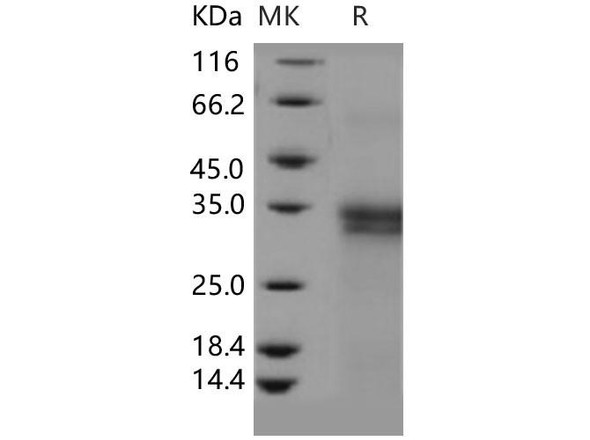
Mouse IFI30 Recombinant Protein (N-His) is a recombinant protein expressed in E. coli, spanning Val59-Lys248, with an N-terminal His tag. Predicted molecular weight: 23.97 kDa. Purity: >90% as determined by SDS-PAGE. Supplied lyophilized from a solution in PBS pH 7.4, 1 mM EDTA, 4% Trehalose, 1% Mannitol. Applications: ELISA, immunogen, SDS-PAGE and Western blot. Gamma-interferon-inducible lysosomal thiol reductase is a ~27 kDa protein. Lysosomal thiol reductase that catalyzes protein disulfide bonds reduction. For research use only.
Plays an important role in antigen processing and presentation, of namely both major histocompatibility complex (MHC) class I- and class II-restricted antigen by reducing the disulfide bonds of endocytosed proteins and facilitating their unfolding and optimal degradation. Shares with thioredoxin a reduction mechanism in which the N-terminal cysteine thiol group in the CXXC active site motif initiates a nucleophilic attack on the substrate disulfide bond,resulting in the formation of a mixed disulfide-linked enzyme-substrate intermediate (Probable). Subsequent intramolecular attack by the second cysteine thiol group enables the release of the reduced substrate and oxidized enzyme (Probable). Lysosomal cysteine is a physiological reducing agent that is capable of reducing IFI30, so that it can catalyzes the next reaction.
| Product Name: | Mouse IFI30 Recombinant Protein (N-His) |
| SKU: | GXRP09881 |
| Size: | 50 µg, 100 µg, 1 mg |
| Species: | Mouse |
| Synonyms: | Gamma-interferon-inducible lysosomal thiol reductase; 1.8.-.-; Gamma-interferon-inducible protein IP-30; Lysosomal thiol reductase IP30; Ifi30; Gilt; Ip30 |
| Tag: | N-His |
| Expression Host: | E. coli |
| Protein Length: | Val59-Lys248 |
| Calculated MW: | 23.97 kDa |
| UniProt: | Q9ESY9 |
| Applications: | ELISA, Immunogen, SDS-PAGE, WB |
| Purity: | >90% as determined by SDS-PAGE. |
| Form: | Lyophilized |
| Formulation: | Lyophilized from a solution in PBS pH 7.4, 1 mM EDTA, 4% Trehalose, 1% Mannitol. |
| Reconstitution: | Reconstitute in sterile water for a stock solution. Adjust the volume of sterile water so that, after reconstitution, the final stock concentration matches the value indicated on the product label or datasheet. |
| Storage: | Store at 2 to 8°C for frequent use. Store at -20 to -80°C for twelve months from the date of receipt. |
| Shipping: | In general, proteins are provided as lyophilized powder/frozen liquid. They are shipped out with dry ice/blue ice unless customers require otherwise. |
| Note: | For research use only |