The PE-Cyanine5.5 Anti-Mouse CD107a Antibody (1D4B) available at AssayGenie is a highly specific tool for researching CD107a expression in mouse samples. This antibody, designed for flow cytometry applications, is ideal for studying degranulation and cytotoxicity in immune cells.CD107a, also known as LAMP-1, is a marker for lysosome-related organelles that are involved in the cytotoxic activity of T cells and NK cells. By targeting CD107a, researchers can investigate the degranulation process that leads to the release of cytotoxic molecules such as perforin and granzymes, crucial for immune defense against pathogens and tumor cells.
The PE-Cyanine5.5 Anti-Mouse CD107a Antibody (1D4B) offers high sensitivity and specificity, allowing for accurate quantification and localization of CD107a-expressing cells. Its reliability and consistency make it a valuable tool for immunologists and cancer researchers seeking to understand the mechanisms of cytotoxicity and immune response in various experimental models.
Product Title:
PE/Cyanine5.5 Anti-Mouse CD107a Antibody [1D4B]
SKU:
AGEL3291
Size:
50 Tests, 100 Tests, 200 Tests
Clone No:
1D4B
Synonyms:
LAMP-1;Lysosome-associated membrane glycoprotein 1; lysosomal membrane glycoprotein 1; CD107 antigen-like family member A; lysosome-associated membrane protein 1;
Host Species:
Rat
Reactivity:
Mouse
Application:
FCM
Isotype:
Rat IgG2a, κ
Isotype Control:
PE/Cyanine5.5 Rat IgG2a, κ Isotype Control[2A3]
Form:
Liquid
Conjugation:
PE/Cyanine 5.5
Recommended Use:
Each lot of this antibody is quality control tested by flow cytometric analysis. The amount of the reagent is suggested to be used 5 µL of antibody per test (million cells in 100 µL staining volume or per 100 µL of whole blood). Please check your vial before the experiment. Since applications vary, the appropriate dilutions must be determined for individual use.
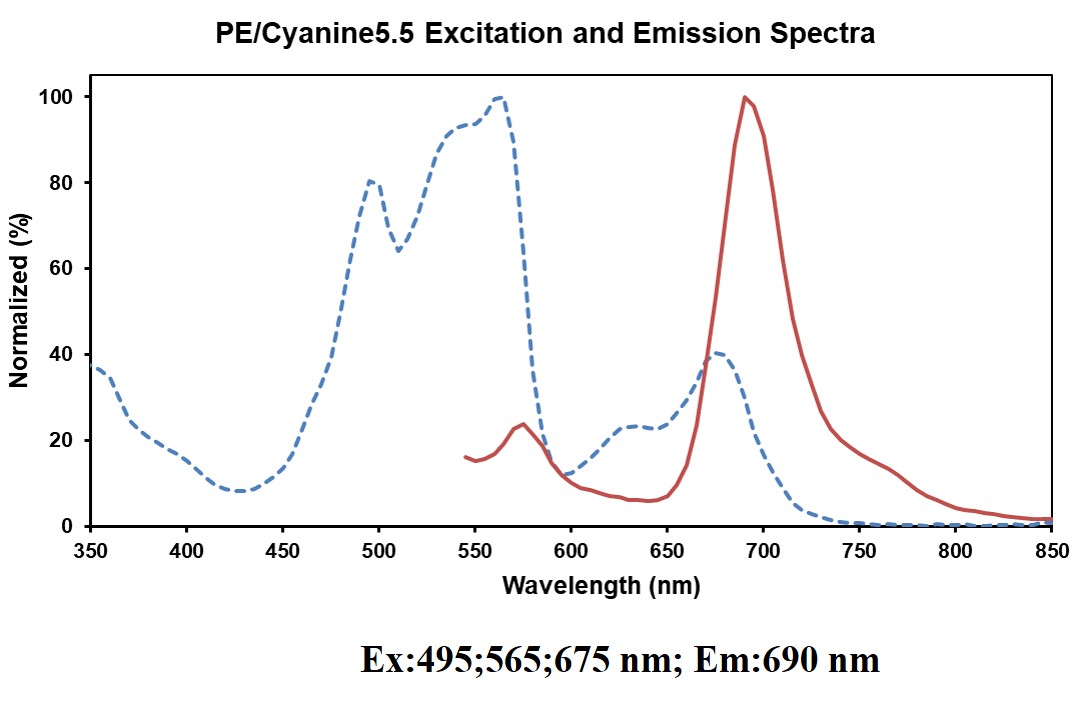
Spectrum:
Swissprot:
P11438
Gene ID:
16783
Storage Buffer:
Phosphate buffered solution, pH 7.2, containing 0.09% stabilizer and 1% protein protectant.
Stability & Storage:
Keep as concentrated solution. Store at 2~8°C and protected from prolonged exposure to light. Do not freeze. Centrifuge before opening to ensure complete recovery of vial contents. This product is guaranteed up to one year from purchase.
Background:
The 1D4B antibody recognizes CD107a which is also known as, Lysosome-Associated Membrane Protein 1 (LAMP-1). CD107a is one of the two major glycoproteins in lysosome membranes that provide useful markers to distinguish lysosomes from other organelles. CD107a may play a role in the lysosomal degradation of certain molecules. Mouse CD107a is a type I transmembrane glycoprotein. It consists of a 40-kDa core protein which is heavily glycosylated to form heterogeneous mature glycoprotein of 110-140 kDa. It is principally expressed in epithelial cells and macrophages in a variety of organs. Following activation, CD107a is relocated to the surface of some lymphocytes, macrophages, epithelial cells, endothelial cells, platelets, and tumor cells. Cell-surface CD107a may participate in intercellular adhesion and adhesion to the extracellular matrix. Cell surface CD107a expression can serve as a useful marker for cytotoxic NK and CD8+ T cells, as well as, some malignant tumor cells.

![PE/Cyanine5.5 Anti-Mouse CD107a Antibody [1D4B] (AGEL3291)](https://cdn11.bigcommerce.com/s-h68l9z2lnx/images/stencil/1280x1280/products/221412/605676/pecyanine5.5-anti-mouse-cd107a-antibody-1d4b-agel3291__78915.1707495647.jpg?c=2?imbypass=on "PE/Cyanine5.5 Anti-Mouse CD107a Antibody [1D4B] (AGEL3291)")
![PE/Cyanine5.5 Anti-Mouse CD107a Antibody [1D4B] (AGEL3291)](https://cdn11.bigcommerce.com/s-h68l9z2lnx/images/stencil/608x608/products/221412/605676/pecyanine5.5-anti-mouse-cd107a-antibody-1d4b-agel3291__78915.1707495647.jpg?c=2 "PE/Cyanine5.5 Anti-Mouse CD107a Antibody [1D4B] (AGEL3291)")
![PE Anti-Mouse CD107a Antibody [1D4B] (AGEL3287)](https://cdn11.bigcommerce.com/s-h68l9z2lnx/images/stencil/590x590/products/221408/606101/pe-anti-mouse-cd107a-antibody-1d4b-agel3287__49885.1707496977.jpg?c=2 "PE Anti-Mouse CD107a Antibody [1D4B] (AGEL3287)")
![PerCP/Cyanine5.5 Anti-Mouse CD107a Antibody [1D4B] (AGEL3292)](https://cdn11.bigcommerce.com/s-h68l9z2lnx/images/stencil/590x590/products/221413/607201/percpcyanine5.5-anti-mouse-cd107a-antibody-1d4b-agel3292__09473.1707500449.jpg?c=2 "PerCP/Cyanine5.5 Anti-Mouse CD107a Antibody [1D4B] (AGEL3292)")
![PE/Cyanine5 Anti-Mouse CD107a Antibody [1D4B] (AGEL3289)](https://cdn11.bigcommerce.com/s-h68l9z2lnx/images/stencil/590x590/products/221410/606643/pecyanine5-anti-mouse-cd107a-antibody-1d4b-agel3289__66776.1707498675.jpg?c=2 "PE/Cyanine5 Anti-Mouse CD107a Antibody [1D4B] (AGEL3289)")
![PE/Cyanine7 Anti-Mouse CD107a Antibody [1D4B] (AGEL3290)](https://cdn11.bigcommerce.com/s-h68l9z2lnx/images/stencil/590x590/products/221411/605987/pecyanine7-anti-mouse-cd107a-antibody-1d4b-agel3290__68932.1707496616.jpg?c=2 "PE/Cyanine7 Anti-Mouse CD107a Antibody [1D4B] (AGEL3290)")
![PE/GenieFluor 594 Anti-Mouse CD107a Antibody [1D4B] (AGEL3295)](https://cdn11.bigcommerce.com/s-h68l9z2lnx/images/stencil/590x590/products/221416/605512/pegeniefluor-594-anti-mouse-cd107a-antibody-1d4b-agel3295__92291.1707495083.jpg?c=2 "PE/GenieFluor 594 Anti-Mouse CD107a Antibody [1D4B] (AGEL3295)")