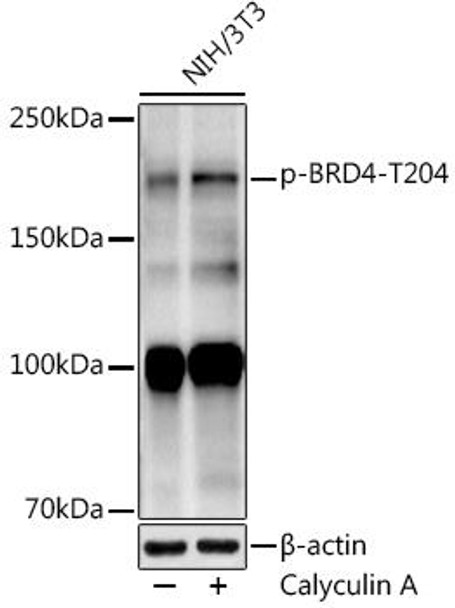
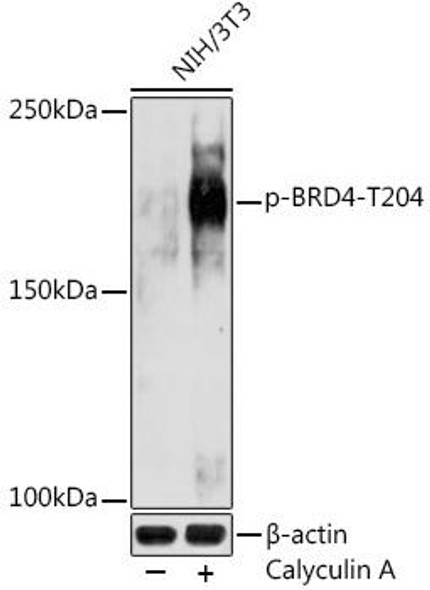
Western blot analysis of extracts of NIH/3T3 cells, using at 1:1000 dilution. NIH/3T3 cells were treated by Calyculin A (100 nM) for 30 minutes with NaCl (400mM) after serum-starvation 16-20 hours. Secondary antibody: HRP Goat Anti-Rabbit IgG (H+L) at 1:10000 dilution. Lysates/proteins: 25ug per lane. Blocking buffer: 3% nonfat dry milk in TBST. Detection: ECL Enhanced Kit. Exposure time: 90s.
The Phospho-BRD4-T204 Monoclonal Antibody (CABP1276) is a high-quality antibody developed for reliable detection and analysis of target proteins. This antibody, raised in rabbits, is highly specific and reactive with human samples, making it ideal for Western blot applications. It specifically binds to BRD4 phosphorylated at threonine 204, allowing for precise detection and analysis in various cell types.BRD4 is known for its role in regulating transcription, cell cycle progression, and cell growth, and its phosphorylation at threonine 204 has been linked to its function in cancer development and progression.
This antibody is validated for use in WB, ELISA applications and has demonstrated reactivity against Human, Rat samples.
Product Name:
Phospho-BRD4-T204 Monoclonal Antibody
SKU:
CABP1276
Size:
20μL, 100μL
Reactivity:
Human, Rat
Clone Number:
ARC50960
Conjugate:
Unconjugated
Immunogen:
Synthetic peptide. This information is considered to be commercially sensitive.
Sequence:
ASTP P
Tested Applications:
WBELISA
Recommended Dilution:
WB
1:500 - 1:1000
ELISA
Recommended starting concentration is 1 μg/mL. Please optimize the concentration based on your specific assay requirements.
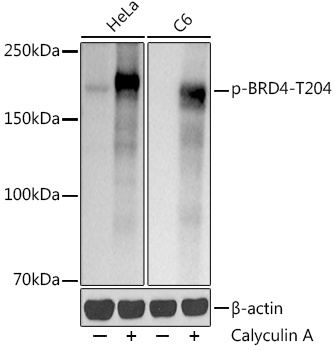
HeLa treated with Calyculin A, C6 treated with Calyculin A
Cellular Localization:
Chromosome, Nucleus.
Calculated MW:
152kDa
Observed MW:
200kDa
The protein encoded by this gene is homologous to the murine protein MCAP, which associates with chromosomes during mitosis, and to the human RING3 protein, a serine/threonine kinase. Each of these proteins contains two bromodomains, a conserved sequence motif which may be involved in chromatin targeting. This gene has been implicated as the chromosome 19 target of translocation t(15;19)(q13;p13.1), which defines an upper respiratory tract carcinoma in young people. Two alternatively spliced transcript variants have been described.
Purification Method
Affinity purification
Gene ID
23476
Buffer Information
Store at -20℃. Avoid freeze / thaw cycles. Buffer: PBS containing 50% glycerol and 0.05% BSA, preserved with proclin300 or sodium azide, pH 7.3.
Western blot analysis of various lysates using (CABP1276) at1:1000 dilution. HeLa cells were treated with Calyculin A (100 nM) at 37℃ for 30 minutes after serum-starvation overnight. C6 cells were treated with Calyculin A (100 nM) at 37℃ for 30 minutes after serum-starvation overnight. Secondary antibody: HRP-conjugated Goat anti-Rabbit IgG (H+L) (CABS014) at1:10000 dilution. Lysates/proteins: 25μg per lane. Blocking buffer: 3% nonfat dry milk in TBST. Detection: ECL Basic Kit (AbGn00020). Exposure time: 1s.




![Anti-Brd4 [R01-1H8] Monoclonal Antibody (AGMB04160)](https://cdn11.bigcommerce.com/s-h68l9z2lnx/images/stencil/590x590/products/275449/679793/anti-brd4-r01-1h8-monoclonal-antibody-agmb04160__32522.1773040000.jpg?c=2 "Anti-Brd4 [R01-1H8] Monoclonal Antibody (AGMB04160)")