The Phospho-EPHA2-S897 Antibody (CABP1082) is a high-quality antibody developed for reliable detection and analysis of target proteins. This antibody, raised in rabbits, exhibits high reactivity with samples from a variety of species and is validated for use in Western blot applications.EPHA2 phosphorylation at the S897 site has been linked to the regulation of cell signaling pathways implicated in cancer progression, making it a key target for investigation in cancer research. The antibody specifically recognizes the phosphorylated form of EPHA2 at S897, enabling precise detection and quantification of this critical modification in cell lysates.
This antibody is validated for use in WB, ELISA applications and has demonstrated reactivity against Human, Mouse, Rat samples.
Product Name:
Phospho-EPHA2-S897 Antibody
SKU:
CABP1082
Size:
20μL, 100μL
Reactivity:
Human, Mouse, Rat
Immunogen:
Synthetic peptide. This information is considered to be commercially sensitive.
Sequence:
LPST S
Tested Applications:
WBELISA
Recommended Dilution:
WB
1:500 - 1:2000
ELISA
Recommended starting concentration is 1 μg/mL. Please optimize the concentration based on your specific assay requirements.
Cell Junction, Cell Membrane, Cell Projection, Single-Pass Type I Membrane Protein, Focal Adhesion, Lamellipodium Membrane, Ruffle Membrane.
Calculated MW:
108kDa
Observed MW:
125kDa
This gene belongs to the ephrin receptor subfamily of the protein-tyrosine kinase family. EPH and EPH-related receptors have been implicated in mediating developmental events, particularly in the nervous system. Receptors in the EPH subfamily typically have a single kinase domain and an extracellular region containing a Cys-rich domain and 2 fibronectin type III repeats. The ephrin receptors are divided into 2 groups based on the similarity of their extracellular domain sequences and their affinities for binding ephrin-A and ephrin-B ligands. This gene encodes a protein that binds ephrin-A ligands. Mutations in this gene are the cause of certain genetically-related cataract disorders.
Purification Method
Affinity purification
Gene ID
1969
RRID
AB_2863954
Buffer Information
Store at -20℃. Avoid freeze / thaw cycles. Buffer: PBS containing 50% glycerol, preserved with proclin300 or sodium azide, pH 7.3.
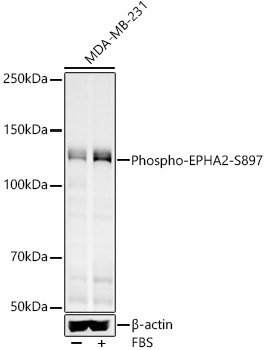
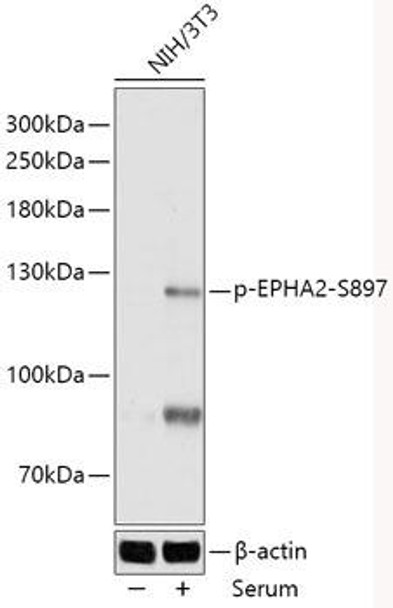
Western blot analysis of lysates from MDA-MB-231 cells, using Phospho-EPHA2-S897 Rabbit pAb (CABP1082) at 1:400 dilution. MDA-MB-231 cells were treated with 20% FBS at 37℃ for 20 minutes after serum-starvation overnight Secondary antibody: HRP-conjugated Goat anti-Rabbit IgG (H+L) (CABS014) at 1:10000 dilution. Lysates/proteins: 25μg per lane. Blocking buffer: 3% nonfat dry milk in TBST. Detection: ECL Enhanced Kit (AbGn00021). Exposure time: 90s.