The Phospho-PDGFRA-Y754 Antibody (CABP0568) is a high-quality antibody developed for reliable detection and analysis of target proteins. This antibody, raised in rabbits, is highly specific to the phosphorylated form of PDGFRα at the Y754 residue and is validated for use in Western blot applications.PDGFRα is a receptor tyrosine kinase that plays a crucial role in cell signaling pathways that regulate cell proliferation, migration, and survival. Phosphorylation of PDGFRα at the Y754 residue is known to be important for its activation and downstream signaling cascades. By targeting this phosphorylation site, researchers can gain insights into the mechanisms underlying PDGFRα activation and its impact on cellular processes.
This antibody is validated for use in WB, ELISA applications and has demonstrated reactivity against Human samples.
Product Name:
Phospho-PDGFRA-Y754 Antibody
SKU:
CABP0568
Size:
20μL, 100μL
Reactivity:
Human
Conjugate:
Unconjugated
Immunogen:
Synthetic peptide. This information is considered to be commercially sensitive.
Sequence:
SKYS D
Tested Applications:
WBELISA
Recommended Dilution:
WB
1:500 - 1:2000
ELISA
Recommended starting concentration is 1 μg/mL. Please optimize the concentration based on your specific assay requirements.
Synonyms:
CD140A, PDGFR2, PDGFR-2, Phospho-PDGFR alpha-Y754
Positive Sample:
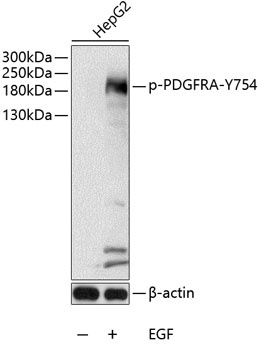
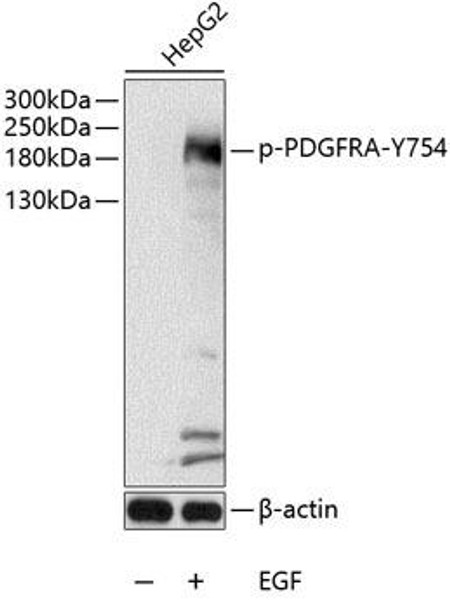
Hep G2 treated with EGF
Cellular Localization:
Cell Membrane, Single-Pass Type I Membrane Protein.
Calculated MW:
123kDa
Observed MW:
180kDa
This gene encodes a cell surface tyrosine kinase receptor for members of the platelet-derived growth factor family. These growth factors are mitogens for cells of mesenchymal origin. The identity of the growth factor bound to a receptor monomer determines whether the functional receptor is a homodimer or a heterodimer, composed of both platelet-derived growth factor receptor alpha and beta polypeptides. Studies suggest that this gene plays a role in organ development, wound healing, and tumor progression. Mutations in this gene have been associated with idiopathic hypereosinophilic syndrome, somatic and familial gastrointestinal stromal tumors, and a variety of other cancers.
Purification Method
Affinity purification
Gene ID
5156
RRID
AB_2771403
Buffer Information
Store at -20℃. Avoid freeze / thaw cycles. Buffer: PBS containing 50% glycerol, preserved with proclin300 or sodium azide, pH 7.3.
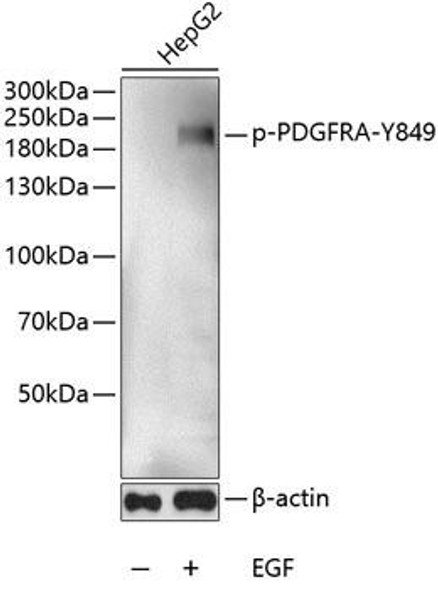
Western blot analysis of lysates from HepG2 cells, using Phospho-PDGFR alpha-Y754 Rabbit pAb (CABP0568) at 1:1000 dilution. HepG2 cells were treated with EGF (100ng/mL) for 30 minutes after serum-starvation overnight. Secondary antibody: HRP-conjugated Goat anti-Rabbit IgG (H+L) (CABS014) at 1:10000 dilution. Lysates/proteins: 25μg per lane. Blocking buffer: 3% BSA.