Description
Plant Flavonoids Colorimetric Assay Kit
The Plant Flavonoids Colorimetric Assay Kit (MAES0171) measures total flavonoid content in plant tissue extracts. Flavonoids form a red complex with aluminum ion in alkaline nitrite solution, and the complex is quantified by absorbance at 510 nm on a microplate reader. Researchers use the kit to compare flavonoid levels across plant tissues and conditions, particularly in plant stress resistance studies.
Flavonoids are plant-derived compounds, and this kit is designed to quantify the flavonoids content of plant tissue samples. The assay reports the result as flavonoid content in mg per g of tissue, calculated from a standard curve and the sample's tissue weight, extraction volume, and dilution factor. The kit is for Research Use Only and is categorized under Plant Physiology.
Researchers use this kit to measure flavonoid levels in plant tissue within plant physiology studies. Examples include Epipremnum aureum, green pepper, pumpkin, and heather tissue, which require different dilution factors, indicating that extract concentrations vary across plant species. The kit is intended for plant tissue only; available information does not describe other sample types for this assay.
The method is based on a colorimetric reaction in which flavonoids form a red complex with aluminum ion in an alkaline nitrite solution. Sample or standard (75 µL) is mixed sequentially with saline (10 µL, 5 min), aluminium reagent (30 µL, 5 min), and alkali reagent (180 µL, 15 min), all at room temperature. Absorbance is read at 510 nm on a microplate reader set to 500-520 nm, and the total assay time is 35 min.
Plant tissue is dried to constant weight at 80°C in a vacuum dryer, crushed, and filtered through a 40 mesh screen before extraction. Approximately 0.02 g of prepared tissue is extracted in 2 mL of 60% alcohol, either by shaking at 60°C for 2 hours or by ultrasonic disruption, followed by centrifugation at 1500×g for 10 min. Kit components are stored at 2-8°C, protected from light, and should be equilibrated to room temperature before use.
The kit has an analytical sensitivity of 0.66 µg/mL and a detection range of 0.66-150 µg/mL. Reported precision is an intra-assay CV of 4% and an inter-assay CV of 5.3%. Average recovery across high, middle, and low standard concentrations was 103%, and recovery values for individual standards ranged from 101% to 105%.
| Sample type: | Plant tissue |
| Detection method: | Colorimetric (absorbance at 510 nm) |
| Instrument: | Microplate reader (500-520 nm) |
| Assay time: | 35 min |
| Sample volume: | 75 µL per well |
| Detection range: | 0.66-150 µg/mL |
| Sensitivity: | 0.66 µg/mL |
| Sample type: | Plant tissue |
| Measurement wavelength: | 510 nm |
| Sensitivity: | 0.66 µg/mL |
| Detection range: | 0.66-150 µg/mL |
| Intra-assay CV: | 4% |
| Inter-assay CV: | 5.3% |
| Recovery rate: | 103% |
- Colorimetric, microplate-based format read at 510 nm
- Detection range 0.66-150 µg/mL with sensitivity of 0.66 µg/mL
- Total assay time of 35 min at room temperature
- Requires 75 µL of sample extract per well
- Intra-assay CV 4% and inter-assay CV 5.3%
- Recovery rate of 103%
In alkaline nitrite solution, flavonoids form a red complex with aluminum ion. The flavonoid content of the sample is calculated from the absorbance of the sample extract measured at 510 nm against a standard curve prepared from a 1 mg/mL potassium standard.
- Quantification of total flavonoid content in plant tissue extracts
- Plant stress resistance research
- Comparison of flavonoid levels across plant species, tissues, or treatments
- Screening of plant extracts for flavonoid content prior to antioxidant or free-radical studies
| Component | Quantity | Storage |
| Standard (1 mg/mL) | 1.8 mL × 1 vial | 2-8°C, 12 months |
| Saline Solution (Reagent 2) | 1 mL × 1 vial | 2-8°C, 12 months |
| Aluminium Reagent (Reagent 3) | 1.8 mL × 1 vial | 2-8°C, 12 months |
| Alkali Reagent (Reagent 4) | 30 mL × 1 vial | 2-8°C, 12 months |
- Microplate reader capable of reading 500-520 nm (510 nm for measurement)
- Micropipettor and tips
- Vortex mixer
- Centrifuge
- Vacuum dryer
- Ultrasonic cell disruptor (optional extraction method)
- Constant-temperature shaking incubator
- Double-distilled water
- 60% alcohol (self-prepared)
- Absolute ethanol
- 40 mesh screen
- Filter paper
Plant tissue
- Weigh 5-10 g of fresh plant tissue and wash with distilled water.
- Blot surface moisture from the tissue with filter paper, then place it in a vacuum dryer and dry to constant weight at 80°C.
- Crush the dried sample and filter it through a 40 mesh screen. Seal and store at room temperature.
- Accurately weigh 0.02 g of the prepared sample and add 2 mL of 60% alcohol (self-prepared).
- Extract by shaking at 60°C for 2 hours in a constant temperature shaking incubator, or by treating the sample with an ultrasonic cell disruptor (power 300 W, 3 seconds on, 4 seconds off, repeated for 30 min).
- Centrifuge at 1500×g for 10 min if shaken, or at 10000×g for 10 min if ultrasonicated. Collect the supernatant for detection.
- Dilute the supernatant with 60% alcohol as needed. Recommended dilution factors (for reference only): Epipremnum aureum 10-15; green pepper 1; pumpkin 1; heather 25-35. For other plant tissues, perform a pretest to confirm the dilution factor.
Sample preparation
- Weigh 5-10 g fresh plant tissue, wash with distilled water, and blot surface moisture with filter paper.
- Dry the tissue in a vacuum dryer to constant weight at 80°C.
- Crush the dried sample and pass it through a 40 mesh screen. Store sealed at room temperature.
- Weigh 0.02 g of prepared sample and add 2 mL of 60% alcohol.
- Shake at 60°C for 2 hours in a constant-temperature shaking incubator, then centrifuge at 1500 × g for 10 min. Use the supernatant for the assay.
- Alternative extraction: treat the sample with an ultrasonic cell disruptor (300 W, 3 s on / 4 s off, 30 min total), then centrifuge at 10000 × g for 10 min. Use the supernatant.
- Dilute the extract as needed (for example, Epipremnum aureum 10-15-fold; green pepper and pumpkin 1-fold; heather 25-35-fold). Pretest unlisted sample types.
Standard curve preparation
- Equilibrate all reagents to room temperature before use.
- Prepare a fresh standard set each time and discard working dilutions after use.
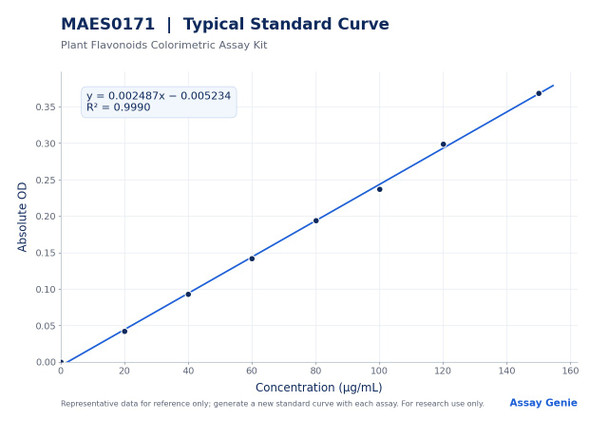
- Dilute the 1 mg/mL standard with absolute ethanol to 0, 20, 40, 60, 80, 100, 120, and 150 µg/mL (for example, 0 µL, 24 µL, 48 µL, 72 µL, 96 µL, 120 µL, 144 µL, and 180 µL of standard, each brought to a final volume of 1200 µL with absolute ethanol).
Assay procedure
- Add 75 µL of each standard to standard wells and 75 µL of sample to sample wells.
- Add 10 µL of Saline Solution to each well, mix thoroughly, and stand for 5 min at room temperature.
- Add 30 µL of Aluminium Reagent to each well, mix thoroughly, and stand for 5 min at room temperature.
- Add 180 µL of Alkali Reagent to each well, mix thoroughly, and stand for 15 min at room temperature.
- Read the OD at 510 nm on a microplate reader.
Flavonoids content (mg/g tissue)=(△A510 -b)÷a×V÷W÷1000×f
- △A510 = OD sample − OD blank, where OD sample is the absorbance of the sample well at 510 nm and OD blank is the mean absorbance of the blank well (Standard #1, 0 µg/mL).
- a and b are the slope and intercept of the standard curve y = ax + b, where y is the absolute OD value (mean standard OD minus mean blank OD) and x is the standard concentration in µg/mL.
- V is the volume of 60% alcohol used in sample pretreatment, 2 mL.
- W is the weight of the sample, 0.02 g.
- 1000 is the unit conversion from µg to mg.
- f is the dilution factor of the tested sample. For an undiluted sample, f = 1.
- The result is expressed in mg of flavonoids per g of tissue.
What sample types can be used with this kit?
The kit is intended for measuring flavonoids content in plant tissue samples. Examples include Epipremnum aureum, green pepper, pumpkin, and heather, and other sample types require a pretest to confirm the dilution factor.
How should the kit components be stored?
Kit components should be stored at 2-8°C for 12 months and protected from light. Equilibrate all reagents to room temperature before use, and centrifuge small reagent volumes before use.
What should I do if my sample is outside the detection range?
The detection range is 0.66-150 µg/mL. If the concentration is not within this range, perform an extra dilution or concentration of the sample and reassay it.
What are the key points for running the assay?
Let the saline or aluminium reagent stand at room temperature for 5 min before adding the next reagent, and let the alkali reagent stand for 15 min. Always prepare a fresh set of standards and discard working standard dilutions after use.
What instrument settings are required?
Read absorbance at 510 nm using a microplate reader with a 500-520 nm filter range. The kit uses 75 µL of standard or sample per well.
How long does the assay take?
The assay time is 35 min, including the saline (5 min), aluminium reagent (5 min), and alkali reagent (15 min) incubations.
Plant Flavonoids Colorimetric Assay Kit (MAES0171) has been used in 1 publication. Newest first.
- 2023Structural organization of the reproductive organs of Japanese quails depending on the effect of chamomile extractView publication ↗Elghabry Sahar et al. · Poultry Science