The PSPC1 Antibody (CAB9209) is a high-quality antibody developed for reliable detection and analysis of target proteins. This antibody, produced in rabbits, exhibits high reactivity with human samples and has been validated for use in Western blot applications. By binding specifically to the PSPC1 protein, this antibody enables accurate detection and analysis in a variety of cell types, making it an excellent choice for studies in molecular biology and gene regulation research.
This antibody is validated for use in WB, IHC-P, IP, ELISA applications and has demonstrated reactivity against Human, Mouse, Rat samples.
Product Name:
PSPC1 Antibody
SKU:
CAB9209
Size:
20μL, 100μL
Reactivity:
Human, Mouse, Rat
Conjugate:
Unconjugated
Immunogen:
Recombinant protein (or fragment).This information is considered to be commercially sensitive.
Sequence:
MMLR GNLK QVRI EKNP ARLR ALES AVGE SEPA AAAA MALA LAGE PAPP APAP PEDH PDEE MGFT IDIK SF
Tested Applications:
WBIHC-PIPELISA
Recommended Dilution:
WB
1:500 - 1:2000
IHC-P
1:50 - 1:200
IP
0.5μg-4μg antibody for 200μg-400μg extracts of whole cells
ELISA
Recommended starting concentration is 1 μg/mL. Please optimize the concentration based on your specific assay requirements.
This gene encodes a nucleolar protein that localizes to punctate subnuclear structures that occur close to splicing speckles, known as paraspeckles. These paraspeckles are composed of RNA-protein structures that include a non-coding RNA, NEAT1/Men epsilon/beta, and the Drosophila Behavior Human Splicing family of proteins, which include the product of this gene and the P54NRB/NONO and PSF/SFPQ proteins. Paraspeckles may function in the control of gene expression via an RNA nuclear retention mechanism. The protein encoded by this gene is found in paraspeckles in transcriptionally active cells, but it localizes to unique cap structures at the nucleolar periphery when RNA polymerase II transcription is inhibited, or during telophase. Alternative splicing of this gene results in multiple transcript variants. A related pseudogene, which is also located on chromosome 13, has been identified.
Purification Method
Affinity purification
Gene ID
55269
RRID
AB_2771861
Buffer Information
Store at -20℃. Avoid freeze / thaw cycles. Buffer: PBS containing 50% glycerol, preserved with proclin300 or sodium azide, pH 7.3.
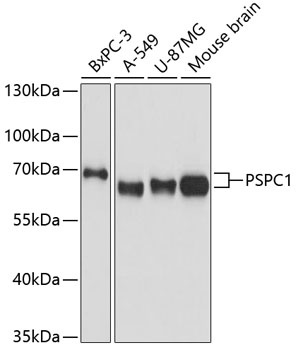
Western blot analysis of various lysates using PSPC1 Rabbit pAb (CAB9209) at 1:3000 dilution. Secondary antibody: HRP-conjugated Goat anti-Rabbit IgG (H+L) (CABS014) at 1:10000 dilution. Lysates/proteins: 25μg per lane. Blocking buffer: 3% nonfat dry milk in TBST. Detection: ECL Basic Kit (AbGn00020). Exposure time: 10s.
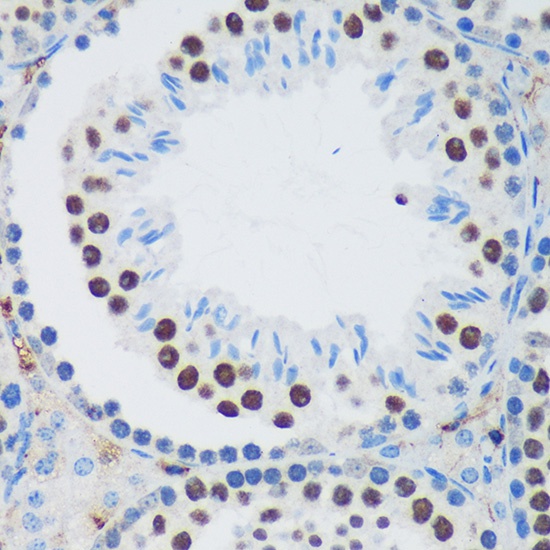
Immunohistochemistry analysis of paraffin-embedded Mouse testis using PSPC1 Rabbit pAb (CAB9209) at dilution of 1:100 (40x lens). Microwave antigen retrieval performed with 0.01M PBS Buffer (pH 7.2) prior to IHC staining.
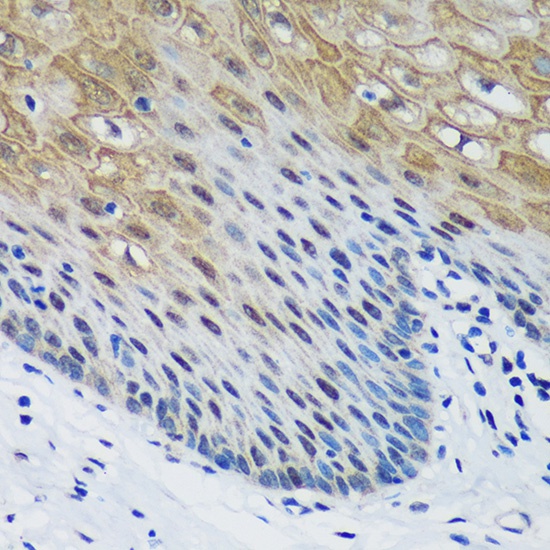
Immunohistochemistry analysis of paraffin-embedded Human esophageal using PSPC1 Rabbit pAb (CAB9209) at dilution of 1:100 (40x lens). Microwave antigen retrieval performed with 0.01M PBS Buffer (pH 7.2) prior to IHC staining.
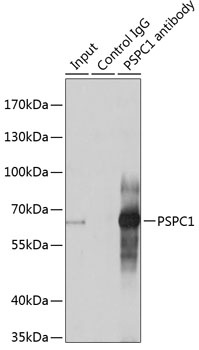
Immunoprecipitation analysis of 200 μg extracts of A-549 cells using 3 μg PSPC1 antibody (CAB9209). Western blot was performed from the immunoprecipitate using PSPC1 antibody (CAB9209) at a dilution of 1:1000.