The Recombinant BRD4 Monoclonal Antibody is a recombinant rabbit monoclonal antibody (clone C110812) against BRD4. The protein encoded by this gene is homologous to the murine protein MCAP, which associates with chromosomes during mitosis, and to the human RING3 protein, a serine/threonine kinase. Each of these proteins contains two bromodomains, a conserved sequence motif which may be involved in chromatin targeting. This gene has been implicated as the chromosome 19 target of translocation t(15;19)(q13;p13.1), which defines an upper respiratory tract carcinoma in young people. Produced by recombinant technology in Rabbit hosts and purified by Protein A affinity chromatography, this Rabbit IgG antibody is reactive against Human, Mouse and Rat samples.
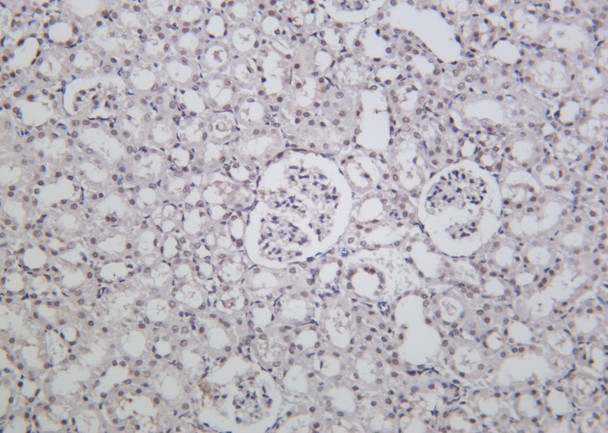
This antibody is suitable for WB, IHC, IF, IP and ELISA applications. It has been validated by IHC analysis of Rat kidney. The target is localized to the nucleus, chromosome, Associates with acetylated chromatin (PubMed:21890894, PubMed:16109376). Released from chromatin upon deacetylation of histones that can be triggered by different signals such as activation of the JNK pathway or nocodazole treatment (PubMed:21890894, PubMed:16109376). Preferentially localizes to mitotic chromosomes, while it does not localizes to meiotic chromosomes (PubMed:21890894, PubMed:16109376), chromosome.
Product Name:
Recombinant BRD4 Monoclonal Antibody
SKU:
AGEL6118
Size:
50 µL, 100 µL
Antibody Type:
Recombinant Monoclonal Antibody
Synonyms:
BRD, BRD4, BRD4-NUT FUSION, BRD4-NUT fusion oncoprotein, bromodomain containing, bromodomain containing 4, bromodomain containing protein 4, Bromodomain-containing protein 4, CAP, chromosome associated protein, HUNK, HUNK1, HUNK1bromodomain-containing protein, HUNK1bromodomain-containing protein 4, HUNKI, MCAP, Mitotic chromosome-associated protein, Protein HUNK1
Reactivity:
Human, Mouse, Rat
Immunogen:
Recombinant Human BRD4 protein
Applications:
WBIHCIFIPELISA
Clonality:
Recombinant Monoclonal
Clone No:
C110812
Host:
Rabbit
Isotype:
Rabbit IgG
Target:
BRD4
Conjugation:
Unconjugated
Recommended Dilution:
IHC 1:100-200; WB 1:2000-10000; IF 1:200-1000; ELISA 1:5000-20000; IP 1:50-200
UniProt:
O60885
Purification:
Protein A
Concentration:
0.2 mg/mL
Buffer:
PBS, 50% glycerol, 0.05% Proclin 300, 0.05% protein protectant.
Storage:
Store at -20°C valid for 12 months. Avoid freeze / thaw cycles.