Activated leukocyte cell adhesion molecule (ALCAM)/Cluster of differentiation (CD166) is a type I transmembrane cell adhesion molecule belonging to the Ig superfamily and a ligand for CD6 that is expressed on T lymphocytes. The extracellular domain of ALCAM contains five Ig-like domains (three Ig-like C2-type domains and two Ig-like V-type domains), of which the amino-terminal V1 domain is essential for ligand binding and ALCAM-mediated cell aggregation. ALCAM mediates both heterophilic (ALCAM-CD6) and homophilic (ALCAM-ALCAM) cell-cell interactions. ALCAM/CD6 interaction plays a role in T cell development and T cell regulation, as well as in the binding of T- and B-cells to activated leukocytes. Recently, homophilic (ALCAM-ALCAM) adhesion was shown to play important roles in tight cell-to-cell interaction and regulation of stem cell differentiation. While expressed in a wide variety of tissues, ALCAM is usually restricted to subsets of cells involved in dynamic growth and/or migration, including neural development, branching organ development, hematopoiesis, immune response and tumor progression. And CD166 is regarded as a potential novel breast cancer indicator and therapeutic target.
Immobilized human ALCAM-His at 10 µg/ml (100 ?l/well) can bind mouse CD6-Fc , The EC50 of mouse CD6-Fc is 0.1-0.22 µg/ml.
Endotoxin:
<1.0 EU per µg as determined by the LAL method.
Protein Construction:
A DNA sequence encoding the extracellular domain (Met 1-Ala 526) of human ALCAM (NP_001618.2) was expressed, with the C-terminal polyhistidine tag.
Purity:
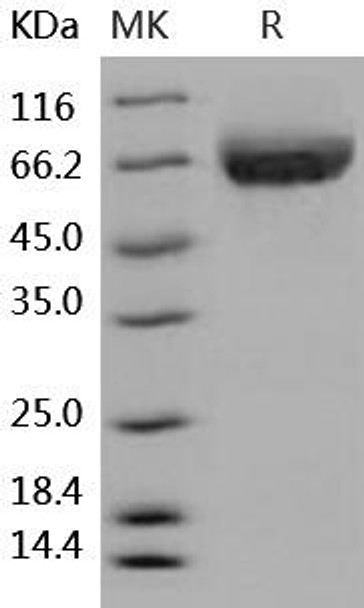
> 98 % as determined by reducing SDS-PAGE.
Mol Mass:
57.4 kDa
AP Mol Mass:
60-70 kDa
Formulation:
Lyophilized from sterile PBS, pH 7.4
Shipping:
This product is provided as lyophilized powder which is shipped with ice packs.
Stability and Storage:
Lyophilized proteins are stable for up to 12 months when stored at -20 to -80°C. Reconstituted protein solution can be stored at 4-8°C for 2-7 days. Aliquots of reconstituted samples are stable at < -20°C for 3 months.