Cathepsins are proteases found in many types of cells conserved in all animals, which have a vital role in mammalian cellular turnover such as bone resorption. The lysosomal cysteine protease Cathepsin C (CTSC), also known as dipeptidyl peptidase I (DPPI/DPP1), activates a number of granule-associated serine proteases with pro-inflammatory and immune functions by removal of their inhibitory N-terminal dipeptides. This lysosomal exo-cysteine protease belonging to the peptidase C1 family. Active cathepsin C is found in lysosomes as a 200-kDa multimeric enzyme. Subunits constituting this assembly all arise from the proteolytic cleavage of a single precursor giving rise to three peptides: the propeptide, the alpha- and the beta-chains. It is a central coordinator for activation of many serine proteases in immune/inflammatory cells. Defects in the Cathepsin C have been shown to be a cause of Papillon-Lefevre disease, an autosomal recessive disorder characterized by palmoplantar keratosis and periodontitis. Cathepsin C plays a key role in the activation of several degradative enzymes linked to tissue destruction in inflammatory diseases. Thus, it is a therapeutic target for the treatment of a number of inflammatory and autoimmune diseases.
Product Name:
Human Cathepsin C/CTSC/DPPI Recombinant Protein (RPES2700)
Product Code:
RPES2700
Size:
10µg
Species:
Human
Expressed Host:
HEK293 Cells
Synonyms:
CPPI,DPP-I,DPP1,DPPI,HMS,JP,JPD,PALS,PDON1,PLS
Accession:
NP_001805.3
Sequence:
Met 1-Leu 463
Fusion tag:
C-His
Activity:
Measured by its ability to cleave the fluorogenic peptide substrate, Gly-Arg-7-amido-4-methylcoumarin (GRAMC). The specific activity is >200 pmoles/min/µg.(Activation description: The proenzyme needs to be activated by Cathepsin L for an activated form)
Endotoxin:
<1.0 EU per µg as determined by the LAL method.
Protein Construction:
A DNA sequence encoding the pro form of human cathepsin C (NP_001805.3) (Met 1-Leu 463) was expressed with a polyhistidine tag at the C-terminus.
Purity:
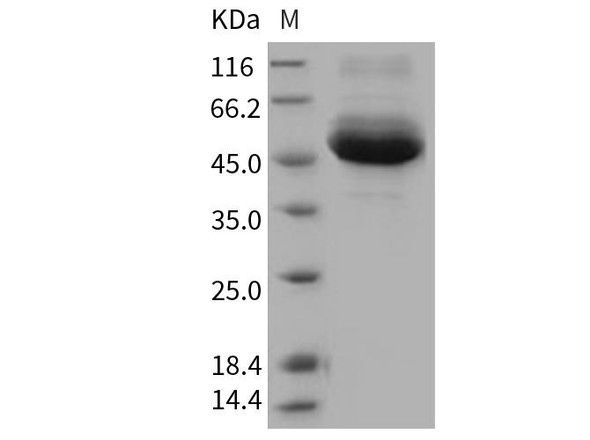
> 92 % as determined by reducing SDS-PAGE.
Mol Mass:
51 kDa
AP Mol Mass:
55 kDa
Formulation:
Lyophilized from sterile PBS, pH 7.4
Shipping:
This product is provided as lyophilized powder which is shipped with ice packs.
Stability and Storage:
Lyophilized proteins are stable for up to 12 months when stored at -20 to -80°C. Reconstituted protein solution can be stored at 4-8°C for 2-7 days. Aliquots of reconstituted samples are stable at < -20°C for 3 months.