CDCP1 contains three extracellular CUB domains. It is a putative stem cell marker that is highly expressed in some human cancer cells and in both; typical and atypical (cancerous) colons. It interacts with CDH2/N-cadherin; CDH3/P-cadherin; SDC1/syndecan-1; SDC4/syndecan-4 and the serine protease ST14/MT-SP1. It also interacts with SRC and PRKCG/protein kinase C gamma. CDCP1 is taken as a key regulator of EGF/EGFR-induced cell migration. It has been shown that signaling via EGF/EGFR induces migration of ovarian cancer Caov3 and OVCA420 cells with concomitant up-regulation of CDCP1 mRNA and protein. Consistent with a role in cell migration CDCP1 relocates from cell-cell junctions to punctate structures on filopodia after activation of EGFR. It may be involved in cell adhesion and cell matrix association. It also may play a role in the regulation of anchorage versus migration or proliferation versus differentiation via its phosphorylation. It has been taken as a novel marker for leukemia diagnosis and for immature hematopoietic stem cell subsets.
Product Name:
Human CDCP1/CD318 Recombinant Protein (RPES0404)
Product Code:
RPES0404
Size:
100 µg
Species:
Human
Expressed Host:
HEK293 Cells
Synonyms:
CUB domain-containing protein 1,Membrane glycoprotein gp140,Subtractive immunization M plus HEp3-associated 135 kDa protein,SIMA135,Transmembrane and associated with src kinases,CD318,TRASK
Accession:
Q9H5V8-3
Sequence:
Met 1-Glu343
Fusion tag:
C-His
Endotoxin:
<1.0 EU per µg of the protein as determined by the LAL method.
Protein Construction:
A DNA sequence encoding the human CDCP1 (Q9H5V8-3) (Met1-Glu343) was expressed with a polyhistidine tag at the C-terminus.
Purity:
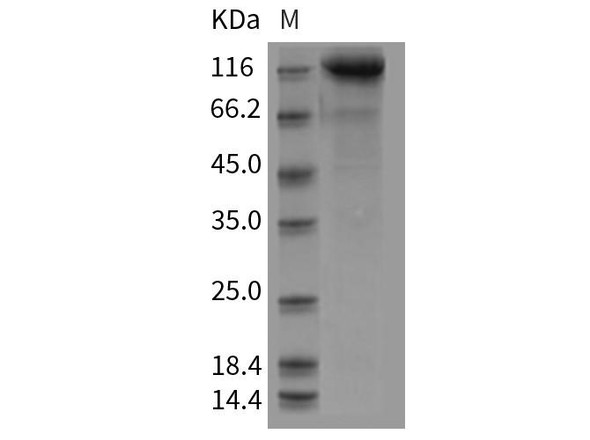
> 90 % as determined by reducing SDS-PAGE.
Mol Mass:
36.4 kDa
Formulation:
Lyophilized from sterile PBS; pH 7.4
Shipping:
This product is provided as lyophilized powder which is shipped with ice packs.
Stability and Storage:
Lyophilized proteins are stable for up to 12 months when stored at -20 to -80°C. Reconstituted protein solution can be stored at 4-8°C for 2-7 days. Aliquots of reconstituted samples are stable at < -20°C for 3 months.