Cyclin-dependent kinase inhibitor 2D(also known as CDKN2D or p19ink4d), a member of the INK4 family of cyclin-dependent kinase (CDK) inhibitors, negatively regulates the cyclin D-CDK4/6 complexes, which promote G1/S transition by phosphorylating the retinoblastoma tumor-suppressor gene product. It is clearly shown that DNA repair is the main target of p19ink4d effect and that diminished apoptosis is a downstream event. Experiments has uncovered a role of p19INK4d as a regulator of DNA-damage-induced apoptosis and suggest that it protects cells from undergoing apoptosis by allowing a more efficient DNA repair. It has been demonstrated that p19INK4d expression enhances cell survival under genotoxic conditions. Previous work has shown that inactivation of the cyclin-dependent kinase inhibitor (CKI) p19(Ink4d) leads to progressive hearing loss attributable to inappropriate DNA replication and subsequent apoptosis of hair cells. It may also involved in male reproductive function including testicular atrophy, alteration in serum follicle stimulating hormone, qualitative increase in germ cell apoptosis, and delayed kinetics of meiotic prophase markers.
Product Name:
Human CDKN2D/p19ink4d Recombinant Protein (RPES2494)
Product Code:
RPES2494
Size:
50 µg
Species:
Human
Expressed Host:
E.coli
Synonyms:
INK4D,p19,p19-INK4D
Accession:
P55273
Sequence:
Met 10Leu 166
Fusion tag:
N-GST
Activity:
Immobilized human GST-CDKN2D at 10 µg/ml (100 ?l/well) can bind biotinylated human GST-CDK4, The EC50 of biotinylated human GST-CDK4 is 0.52-1.2 µg/ml.
Endotoxin:
Please contact us for more information.
Protein Construction:
A DNA sequence encoding the human CDKN2D (P55273) (Met 10Leu 166) was fused with the GST tag at the N-terminus.
Purity:
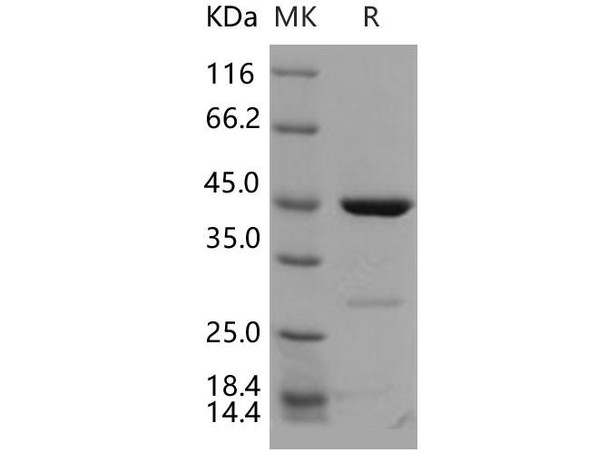
> 90 % as determined by reducing SDS-PAGE.
Mol Mass:
44.9 kDa
AP Mol Mass:
46 kDa
Formulation:
Lyophilized from sterile PBS, pH 7.5
Shipping:
This product is provided as lyophilized powder which is shipped with ice packs.
Stability and Storage:
Lyophilized proteins are stable for up to 12 months when stored at -20 to -80°C. Reconstituted protein solution can be stored at 4-8°C for 2-7 days. Aliquots of reconstituted samples are stable at < -20°C for 3 months.