Fibroblast growth factors (FGFs) are involved in a multitude of physiological and pathological cellular processes. The biological activities of the FGFs are mediated by a family of type I transmembrane tyrosine kinases which undergo dimerization and autophosphorylation after ligand binding. Four distinct genes encoding closely related FGF receptors, FGF R1-4, are known. All four genes for FGF Rs encode proteins with an N-terminal signal peptide, three immunoglobulin (Ig)-like domains, an acid-box region containing a run of acidic residues between the IgI and IgII domains, a transmembrane domain and the split tyrosine-kinase domain. Multiple forms of FGF R1-3 are generated by alternative splicing of the mRNAs. A frequent splicing event involving FGF R1 and 2 results in receptors containing all three Ig domains, referred to as the ? isoform, or only IgII and IgIII, referred to as the β isoform. Only the ? isoform has been identified for FGF R3 and FGF R4. Additional splicing events for FGF R1-3, involving the C-terminal half of the IgIII domain encoded by two mutually exclusive alternative exons, generate FGF receptors with alternative IgIII domains (IIIb and IIIc). The complex patterns of expression of these receptors as well as the specificity of their interactions with the various FGF ligand family members are under investigation.
Measured by its ability to inhibit FGF acidic-dependent proliferation of BALB/c 3T3 cells. The ED50 for this effect is 18.2 ng/ml.
Endotoxin:
<1.0 EU per µg as determined by the LAL method.
Protein Construction:
Recombinant Human FGFR3 is produced by our Mammalian expression system and the target gene encoding Glu23-Gly375 is expressed with a Fc tag at the C-terminus.
Purity:
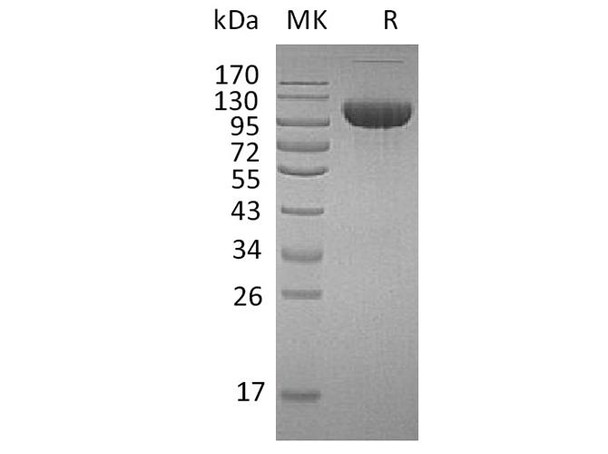
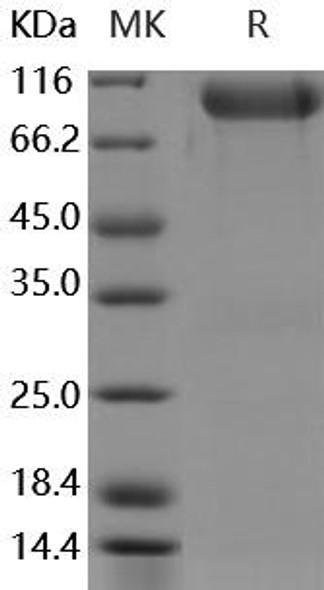
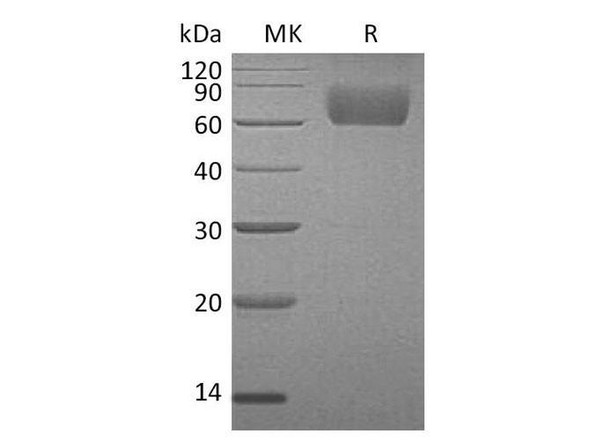
> 95% as determined by reducing SDS-PAGE.
Mol Mass:
64.8 kDa
AP Mol Mass:
95-110 kDa
Formulation:
Lyophilized from a 0.2 µm filtered solution of PBS, pH7.4.
Shipping:
This product is provided as lyophilized powder which is shipped with ice packs.
Stability and Storage:
Lyophilized proteins are stable for up to 12 months when stored at -20 to -80°C. Reconstituted protein solution can be stored at 4-8°C for 2-7 days. Aliquots of reconstituted samples are stable at < -20°C for 3 months.