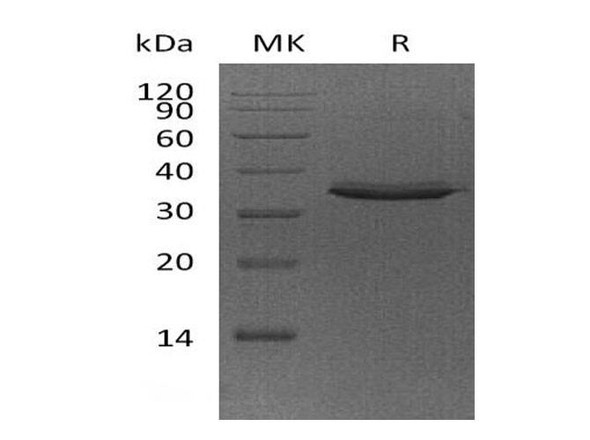
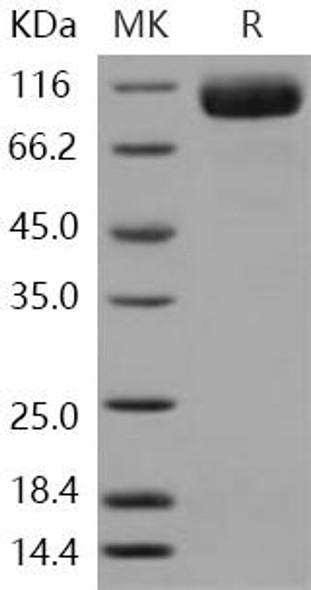
Fn14 (tumor necrosis factor receptor superfamily, member 12A), also known as TNFRSF12A, is the receptor for TNFSF12/TWEAK. Fn14 shares 82% amino acid identity with the mouse sequence. It contains a signal peptide, an extracellular domain, a membrane-anchoring domain, and a cytoplasmic domain. In response to FGF1, calf serum, or phorbol ester stimulation of human quiescent fibroblasts in vitro, the level of Fn14 is increased. A 1.2-kb FN14 transcript was expressed at high levels in heart, placenta, and kidney, at intermediate levels in lung, skeletal muscle, and pancreas, and at low levels in brain and liver. In addition, elevated FN14 expression was found in human liver cancer cell lines and hepatocellular carcinoma specimens. Expression of mouse Fn14 was upregulated in hepatocellular carcinoma nodules that develop in 2 different transgenic mouse models of hepatocarcinogenesis. TNFRSF12A is the weak inducer of apoptosis in some cell types. It promotes angiogenesis and the proliferation of endothelial cells. TNFRSF12A may modulate cellular adhesion to matrix proteins.
Product Name:
Human FN14/TWEAKR Recombinant Protein (RPES3276)
Product Code:
RPES3276
Size:
100 µg
Species:
Human
Expressed Host:
HEK293 Cells
Synonyms:
CD266,FN14,TWEAKRTNFRSF12A,Fibroblast growth factor-inducible immediate-early response protein 14, FN14
Accession:
Q9NP84-1
Sequence:
Glu 28-Trp 79
Fusion tag:
N-Fc
Activity:
Immobilized Cynomolgus mFc-TNFSF12 at 10 µg/ml (100 ?l/well) can bind human Fc-TNFRSF12A, The ED50 of human Fc-TNFRSF12A is 0.07-0.15 µg/ml.
Endotoxin:
<1.0 EU per µg as determined by the LAL method.
Protein Construction:
A DNA sequence encoding the human TNFRSF12A isoform 1 (Q9NP84-1) extracellular domain (Glu 28-Trp 79) was fused with the Fc region of human IgG1 at the N-terminus.
Purity:
> 95 % as determined by reducing SDS-PAGE.
Mol Mass:
34 kDa
AP Mol Mass:
37 kDa
Formulation:
Lyophilized from sterile PBS, pH 7.4
Shipping:
This product is provided as lyophilized powder which is shipped with ice packs.
Stability and Storage:
Lyophilized proteins are stable for up to 12 months when stored at -20 to -80°C. Reconstituted protein solution can be stored at 4-8°C for 2-7 days. Aliquots of reconstituted samples are stable at < -20°C for 3 months.