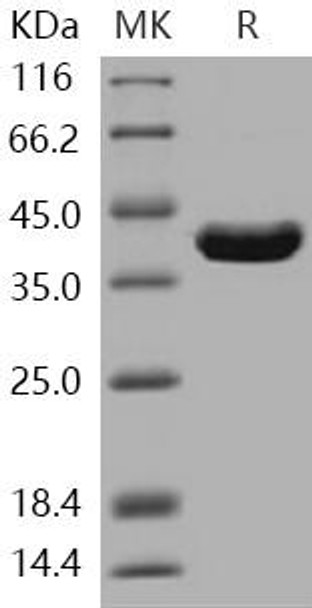
E3 ubiquitin-protein ligase Itchy homolog, also known as Atrophin-1-interacting protein 4, NFE2-associated polypeptide 1, NAPP1 and ITCH, is a cell membrane protein that contains one C2 domain, one HECT (E6AP-type E3 ubiquitin-protein ligase) domain and contains four WW domains. ITCH acts as an E3 ubiquitin-protein ligase that accepts ubiquitin from an E2 ubiquitin-conjugating enzyme in the form of a thioester and then directly transfers the ubiquitin to targeted substrates. ITCH catalyses the lysine-29, lysine-48, and lysine-63 linked ubiquitin conjugation. ITCH is involved in the regulation of inflammatory signalling pathways. It is an essential component of a ubiquitin-editing protein complex that includes TNFAIP3, TAX1BP1, and RNF11 and ensures the transitory nature of inflammatory signalling pathways. In the presence of TNF, ITCH promotes the connection between the complex. After that, TNFAIP3 deubiquitinates 'Lys-63' polyubiquitin chains on RIPK1 and generates 'Lys-48'-polyubiquitin chains. TNF- or LPS-induced NFKB1 activation is terminated by RIPK1 proteasomal degradation. ITCH defects are the underlying cause of the syndromic multisystem autoimmune disease (SMAD), which is defined by organomegaly, poor growth, developmental delay, dysmorphic characteristics, and immune-inflammatory cell infiltration of the lungs, liver, and gastrointestinal tract. Human ITCH/AIP4 Recombinant Protein is a highly pure recombinant protein developed by Assay Genie for use in a range of applications.
Product Name:
Human ITCH/AIP4 Recombinant Protein (RPES3476)
Product Code:
RPES3476
Size:
100 µg
Species:
Human
Expressed Host:
E.coli
Synonyms:
ADMFD,AIF4,AIP4,dJ468O1.1,NAPP1
Accession:
NP_113671.3
Sequence:
Arg 526-Glu 903
Fusion tag:
Endotoxin:
Please contact us for more information.
Protein Construction:
A DNA sequence encoding the human ITCH (NP_113671.3) N-terminal segment (Arg 526-Glu 903) was expressed and purified, with two additional amino acids (Gly & Pro) at the N-terminus.
This product is provided as lyophilized powder which is shipped with ice packs.
Stability and Storage:
Lyophilized proteins are stable for up to 12 months when stored at -20 to -80°C. Reconstituted protein solution can be stored at 4-8°C for 2-7 days. Aliquots of reconstituted samples are stable at < -20°C for 3 months.