Myocilin, also known as Trabecular meshwork-induced glucocorticoid response protein, MYOC and GLC1A, is a protein which contains one olfactomedin-like domain. Myocilin / MYOC may participate in the obstruction of fluid outflow in the trabecular meshwork. Myocilin / MYOC is expressed in large amounts in various types of muscle, ciliary body, papillary sphincter, skeletal muscle, heart and other tissues. Myocilin / MYOC is expressed predominantly in the retina. In normal eyes, it is found in the inner uveal meshwork region and the anterior portion of the meshwork. In contrast, in many glaucomatous eyes, it is found in more regions of the meshwork and appeared more intensively than in normal eyes, regardless of the type or clinical severity of glaucoma. Defects in Myocilin / MYOC may contribute to primary congenital glaucoma type 3A (GLC3A). Defects in MYOC may also contribute to this phenotype via digenic inheritance. GLC3A is an autosomal recessive form of primary congenital glaucoma (PCG). PCG is characterized by marked increase of intraocular pressure at birth or early choldhood, large ocular globes (buphthalmos) and corneal edema.
Product Name:
Human MYOC/Myocilin Recombinant Protein (RPES1268)
Product Code:
RPES1268
Size:
10µg
Species:
Human
Expressed Host:
HEK293 Cells
Synonyms:
GLC1A,GPOA,JOAG,JOAG1,myocilin,TIGR
Accession:
Q99972
Sequence:
Met 1-Met 504
Fusion tag:
C-His
Endotoxin:
<1.0 EU per µg as determined by the LAL method.
Protein Construction:
A DNA sequence encoding the full length of human MYOC (Q99972) (Met 1-Met 504) was fused with a polyhistidine tag at the C-terminus.
Purity:
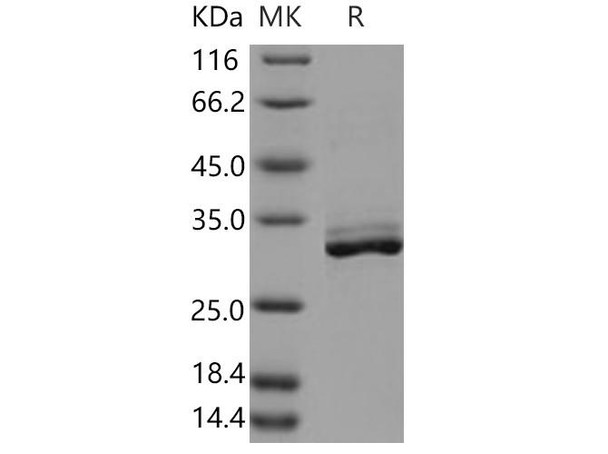
> 95 % as determined by reducing SDS-PAGE.
Mol Mass:
54.7 kDa
AP Mol Mass:
33 kDa
Formulation:
Lyophilized from sterile PBS, pH 7.4
Shipping:
This product is provided as lyophilized powder which is shipped with ice packs.
Stability and Storage:
Lyophilized proteins are stable for up to 12 months when stored at -20 to -80°C. Reconstituted protein solution can be stored at 4-8°C for 2-7 days. Aliquots of reconstituted samples are stable at < -20°C for 3 months.