Poliovirus receptor-related 3 (PVRL3), also known as Nectin-3 and CD113, is a member of the nectin family. PVRL3/Nectin-3 is an 83 kDa, type I transmembrane glycoprotein. Its precursor is 549 amino acids (aa) in length and contains an extended signal sequence of 57 aa, an extracellular domain (ECD) of 347 aa, a transmembrane segment of 21 aa, and a cytoplasmic region of 124 aa. Nectin-3 has three splicing variants, nectin-3alpha (biggest), -3beta (middle), and -3gamma (smallest). It is predominantly expressed in testis and placenta as well as in various cell lines, including epithelial cell lines. PVRL3/Nectin-3 plays a role in cell-cell adhesion through heterophilic trans-interactions with nectin-like proteins or nectins, such as trans-interaction with PVRL2/Nectin-2 at Sertoli-spermatid junctions. PVRL3/Nectin-3 is thus involved in the formation of cell-cell junctions, including adherens junctions and synapses. It has been shown to induce endocytosis-mediated down-regulation of PVR from the cell surface, resulting in reduction of cell movement and proliferation.
Product Name:
Human Nectin-3/PVRL3 Recombinant Protein (RPES0406)
Product Code:
RPES0406
Size:
100 µg
Species:
Human
Expressed Host:
HEK293 Cells
Synonyms:
Poliovirus Receptor-Related Protein 3, CDw113, Nectin-3, CD113, PVRL3, PRR3,PVRR3
Accession:
NP_056295.1
Sequence:
Met 1-Asp 400
Fusion tag:
C-His
Activity:
Measured by its binding ability in a functional ELISA.Immobilized recombinant human PVRL3 at 1 µg/ml (100 ?l/well) can bind biotinylated Nectin-1 with a linear range of 6.4-800 ng/ml.2. Immobilized recombinant human PVRL3 at 1 µg/ml (100 ?l/well) can bind Nectin-1/ Fc chimera with a linear range of 0.156-5 ng/ml.
Endotoxin:
<1.0 EU per µg as determined by the LAL method.
Protein Construction:
A DNA sequence encoding the extracellular domain of human PVRL3 (NP_056295.1) (Met 1-Asp 400) was expressed, with a polyhistidine tag at the C-terminus.
Purity:
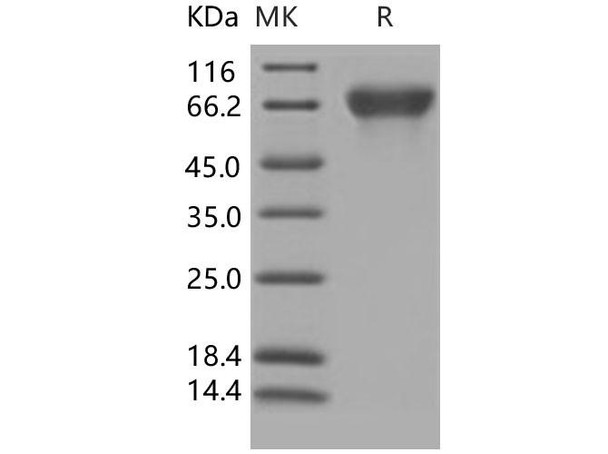
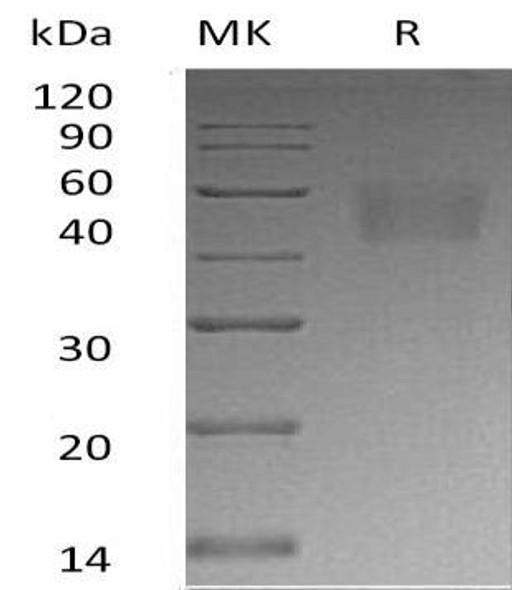
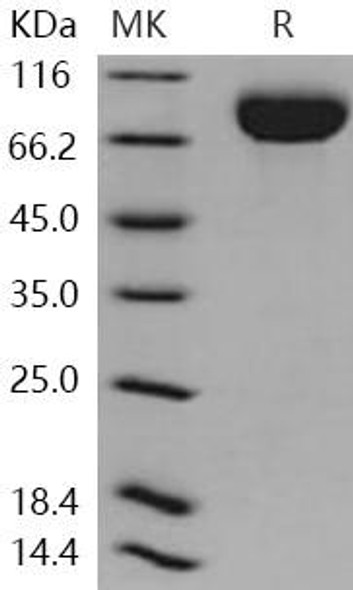
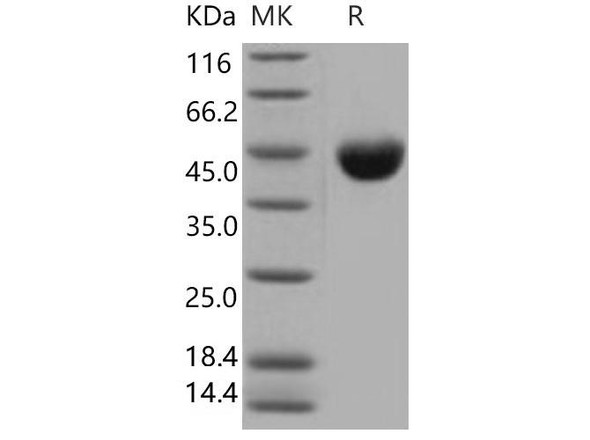
> 98 % as determined by reducing SDS-PAGE.
Mol Mass:
39.3 kDa
AP Mol Mass:
65-75 kDa
Formulation:
Lyophilized from sterile PBS, pH 7.4
Shipping:
This product is provided as lyophilized powder which is shipped with ice packs.
Stability and Storage:
Lyophilized proteins are stable for up to 12 months when stored at -20 to -80°C. Reconstituted protein solution can be stored at 4-8°C for 2-7 days. Aliquots of reconstituted samples are stable at < -20°C for 3 months.