Prolactin (PRL) is a secreted neuroendocrine pituitary hormone that acts primarily on the mammary gland to promote lactation; but has pleiotropic effects in both males and females. Non-glycosylated prolactin is produced by the pituitary and packaged in storage granules before secretion; while glycosylated prolactin is reported to be constitutively secreted; have lower biological potency; and be removed from the circulation more quickly. Prolactin is synthesized mainly by the anterior pituitary in all mammals; where secretion is under tonic inhibition by hypothalamic dopamine. In humans; prolactin is also produced peripherally. Prolactin expression is low during early human pregnancy; but increases in late pregnancy. The prolactin receptor (PRLR) is a transmembrane type I glycoprotein that belongs to the cytokine hematopoietic receptor family. prolactin molecule is thought to bind two receptor molecules. In addition to its lactogenic activity; peripherally produced prolactin plays roles in breast and prostate cancer development; regulation of reproductive function; and immunoregulation.
Product Name:
Human Prolactin/PRL Recombinant Protein (RPES2645)
Product Code:
RPES2645
Size:
10µg
Species:
Human
Expressed Host:
Human Cells
Synonyms:
Prolactin, PRL
Accession:
P01236
Sequence:
Leu29-Cys227
Fusion tag:
C-6His
Endotoxin:
<1.0 EU per µg as determined by the LAL method.
Protein Construction:
Recombinant Human Prolactin is produced by our Mammalian expression system and the target gene encoding Leu29-Cys227 is expressed with a 6His tag at the C-terminus.
Purity:
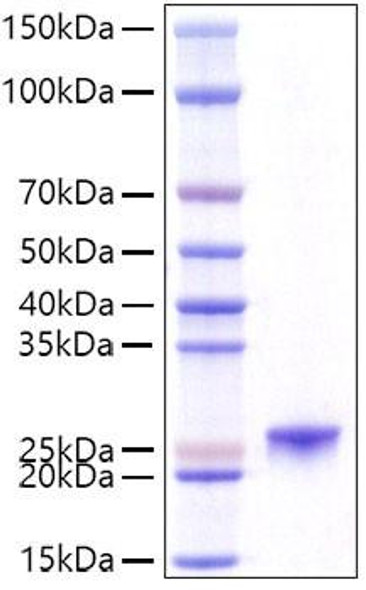
> 95 % as determined by reducing SDS-PAGE.
Mol Mass:
23.9 kDa
AP Mol Mass:
25-30 kDa
Formulation:
Lyophilized from a 0.2 µm filtered solution of 20mM PB;150mM NaCl;pH7.4.
Shipping:
This product is provided as lyophilized powder which is shipped with ice packs.
Stability and Storage:
Lyophilized proteins are stable for up to 12 months when stored at -20 to -80°C. Reconstituted protein solution can be stored at 4-8°C for 2-7 days. Aliquots of reconstituted samples are stable at < -20°C for 3 months.