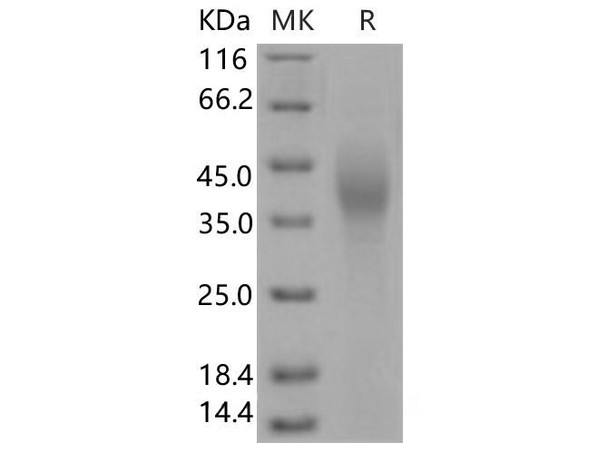
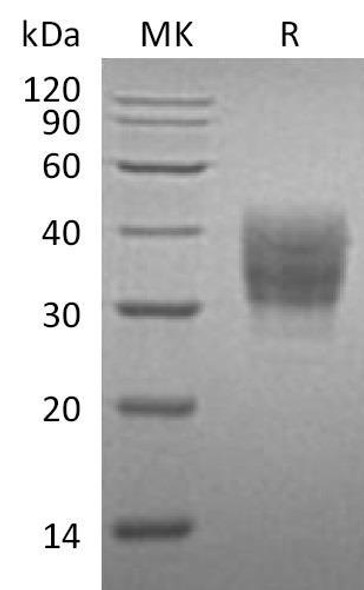
SLAM family member 7 (SLAMF7), also known as CRACC, CD319, CD2-like receptor-activating cytotoxic cells, and CS1, is a single-pass type I membrane protein and a member of the CD2 family of cell surface receptors. SLAMF7 is expressed in NK cells, activated B-cells, NK-cell line but not in promyelocytic, B-cell lines, or T-cell lines. Although the cytoplasmic domain of CS1 contains immunoreceptor tyrosine-based switch motifs (ITSM), which enables to recruite signaling lymphocyte activation molecule (SLAM)-associated protein (SAP/SH2D1A), it activates NK cells in the absence of a functional SAP. CS1 is a self ligand and homophilic interaction of CS1 regulates NK cell cytolytic activity. CRACC positively regulated natural killer cell functions by a mechanism dependent on the adaptor EAT-2 but not the related adaptor SAP. However, in the absence of EAT-2, CRACC potently inhibited natural killer cell function. It was also inhibitory in T cells, which are typically devoid of EAT-2. Thus, CRACC can exert activating or inhibitory influences on cells of the immune system depending on cellular context and the availability of effector proteins.
Product Name:
Human SLAMF7/CD319 Recombinant Protein (RPES0968)
Product Code:
RPES0968
Size:
100 µg
Species:
Human
Expressed Host:
HEK293 Cells
Synonyms:
SLAM Family Member 7, CD2 Subset 1, CD2-Like Receptor-Activating Cytotoxic Cells, CRACC, Membrane Protein FOAP-12, Novel Ly9, Protein 19A, CD319, SLAMF7, CS1,SLAM7
Accession:
NP_067004.3
Sequence:
Met 1-Met 226
Fusion tag:
C-His
Activity:
Measured by its ability to bind biotinylated human SH2D1A-His in a functional ELISA.
Endotoxin:
<1.0 EU per µg of the protein as determined by the LAL method.
Protein Construction:
A DNA sequence encoding the human SLAMF7 (NP_067004.3) extracellular domain (Met 1-Met 226) was expressed, fused with a polyhistidine tag at the C-terminus.
Purity:
> 93 % as determined by reducing SDS-PAGE.
Mol Mass:
23.8 kDa
Formulation:
Lyophilized from sterile PBS, pH 7.4
Shipping:
This product is provided as lyophilized powder which is shipped with ice packs.
Stability and Storage:
Lyophilized proteins are stable for up to 12 months when stored at -20 to -80°C. Reconstituted protein solution can be stored at 4-8°C for 2-7 days. Aliquots of reconstituted samples are stable at < -20°C for 3 months.