Tumor Necrosis Factor-? (TNF-?) is secreted by macrophages; monocytes; neutrophils; T-cells; and NK-cells following stimulation by bacterial LPS. Cells expressing CD4 secrete TNF-? while cells that express CD8 secrete little or no TNF-?. Synthesis of TNF-? can be induced by many different stimuli including interferons; IL2; and GM-CSF. The clinical use of the potent anti-tumor activity of TNF-? has been limited by the proinflammatory side effects such as fever; dose-limiting hypotension; hepatotoxicity; intravascular thrombosis; and hemorrhage. Designing clinically applicable TNF-? mutants with low systemic toxicity has been of intense pharmacological interest. Human TNF-? that binds to murine TNF-R55 but not murine TNF-R7; exhibits retained anti-tumor activity and reduced systemic toxicity in mice compared with murine TNF-?; which binds to both murine TNF receptors. Based on these results; many TNF-? mutants that selectively bind to TNF-R55 have been designed. These mutants displayed cytotoxic activities on tumor cell lines in vitro and have exhibited lower systemic toxicity in vivo. Recombinant Human TNF-? High Active Mutant differs from the wild-type by amino acid subsitution of amino acids 1-7 with Arg8; Lys9; Arg10 and Phe157. This mutant form has been shown to have increased activity with less inflammatory side effects in vivo.
Product Name:
Human TNF-alpha/TNFA Recombinant Protein (RPES1664)
Measured in a cytotoxicity assay using L?929 mouse fibroblast cells in the presence of the metabolic inhibitor actinomycin D. The ED50 for this effect is 30-150 pg/ml.
Endotoxin:
<1.0 EU per µg as determined by the LAL method.
Protein Construction:
Recombinant Human Tumor Necrosis Factor alpha is produced by our E.coli expression system and the target gene encoding Gly57-Leu233 is expressed with a 6His tag at the N-terminus.
Purity:
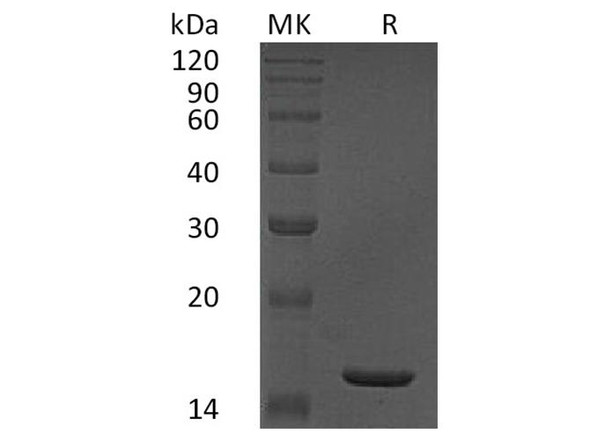
> 95 % as determined by reducing SDS-PAGE.
Mol Mass:
21.8 kDa
AP Mol Mass:
21 kDa
Formulation:
Lyophilized from a 0.2 µm filtered solution of 20mM PB;100mM NaCl; pH 7.2.
Shipping:
This product is provided as lyophilized powder which is shipped with ice packs.
Stability and Storage:
Lyophilized proteins are stable for up to 12 months when stored at -20 to -80°C. Reconstituted protein solution can be stored at 4-8°C for 2-7 days. Aliquots of reconstituted samples are stable at < -20°C for 3 months.