VSIG4 (V-set and immunoglobulin domain containing 4); also known as complement receptor of the immunoglobulin superfamily (CRIg) and Z39Ig; is a type I transmembrane glycoprotein. It is a B7 family-related protein and an Ig superfamily member. In contrast to the B7 family members which contain two IgG domains; VSIG4 contains one complete V-type I g domain and a truncated C-type I g domain. VSIG4 is exclusively expressed on tissue resident macrophages and binds to multimers of C3b and iC3b that are covalently attached to particle surfaces. No VSIG4 expression appears to be present in T and B cells. VSIG4 functions as a negative regulator of T cell activation; and may be involved in the maintenance of peripheral T cell tolerance; and is also identified as a potent suppressor of established inflammation. Mouse VSIG4 is synthesized as a 280 amino acid precursor that contains a signal sequence; an V-type I g domain (aa 36-115); one potential N-linked glycosylation site; and a single transmembrane domain. The V-type I g domain of mouse VSIG4 shares 86% and 80% aa sequence identity with the V-type I g domains of rat and human VSIG4; respectively.
Product Name:
Human VSIG4 Recombinant Protein (RPES3375)
Product Code:
RPES3375
Size:
100 µg
Species:
Human
Expressed Host:
HEK293 Cells
Synonyms:
V-Set and Immunoglobulin Domain-Containing Protein 4, Protein Z39Ig, VSIG4, CRIg, Z39IG
Accession:
O75144-1
Sequence:
Met 1-Pro283
Fusion tag:
C-Fc
Endotoxin:
<1.0 EU per µg as determined by the LAL method.
Protein Construction:
A DNA sequence encoding the human VSIG4 (O75144-1) (Met1-Pro283) was expressed with the Fc region of human IgG1 at the C-terminus.
Purity:
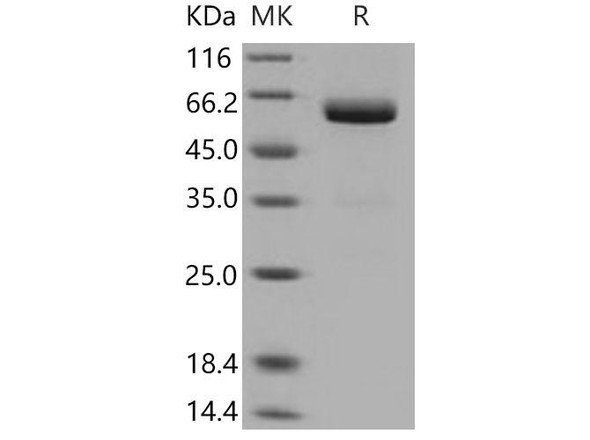
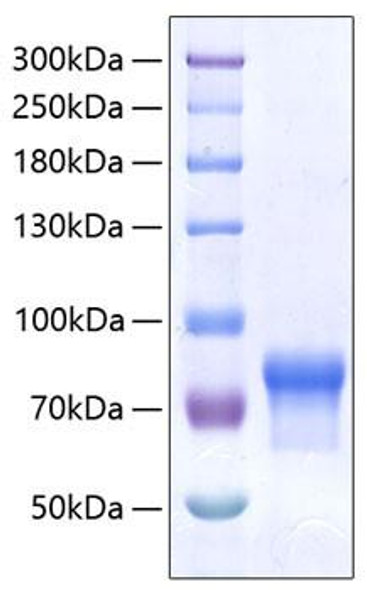
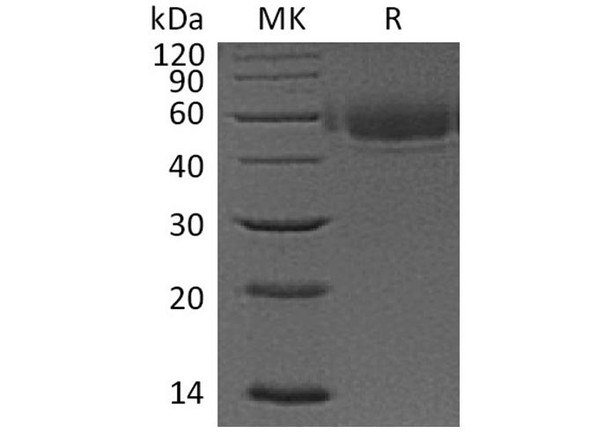
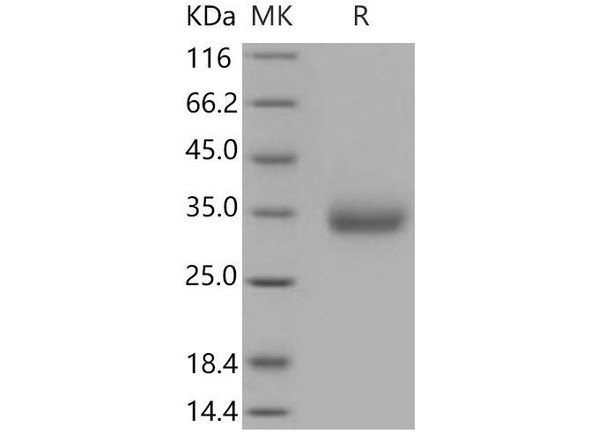
(97.2+1.4) % as determined by reducing SDS-PAGE.
Mol Mass:
56.2 kDa
AP Mol Mass:
57 kDa
Formulation:
Lyophilized from sterile PBS; pH 7.4
Shipping:
This product is provided as lyophilized powder which is shipped with ice packs.
Stability and Storage:
Lyophilized proteins are stable for up to 12 months when stored at -20 to -80°C. Reconstituted protein solution can be stored at 4-8°C for 2-7 days. Aliquots of reconstituted samples are stable at < -20°C for 3 months.