Noggin is a secreted homodimeric glycoprotein that is an antagonist of bone morphogenetic proteins (BMPs). Mouse Noggin cDNA encodes a 232 amino acid (aa) residue precursor protein with 19 aa residue putative signal peptide that is cleaved to generate the 213 aa residue mature protein which is secreted as a homodimeric glycoprotein. Secreted Noggin probably remains close to the cell surface due to its binding of heparin-containing proteoglycans. Noggin binds some BMPs such as BMP4 with high affinity and others such as BMP7 with lower affinity. It antagonizes BMP bioactivities by blocking epitopes on BMPs that are needed for binding to both type I and type II receptors. Noggin is expressed in defined areas of the adult central nervous system and peripheral tissues such as lung, skeletal muscle and skin. During culture of human embryonic stem cells (hESC) or neural stem cells under certain conditions, addition of Noggin to antagonize BMP activity may allow stem cells to proliferate while maintaining their undifferentiated state, or alternatively, to differentiate into dopaminergic neurons.
Product Name:
Mouse Noggin/NOG Recombinant Protein (RPES1029)
Product Code:
RPES1029
Size:
10µg
Species:
Mouse
Expressed Host:
Human Cells
Synonyms:
Noggin, Nog
Accession:
P97466
Sequence:
Gln28-Cys232
Fusion tag:
C-His
Endotoxin:
<1.0 EU per µg as determined by the LAL method.
Protein Construction:
Recombinant Mouse Noggin is produced by our Mammalian expression system and the target gene encoding Gln28-Cys232 is expressed with a 6His tag at the C-terminus.
Purity:
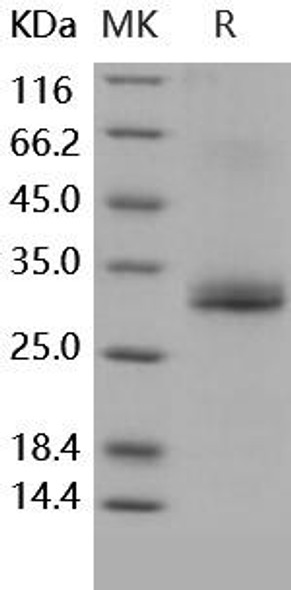
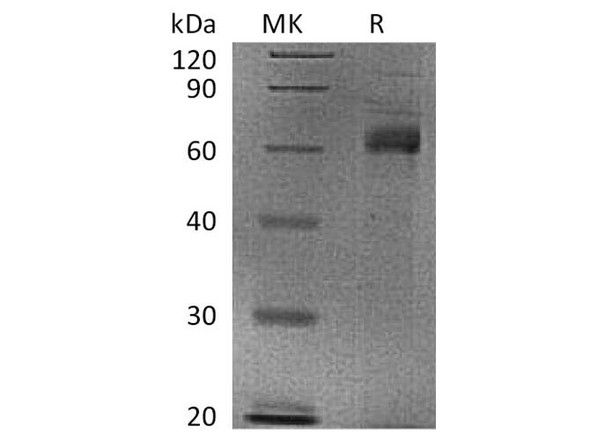
> 95% as determined by reducing SDS-PAGE.
Mol Mass:
23.9 kDa
AP Mol Mass:
30 kDa
Formulation:
Lyophilized from a 0.2 µm filtered solution of PBS, 5mM EDTA, 5% Trehalose,pH7.4.
Shipping:
This product is provided as lyophilized powder which is shipped with ice packs.
Stability and Storage:
Lyophilized proteins are stable for up to 12 months when stored at -20 to -80°C. Reconstituted protein solution can be stored at 4-8°C for 2-7 days. Aliquots of reconstituted samples are stable at < -20°C for 3 months.