Programmed Death-1 (PD-1), firstly cloned from mouse T cell hybridoma 2B4.11, is one member of CD28/CTLA-4 superfamily. PD-1 belongs to type I transmembrane protein and acts as an important immunosuppressive molecule. This family also include members of CD28, CTLA-4 and ICOS.The mouse Programmed Death-1 protein, encoded by PD-1 gene, comprises four parts including a putative 20 aa signal peptide, a 149 aa extracellular region, a 21 aa transmembrane domain and a 98 aa cytoplasmic region. The cytoplamsic tail of PD-1 contains two structural motifs, an immunoreceptor tyrosine-based inhibitory motif (ITIM) and an immunoreceptor tyrosine-based switch motif (ITSM) formed by two tyrosine residues which make the difference in PD-1 signal mediating. Mouse PD-1 is expressed in thymus and shares about 69% aa sequence identity with human PD-1. Recently, programmed death-1 (PD-1) with its ligands, programmed death ligand B7H1 (PD-L1) and B7DC (PD-L2), was found to regulate T-cell activation and tolerance, upon ligand binding, inhibiting T-cell effector functions in an antigen-specific manner. PD-1 gene knocked out mice would induce some autoimmune diseases, which suggests that PD-1 acts as a co-inhibitory molecule actively participating in maintaining peripheral tolerance. Thus, PD-1 may be a useful target for the immunologic therapy of carcinoma,infection,autoimmune diseases as well as organ transplantation.
Product Name:
Mouse PD/PDCD1 Recombinant Protein (RPES0833)
Product Code:
RPES0833
Size:
10µg
Species:
Mouse
Expressed Host:
Human Cells
Synonyms:
Programmed cell death protein 1,PD-1,CD279,Pdcd1,mPD-1
Accession:
Q02242
Sequence:
Leu25-Gln167
Fusion tag:
C-Fc
Activity:
Immobilized Human PD-L1-His(Cat: PKSH033557) at 2µg/ml(100 ?l/well) can bind Mouse PD-1-Fc.
Endotoxin:
<1.0 EU per µg as determined by the LAL method.
Protein Construction:
Recombinant Mouse PD-1 is produced by our Mammalian expression system and the target gene encoding Leu25-Gln167 is expressed with a Fc tag at the C-terminus.
Purity:
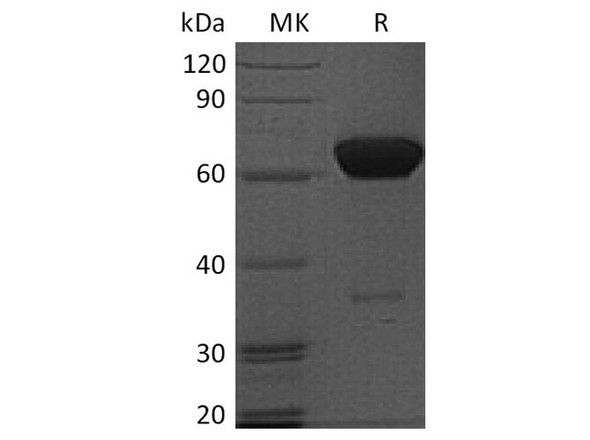
> 95% as determined by reducing SDS-PAGE.
Mol Mass:
43.3 kDa
AP Mol Mass:
58-85 kDa
Formulation:
Lyophilized from a 0.2 µm filtered solution of 20mM Tris,150mM NaCl,pH8.0.
Shipping:
This product is provided as lyophilized powder which is shipped with ice packs.
Stability and Storage:
Lyophilized proteins are stable for up to 12 months when stored at -20 to -80°C. Reconstituted protein solution can be stored at 4-8°C for 2-7 days. Aliquots of reconstituted samples are stable at < -20°C for 3 months.