The CD2 family receptors are type I transmembrane glycoproteins belonging to immunoglobulin (Ig) superfamily characterized by a membrane-proximal Ig constant 2 (C2) domain and a membrane-distal variable (V) domain that is responsible for ligand recognition. CD84, also known as LY9B and SLAMF5, is a homophilic member of the SLAM (signaling lymphocyte activation molecule) subfamily of the CD2 family. The SLAM family receptorsmediate signal transduction through the interaction of its ITSM (immunoreceptor tyrosine-based switch motifs) in the intracellular region and the SH2 domain of adaptor molecules SAP (SLAM-associated protein) and EAT-2 (EWS-activated transcript 2), and accordingly modulate both adaptive and innate immune responses. The CD84-CD84 interaction was independent of its cytoplasmic tail. Thus, CD84 is its own ligand and acts as a costimulatory molecule. CD84 is expressed on cells from almost all hematopoietic lineages and on CD34+ hematopoietic progenitor cells, suggesting that CD84 serves as a marker for committed hematopoietic progenitor cells.
Product Name:
Mouse SLAMF5/CD84 Recombinant Protein (RPES4711)
Product Code:
RPES4711
Size:
100 µg
Species:
Mouse
Expressed Host:
HEK293 Cells
Synonyms:
SLAM family member 5, Cd84, Leukocyte differentiation antigen CD84, Signaling lymphocytic activation molecule 5, CD84, Ly-9B, SLAMF5, CD84 antigen, CD84 molecule, SLAM family member 5
Accession:
Q18PI6-1
Sequence:
Met 1-Val 221
Fusion tag:
C-His
Activity:
Measured by its ability to bind biotinylated recombinant human SH2D1A in a functional ELISA.
Endotoxin:
<1.0 EU per µg of the protein as determined by the LAL method.
Protein Construction:
A DNA sequence encoding the mouse CD84 isoform 1 (Q18PI6-1) extracellular domain (Met 1-Val 221) was expressed, with a polyhistidine tag at the C-terminus.
Purity:
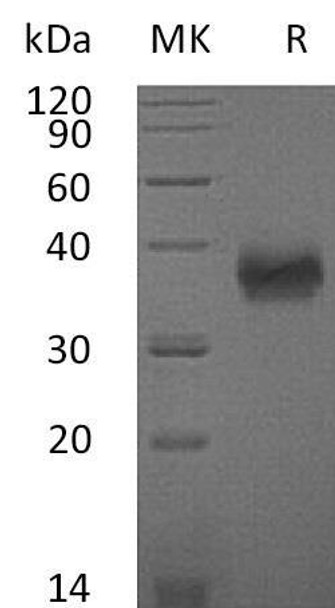
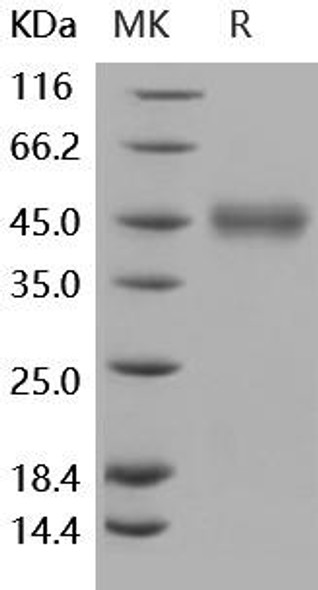
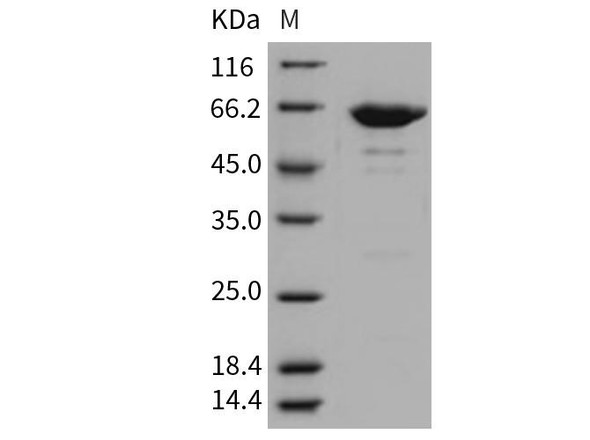
> 97 % as determined by SDS-PAGE
Mol Mass:
24 kDa
Formulation:
Lyophilized from sterile PBS, pH 7.4
Shipping:
This product is provided as lyophilized powder which is shipped with ice packs.
Stability and Storage:
Lyophilized proteins are stable for up to 12 months when stored at -20 to -80°C. Reconstituted protein solution can be stored at 4-8°C for 2-7 days. Aliquots of reconstituted samples are stable at < -20°C for 3 months.