TRKA is a member of the neurotrophic tyrosine kinase receptor (NTKR) family. It is a membrane-bound receptor that, upon neurotrophin binding, phosphorylates itself and members of the MAPK pathway. Isoform TrkA-III promotes angiogenesis and has oncogenic activity when overexpressed. Isoform TrkA-I is found in most non-neuronal tissues. Isoform TrkA-II is primarily expressed in neuronal cells. TrkA-III is specifically expressed by pluripotent neural stem and neural crest progenitors. The presence of NTRK1 leads to cell differentiation and may play a role in specifying sensory neuron subtypes. Mutations in TRKA gene have been associated with congenital insensitivity to pain, anhidrosis, self-mutilating behavior, mental retardation and cancer. It was originally identified as an oncogene as it is commonly mutated in cancers, particularly colon and thyroid carcinomas. TRKA is required for high-affinity binding to nerve growth factor (NGF), neurotrophin-3 and neurotrophin-4/5 but not brain-derived neurotrophic factor (BDNF). Known substrates for the Trk receptors are SHC1, PI 3-kinase, and PLC-gamma-1. NTRK1 has a crucial role in the development and function of the nociceptive reception system as well as establishment of thermal regulation via sweating. It also activates ERK1 by either SHC1- or PLC-gamma-1-dependent signaling pathway. Defects in NTRK1 are a cause of congenital insensitivity to pain with anhidrosis and thyroid papillary carcinoma.Immune Checkpoint Immunotherapy Cancer Immunotherapy Targeted Therapy
Product Name:
Mouse TrkA/NTRK1 Recombinant Protein (RPES0883)
Product Code:
RPES0883
Size:
100 µg
Species:
Mouse
Expressed Host:
HEK293 Cells
Synonyms:
C80751,Tkr,trk,TrkA
Accession:
NP_001028296.1
Sequence:
Met1-Gly420
Fusion tag:
C-His
Activity:
Measured by its ability to inhibit NGF-induced proliferation of TF?1 human erythroleukemic cells.The ED50 for this effect is typically 0.2-1 µg/mL in the presence of 10 ng/mL of recombinant mouse NGF.
Endotoxin:
<1.0 EU per µg of the protein as determined by the LAL method.
Protein Construction:
A DNA sequence encoding the mouse NTRK1 (Met1-Gly420) was expressed with a C-terminal polyhistidine tag.
Purity:
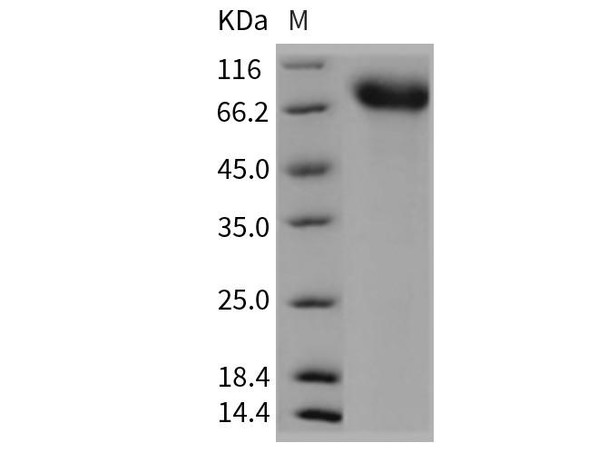
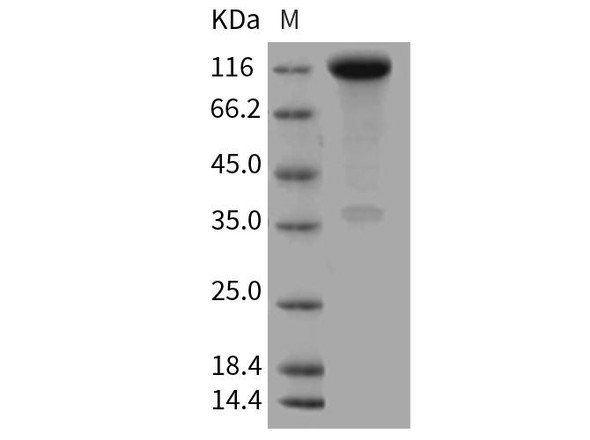
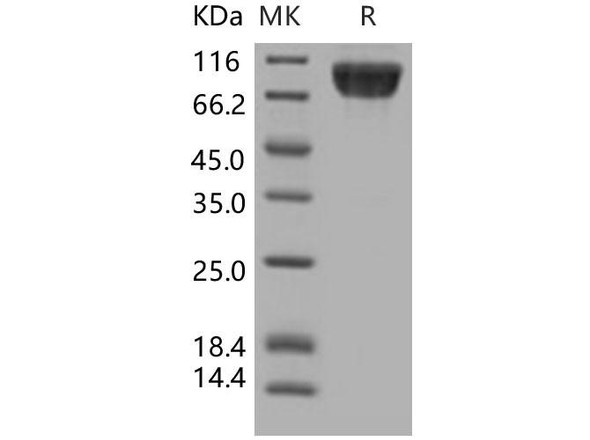
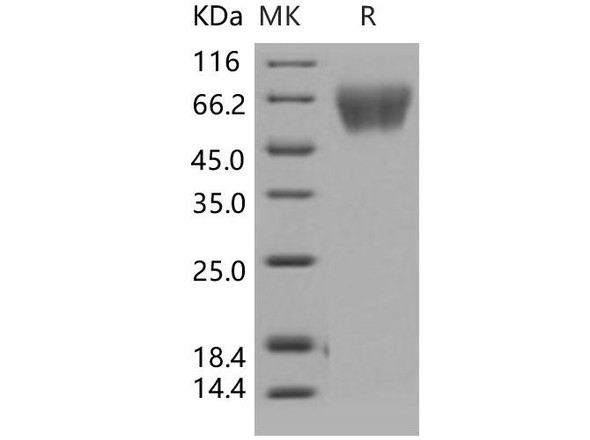
> 95 % as determined by SDS-PAGE
Mol Mass:
43.7 kDa
AP Mol Mass:
69 kDa
Formulation:
Lyophilized from sterile PBS, pH 7.4
Shipping:
This product is provided as lyophilized powder which is shipped with ice packs.
Stability and Storage:
Lyophilized proteins are stable for up to 12 months when stored at -20 to -80°C. Reconstituted protein solution can be stored at 4-8°C for 2-7 days. Aliquots of reconstituted samples are stable at < -20°C for 3 months.