Vitronectin, also known as VTN, is a member of the pexin family. It is an abundant glycoprotein found in serum the extracellular matrix and promotes cell adhesion and spreading. Vitronectin is a secreted protein and exists in either a single chain form or a cleaved, two chain form held together by a disulfide bond. Vitronectin is a plasma glycoprotein implicated as a regulator of diverse physiological process, including blood coagulation, fibrinolysis, pericellular proteolysis, complement dependent immune responses, and cell attachment and spreading. Because of its ability to bind platelet glycoproteins and mediate platelet adhesion and aggregation at sites of vascular injury, vitronectin has become an important mediator in the pathogenesis of coronary atherosclerosis. As a multifunctional protein with a multiple binding domain, Vitronectin interacts with a variety of plasma and cell proteins. Vitronectin binds multiple ligands, including the soluble vitronectin receptor. It may be an independent predictor of adverse cardiovascular outcomes following acute stenting. Accordingly, Vitronectin is suggested to be involved in hemostasis, cell migration, as well as tumor malignancy.
Product Name:
Mouse Vitronectin/VTN Recombinant Protein (RPES2212)
Product Code:
RPES2212
Size:
50µg
Species:
Mouse
Expressed Host:
HEK293 Cells
Synonyms:
AI256434,Vn
Accession:
NP_035837.1
Sequence:
Met 1-Lys 478
Fusion tag:
C-His
Activity:
Measured by the ability of the immobilized protein to support the adhesion of DU145 human prostate carcinoma cells.When cells are added to mouse Vitronectin coated plates (10 µg/mL and 100 ?L/well), > 60% cells will adhere specifically after 30 minutes at 37 ?.
Endotoxin:
<1.0 EU per µg of the protein as determined by the LAL method.
Protein Construction:
A DNA sequence encoding the mouse vitronectin (NP_035837.1) (Met 1-Lys 478) was expressed, with a polyhistidine tag at the C-terminus.
Purity:
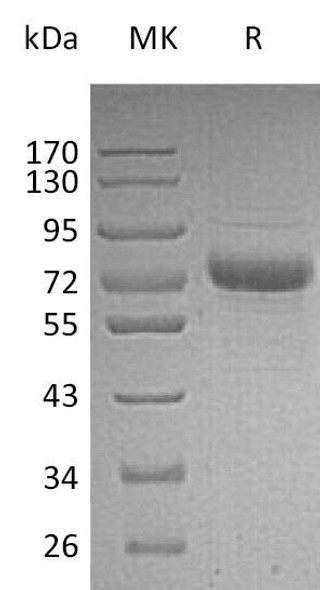
> 94 % as determined by SDS-PAGE
Mol Mass:
54.2 kDa
AP Mol Mass:
75-85 kDa
Formulation:
Lyophilized from sterile PBS, pH 7.4
Shipping:
This product is provided as lyophilized powder which is shipped with ice packs.
Stability and Storage:
Lyophilized proteins are stable for up to 12 months when stored at -20 to -80°C. Reconstituted protein solution can be stored at 4-8°C for 2-7 days. Aliquots of reconstituted samples are stable at < -20°C for 3 months.