The TNFAIP3 Monoclonal Antibody (CAB19128) is a high-quality antibody developed for reliable detection and analysis of target proteins. This antibody, generated in rabbits, exhibits high specificity and sensitivity to TNFAIP3 protein in human samples, making it a reliable choice for Western blot analysis and immunohistochemistry studies.TNFAIP3, also known as A20, is a critical negative regulator of NF-κB signaling and pro-inflammatory cytokine production. Dysregulation of TNFAIP3 has been implicated in various autoimmune diseases, cancer, and inflammatory disorders. The TNFAIP3 Rabbit Monoclonal Antibody enables precise detection and quantification of TNFAIP3 expression levels in different cell types and tissues, providing valuable insights into the mechanisms of immune response modulation and inflammation regulation.
This antibody is validated for use in WB, IHC-P, ELISA applications and has demonstrated reactivity against Human samples.
Product Name:
TNFAIP3 Monoclonal Antibody
SKU:
CAB19128
Size:
20μL, 100μL
Reactivity:
Human
Clone Number:
ARC0355
Conjugate:
Unconjugated
Immunogen:
Synthetic peptide. This information is considered to be commercially sensitive.
Recommended starting concentration is 1 μg/mL. Please optimize the concentration based on your specific assay requirements.
Synonyms:
A20, AISBL, AIFBL1, OTUD7C, TNFA1P2, TNFAIP3
Positive Sample:
Jurkat, HeLa
Cellular Localization:
Cytoplasm, Lysosome, Nucleus.
Calculated MW:
90kDa
Observed MW:
80-90kDa
This gene was identified as a gene whose expression is rapidly induced by the tumor necrosis factor (TNF). The protein encoded by this gene is a zinc finger protein and ubiqitin-editing enzyme, and has been shown to inhibit NF-kappa B activation as well as TNF-mediated apoptosis. The encoded protein, which has both ubiquitin ligase and deubiquitinase activities, is involved in the cytokine-mediated immune and inflammatory responses. Several transcript variants encoding the same protein have been found for this gene.
Purification Method
Affinity purification
Gene ID
7128
RRID
AB_2862621
Buffer Information
Store at -20℃. Avoid freeze / thaw cycles. Buffer: PBS containing 50% glycerol and 0.05% BSA, preserved with proclin300 or sodium azide, pH 7.3.
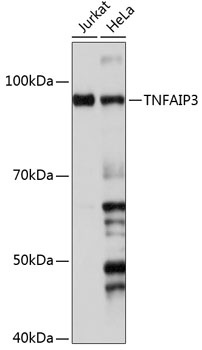
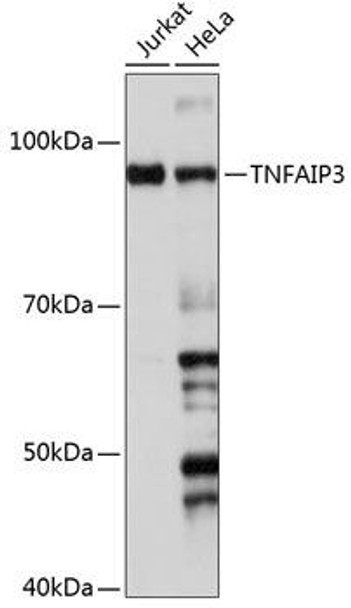
Western blot analysis of various lysates using TNFAIP3 Rabbit mAb (CAB19128) at 1:1000 dilution. Secondary antibody: HRP-conjugated Goat anti-Rabbit IgG (H+L) (CABS014) at 1:10000 dilution. Lysates/proteins: 25μg per lane. Blocking buffer: 3% nonfat dry milk in TBST. Detection: ECL Basic Kit (AbGn00020). Exposure time: 5s.
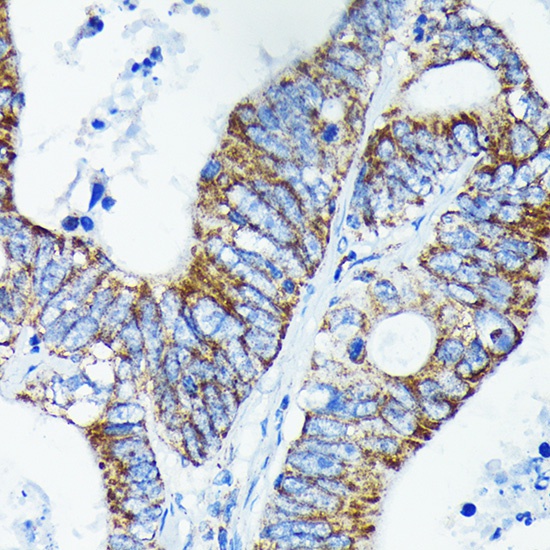
Immunohistochemistry analysis of paraffin-embedded Human colon carcinoma using TNFAIP3 Rabbit mAb (CAB19128) at dilution of 1:100 (40x lens). Microwave antigen retrieval performed with 0.01M PBS Buffer (pH 7.2) prior to IHC staining.



![Anti-TNFAIP3 [R06-9B2] Monoclonal Antibody (AGMB02380)](https://cdn11.bigcommerce.com/s-h68l9z2lnx/images/stencil/590x590/products/273669/678257/anti-tnfaip3-r06-9b2-monoclonal-antibody-agmb02380__82894.1773035187.jpg?c=2 "Anti-TNFAIP3 [R06-9B2] Monoclonal Antibody (AGMB02380)")