Description
AF647-11-dUTP
AF647-11-dUTP (AKES089) is an AF647-labeled deoxyuridine triphosphate for enzymatic labeling of DNA 3'-OH termini. It is added to broken DNA ends by terminal deoxynucleotidyl transferase (TdT), so the fluorescent signal marks DNA strand breaks. Researchers use it to detect apoptotic cells by fluorescence microscopy or flow cytometry.
AF647-11-dUTP is a modified triphosphate nucleotide that carries an AF647 fluorescent dye. A terminal deoxynucleotidyl transferase (TdT) can link it to the 3'-OH terminus of DNA. The dye is joined to the nitrogenous base through an 11-atom chain. According to the product description, this linker effectively prevents static quenching of fluorescence and improves the efficiency of nucleotide binding to the 3'-OH terminus of DNA.
DNA breakage is an important marker event in apoptosis. Double-strand breaks in apoptotic cells, or a gap in one DNA strand, generate 3'-OH termini that can be labeled. Researchers use this nucleotide to detect these termini in situ, which underlies TUNEL-type apoptosis assays. The Assay Genie product page lists related one-step TUNEL in situ apoptosis kits in several dye colors, and these are cited together in published literature with this nucleotide. The application is therefore framed around apoptosis detection in tissue sections and cell preparations.
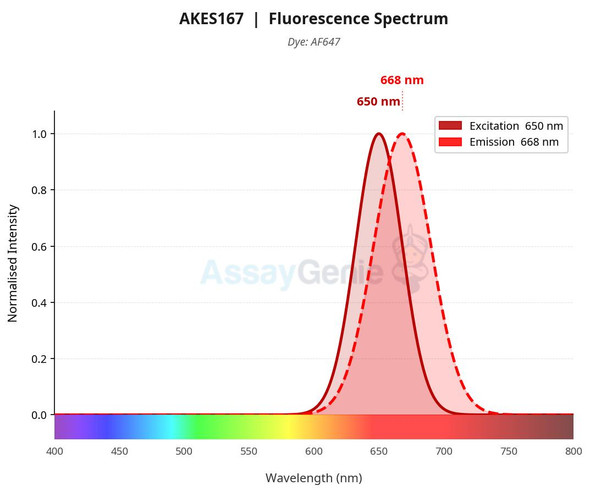
The labeled dUTP is incorporated onto broken DNA ends by TdT, so the fluorescent signal marks sites of DNA 3'-OH termini. Detection is fluorometric, and the conjugate can be read by fluorescence microscopy or flow cytometry. The dye has excitation and emission maxima of 650 nm and 665 nm, respectively, and the listed filter set is Cy5. Readout therefore requires a far-red fluorescence channel compatible with these wavelengths.
Listed sample types are paraffin sections, frozen sections, and cell slides. The reagent should be stored at -20°C for 12 months and protected from light. Repeated freezing and thawing should be avoided, and the reagent should not be vortexed. The product ships on ice bags. Research use only; lab coat and disposable gloves are recommended during handling.
| Product name: | AF647-11-dUTP |
| SKU: | AKES089 |
| Detection method: | Fluorometric |
| Detection instrument: | Fluorescence microscope or flow cytometer |
| Sample types: | Paraffin section; frozen section; cell slide |
| Dye: | AF647 |
| Filter set: | Cy5 |
- AF647-labeled dUTP with an 11-atom linker between the fluorophore and the nucleotide base
- Incorporated at 3'-OH termini of DNA by terminal transferase (TdT)
- Detection with Cy5 filter set (Ex/Em 650/665 nm)
- Compatible with paraffin sections, frozen sections, and cell slides
- Supplied at 1 nmol/µL
TdT catalyzes the addition of AF647-11-dUTP to the 3'-OH termini of fragmented DNA. The fluorescent dUTP conjugate incorporated at these break sites is then detected by fluorescence microscopy or flow cytometry.
- Detection of apoptotic cells through labeling of DNA 3'-OH termini in tissue sections
- Fluorescence imaging of DNA strand breaks in paraffin sections, frozen sections, and cell slides
- Flow cytometric analysis of DNA fragmentation in apoptotic cell populations
- Assay development for TdT-mediated dUTP labeling protocols using a far-red (AF647) fluorophore
| Component | Storage |
| AF647-11-dUTP | -20°C, protected from light |
- Terminal deoxynucleotidyl transferase (TdT) and reaction buffer
- Fluorescence microscope with Cy5 filter set, or flow cytometer
- Samples: paraffin sections, frozen sections, or cell slides
- Lab coat and disposable gloves
- Prepare samples as paraffin sections, frozen sections, or cell slides.
- Incubate samples with terminal deoxynucleotidyl transferase (TdT) and AF647-11-dUTP so the labeled dUTP is added to 3'-OH DNA termini.
- Detect the incorporated AF647 signal by fluorescence microscopy (Cy5 filter set) or by flow cytometry.
Which sample types are supported?
The listed sample types are paraffin sections, frozen sections, and cell slides. Detection is performed by fluorescence microscope or flow cytometer.
How should the reagent be stored and handled?
Store at -20°C for 12 months, protected from light. Avoid repeated freezing and thawing, and do not vortex the reagent.
Which instrument settings should be used?
The dye has excitation and emission at 650/665 nm. The listed filter set is Cy5.
What does the 11-atom linker do?
The linker separates the dye from the nitrogenous base. According to the product description, this prevents static quenching of fluorescence and improves nucleotide binding efficiency to the 3'-OH terminus of DNA.
What precautions apply when working with this product?
This product is for research use only. Wear a lab coat and disposable gloves before experiments.
| Storage: | -20°C for 12 months, protected from light |
| Handling: | Avoid repeated freezing and thawing; do not vortex |
| Expiration: | 12 months |
| Shipping: | Ice bag |
Cautions
- For research use only. Not for use in diagnostic or therapeutic procedures.
- Wear a lab coat and disposable gloves during all experiments.
- Store in the dark at -20°C. Avoid repeated freezing and thawing.
- Do not vortex.